



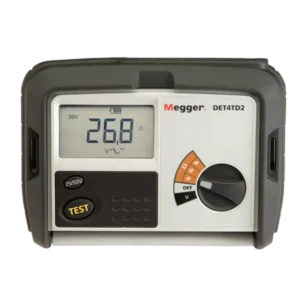
Megger DET4TD2 Digital Earth Resistance Tester Kit — 4-Terminal | SKU 1000-347
$2,800.00 .( $3,080.00 inc. GST )
100 in stock
For all your equipment calibration needs, visit our MyCalibration website.
 Free Delivery on orders over $1000
Shipping time may vary for certain products*

Product Enquiry
If you would like more information regarding this product, simply email us here.

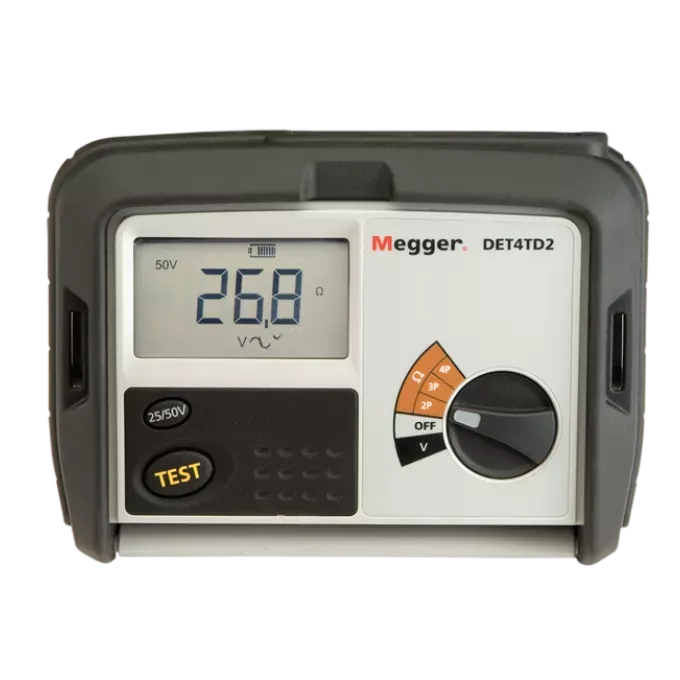
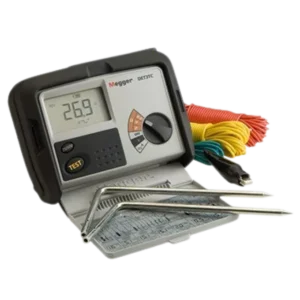
The Megger DET4TD2 is a rugged, IP54-rated digital earth resistance tester supporting 2, 3, and 4-terminal test methods — everything an electrician or earthing technician needs in one ready-to-test kit. Measuring earth electrode resistance from 0.01 Ω to 20 kΩ with 2% accuracy and noise rejection to 40 V pk-pk, it delivers reliable results even on noisy industrial sites. Includes carry case, lead set, test spikes, right-angle terminal adaptors, and a calibration certificate.

Earthing You Can Rely On — From the Brand That Wrote the Book on Ground Testing
When an earthing system fails, the consequences range from tripped protection relays to personnel injury and equipment destruction. Whether you’re commissioning a new installation, conducting periodic compliance testing, or troubleshooting a fault, the quality of your earth resistance measurement depends entirely on the quality of your instrument. That’s why Australian electricians, industrial maintenance teams, and utility contractors have trusted Megger earth testers for generations.
The Megger DET4TD2 is the clean, capable entry point into Megger’s four-terminal DET4 series — a digital earth resistance tester that covers the measurement methods most commonly required on Australian job sites, packed into a ready-to-use kit with everything you need out of the box.
Four Terminals. Three Test Methods. One Kit.
The DET4TD2 supports 2-terminal, 3-terminal, and 4-terminal earth resistance testing — the three standard Fall of Potential configurations recognised in industry practice and referenced in AS/NZS 3000 earthing requirements. The large rotary selector switch steps cleanly between measurement modes, and is sized deliberately so it can be operated comfortably with gloved hands on site.
Unlike lower-spec instruments, the DET4TD2 eliminates the need for a shorting link when conducting 2-pole continuity measurements — one less step, one less thing to forget on a busy job.
Measurement Range Built for Real-World Earthing Systems
The DET4TD2 measures earth resistance across a range of 0.01 Ω to 20 kΩ, autoranging automatically so you’re not hunting for the right range on the selector. This span covers virtually every practical earthing scenario — from sub-ohm grid connections at substations and data centres to high-resistance rod electrodes in dry or rocky Australian soils.
Earth noise voltage measurement up to 100 V AC is built in, letting you check whether the site environment is suitable for testing before you commit to a reading. Noise rejection is rated to 40 V peak-to-peak, meaning the instrument is engineered to cope with the electrically noisy environments typical of industrial plant, switchyards, and utility infrastructure.
Resistance accuracy is 2% ± 3 digits across all three measurement modes (2P, 3P, 4P) — a consistent, trustworthy specification that supports compliance documentation and test reporting.
Automatic Probe Checks Mean Faster, Reliable Testing
Before any measurement is taken, the DET4TD2 automatically verifies the connection and condition of both the C spike (current probe) and P spike (potential probe) and reports their status on the display. If probe resistance exceeds the instrument’s limits, you’ll know immediately — rather than discovering a suspect reading after the fact.
This automatic spike monitoring is particularly valuable on large sites where lead runs are long, soil conditions vary, or temporary spike placement is awkward. Maximum probe resistance is 100 kΩ at the 50 V output setting, with limits adjusted automatically at the 25 V setting and for high-resolution 0.01 Ω measurements.
Field-Ready and Built for Outdoor Conditions
The DET4TD2 is rated to IP54 — splash-proof and dust-protected, designed to handle the realities of outdoor ground testing in Australian conditions. Whether you’re testing a rural transformer earth in dry compacted soil or a substation earth grid after rain, this instrument is built to keep working.
The 3½-digit high-contrast LCD delivers clear readings in bright outdoor light, and a thumb-sized test button makes single-handed operation straightforward. Power comes from 8 × AA (LR6) batteries — a universally available format that means you won’t be hunting for proprietary cells in the field.
Safety is rated to CAT IV 100 V between terminal pairs, meeting the requirements of IEC 61010-1. Output voltage is user-selectable between 25 V and 50 V at 128 Hz, allowing compliance with IEC 61557-5 including the 25 V requirement for testing in agricultural environments.
What’s in the Kit (Part 1000-347)
This complete kit configuration gives you everything needed to start earth resistance testing immediately on arrival at site:
- DET4TD2 instrument with 3½-digit LCD display
- Hard polypropylene carry case with space for all accessories
- Lead set: 15 m, 10 m, 10 m, and 3 m colour-coded test leads
- Two earth test spikes (200 mm × 8 mm diameter)
- Right-angle terminal adaptors for connecting bare wires to the instrument terminals
- 8 × AA batteries (pre-installed)
- Calibration certificate (issued at factory)
All leads, spikes, adaptors, and the instrument stow neatly in the carry case — no sourcing individual accessories separately.
Who This Instrument Is For
Electrical contractors and licensed electricians performing AS/NZS 3000 earthing compliance verification, initial commissioning, and periodic maintenance testing on residential, commercial, and industrial installations.
Industrial maintenance and asset management teams responsible for earth electrode integrity at manufacturing plants, mining sites, process facilities, and heavy industry — where reliable earthing is fundamental to both personnel safety and equipment protection.
Utilities and infrastructure operators conducting routine electrode testing on pole-top transformer earths, substation perimeter rods, and streetlight earthing systems.
Solar installers and CEC accredited designers verifying earth resistance at PV system installation points and grid-connection infrastructure, where AS/NZS 5033 earthing requirements must be met.
Facility managers and safety officers managing periodic test records for compliance reporting and insurance documentation.
Why Choose the DET4TD2 Over a 3-Terminal Instrument?
Three-terminal testers perform well for basic electrode resistance measurements. Four terminals add the ability to conduct soil resistivity testing — the Wenner four-electrode method used to characterise soil before designing an earthing system, prospecting for optimal electrode locations, or conducting detailed site surveys. If there’s any chance you’ll need soil resistivity data — for a new installation design, a site remediation project, or geological survey work — the DET4TD2’s four-terminal capability means you’re covered without needing a second instrument.
NATA Calibration Available
This instrument is supplied with a Megger factory calibration certificate. For Australian compliance requirements, including NATA-traceable calibration documentation for test records, calibration services are available — contact us for details.
Technical Specifications
| Specification | Value | Why It Matters |
|---|---|---|
| Test Methods | 2-terminal, 3-terminal, 4-terminal | Covers all standard Fall of Potential configurations and soil resistivity testing |
| Resistance Range | 0.01 Ω to 20 kΩ (autoranging) | Spans sub-ohm grid connections through to high-resistance rod electrodes in poor soil |
| Resistance Accuracy | 2% ± 3 digits (2P, 3P, 4P measurements) | Publication-quality accuracy for compliance records and test reports |
| Earth Voltage Range | 0 to 100 V AC | Lets you verify site noise conditions before committing to a measurement |
| Earth Voltage Accuracy | 2% ± 2 V | Reliable indication of earth noise voltage |
| Noise Rejection | 40 V peak-to-peak | Maintains accurate readings on noisy industrial sites and near HV infrastructure |
| Test Frequency | 128 Hz | Fixed frequency avoids common power frequency harmonics |
| Output Voltage | ±25 V or ±50 V (user-selectable) | 25 V mode for IEC 61557-5 agricultural environment compliance |
| Output Current | 4.5 mA or 0.45 mA | Selectable to suit site conditions and required resolution |
| Max Probe Resistance (Rp/Rc) | 100 kΩ at 50 V; 50 kΩ at 25 V; 5 kΩ for 0.01 Ω resolution | Automatic limit monitoring prevents invalid readings |
| Probe Checks | C spike and P spike — automatic | Confirms probe contact before testing; flags poor connection on display |
| Noise Check | Automatic | Detects earth noise conditions prior to measurement |
| Shorting Links Required | No | 2-pole tests without link fitting — saves time and reduces operator error |
| Display | 3½-digit high-contrast LCD | Clear outdoor readability in Australian sunlight |
| Power Supply | 8 × AA (LR6) alkaline cells | Universal cell format — available anywhere |
| Battery Life | ~3 hours / ~700 consecutive tests | Full day of field testing on a single set of batteries |
| Battery Status | Bar graph on LCD | Know when to change batteries before they expire mid-test |
| Safety Rating | CAT IV 100 V (IEC 61010-1) | Rated for outdoor use on distribution systems |
| Ingress Protection | IP54 | Splash-proof and dust-protected for outdoor use |
| EMC | IEC 61326-1 (heavy industrial environments) | Tested for use around industrial equipment and interference sources |
| Standards Compliance | EN 61557 Part 1 & Part 5; KEMA K85B; IEC 61010-1 | Meets international safety and measurement standards |
| Operating Temperature | −15 °C to +55 °C | Full operational range across Australian climate zones |
| Storage Temperature | −40 °C to +70 °C | Safe storage in vehicles and site cabinets |
| Humidity | 95% RH non-condensing at 40 °C | Handles coastal and tropical Australian environments |
| Dimensions | 203 × 148 × 78 mm | Compact enough for a tool bag; sized for easy one-handed grip |
| Weight | 1 kg (instrument only) | Lightweight for extended field use |
| Warranty | 2 years | Megger standard warranty |
| Calibration Certificate | Included (factory issued) | Supplied ready for compliance records |
Included Kit Contents (SKU 1000-347)
| Item | Detail |
|---|---|
| DET4TD2 Instrument | 2/3/4-terminal digital earth tester |
| Hard carry case | Polypropylene, fits all included accessories |
| Test leads | 15 m, 10 m, 10 m, and 3 m colour-coded set |
| Earth test spikes | 2 × 200 mm × 8 mm diameter |
| Right-angle terminal adaptors | For bare wire connections to instrument terminals |
| AA batteries | 8 × LR6 (pre-installed) |
| Calibration certificate | Factory issued |
What is the Megger DET4TD2 used for?
The Megger DET4TD2 is a digital earth resistance tester used to measure the resistance of earthing electrodes, earth grids, and bonding connections. It supports 2-terminal, 3-terminal, and 4-terminal test methods, including the Fall of Potential technique, and can also perform soil resistivity measurements using the Wenner four-electrode method. It is commonly used by electricians, utilities, solar installers, and industrial maintenance teams to verify earthing system integrity in compliance with AS/NZS 3000 and related standards.
What test methods does the DET4TD2 support?
The DET4TD2 supports 2-pole, 3-pole, and 4-pole (4-terminal) earth resistance testing methods. The 4-terminal capability also enables soil resistivity measurement using the Wenner method. The instrument does not include ART (Attached Rod Technique) or stakeless (clamp-on) test modes — those capabilities are available in the higher-specification DET4TC2 model.
What is the earth resistance measurement range of the DET4TD2?
The DET4TD2 measures earth electrode resistance from 0.01 Ω to 20 kΩ with autoranging. Resistance accuracy is 2% ± 3 digits across all measurement modes. Earth noise voltage can be measured from 0 to 100 V AC.
What is the difference between the DET4TD2 and the DET4TC2?
The DET4TD2 is the dry-cell battery-powered basic 4-terminal model supporting 2P, 3P, and 4P measurement modes at a fixed 128 Hz test frequency. The DET4TC2 is the advanced model that adds selectable test frequencies (94 Hz, 105 Hz, 111 Hz, and 128 Hz), ART (Attached Rod Technique) capability for testing without disconnecting the utility connection, stakeless (clamp-on) measurement capability, a backlit display, and an extended resistance range to 200 kΩ. If you only need standard Fall of Potential testing and soil resistivity, the DET4TD2 offers excellent value. If you need to test energised grounding systems without disconnection, or use clamp-on methods, the DET4TC2 is the appropriate choice.
What is the difference between the DET4TD2 and the DET4TR2?
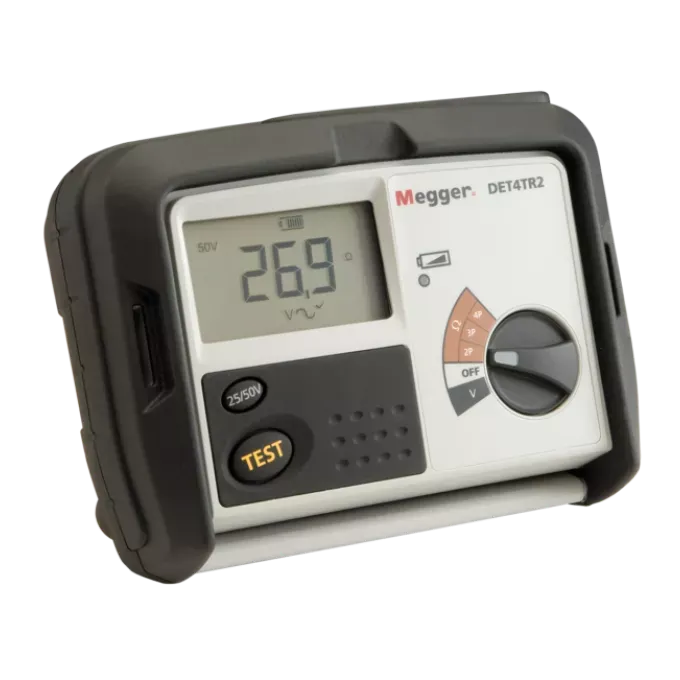
The DET4TD2 (SKU 1000-347) and DET4TR2 (SKU 1000-324) are functionally identical earth testers. The only difference is the power source: the DET4TD2 uses 8 × AA alkaline (dry-cell) batteries, while the DET4TR2 uses 8 × AA NiMH rechargeable cells with a built-in charger and included AC/DC adaptor. Choose the DET4TD2 for flexibility in remote locations where charging infrastructure may not be available; choose the DET4TR2 if you prefer rechargeable power and have regular access to mains power for charging.
Does the DET4TD2 come with a calibration certificate?
Yes. The DET4TD2 kit (SKU 1000-347) is supplied with a factory-issued calibration certificate as standard. For applications requiring NATA-traceable calibration documentation — such as formal compliance testing records, power industry asset management, or regulated safety inspection programs — NATA-traceable calibration services are available separately.
Is the DET4TD2 rated for use outdoors in Australia?
Yes. The DET4TD2 is rated to IP54, making it splash-proof and dust-protected for outdoor use in Australian field conditions. It operates across a temperature range of −15 °C to +55 °C and is rated to CAT IV 100 V for use on distribution-level electrical systems.
What leads and accessories are included with SKU 1000-347?
The DET4TD2 basic kit (1000-347) includes a hard polypropylene carry case, four colour-coded test leads (15 m, 10 m, 10 m, and 3 m), two earth test spikes (200 mm × 8 mm diameter), right-angle terminal adaptors for bare wire connections, 8 × AA batteries (pre-installed), and a factory calibration certificate.
Be the first to review “Megger DET4TD2 Digital Earth Resistance Tester Kit — 4-Terminal | SKU 1000-347”
You must be logged in to post a review.
Technical Specifications
| Specification | Value | Why It Matters |
|---|---|---|
| Test Methods | 2-terminal, 3-terminal, 4-terminal | Covers all standard Fall of Potential configurations and soil resistivity testing |
| Resistance Range | 0.01 Ω to 20 kΩ (autoranging) | Spans sub-ohm grid connections through to high-resistance rod electrodes in poor soil |
| Resistance Accuracy | 2% ± 3 digits (2P, 3P, 4P measurements) | Publication-quality accuracy for compliance records and test reports |
| Earth Voltage Range | 0 to 100 V AC | Lets you verify site noise conditions before committing to a measurement |
| Earth Voltage Accuracy | 2% ± 2 V | Reliable indication of earth noise voltage |
| Noise Rejection | 40 V peak-to-peak | Maintains accurate readings on noisy industrial sites and near HV infrastructure |
| Test Frequency | 128 Hz | Fixed frequency avoids common power frequency harmonics |
| Output Voltage | ±25 V or ±50 V (user-selectable) | 25 V mode for IEC 61557-5 agricultural environment compliance |
| Output Current | 4.5 mA or 0.45 mA | Selectable to suit site conditions and required resolution |
| Max Probe Resistance (Rp/Rc) | 100 kΩ at 50 V; 50 kΩ at 25 V; 5 kΩ for 0.01 Ω resolution | Automatic limit monitoring prevents invalid readings |
| Probe Checks | C spike and P spike — automatic | Confirms probe contact before testing; flags poor connection on display |
| Noise Check | Automatic | Detects earth noise conditions prior to measurement |
| Shorting Links Required | No | 2-pole tests without link fitting — saves time and reduces operator error |
| Display | 3½-digit high-contrast LCD | Clear outdoor readability in Australian sunlight |
| Power Supply | 8 × AA (LR6) alkaline cells | Universal cell format — available anywhere |
| Battery Life | ~3 hours / ~700 consecutive tests | Full day of field testing on a single set of batteries |
| Battery Status | Bar graph on LCD | Know when to change batteries before they expire mid-test |
| Safety Rating | CAT IV 100 V (IEC 61010-1) | Rated for outdoor use on distribution systems |
| Ingress Protection | IP54 | Splash-proof and dust-protected for outdoor use |
| EMC | IEC 61326-1 (heavy industrial environments) | Tested for use around industrial equipment and interference sources |
| Standards Compliance | EN 61557 Part 1 & Part 5; KEMA K85B; IEC 61010-1 | Meets international safety and measurement standards |
| Operating Temperature | −15 °C to +55 °C | Full operational range across Australian climate zones |
| Storage Temperature | −40 °C to +70 °C | Safe storage in vehicles and site cabinets |
| Humidity | 95% RH non-condensing at 40 °C | Handles coastal and tropical Australian environments |
| Dimensions | 203 × 148 × 78 mm | Compact enough for a tool bag; sized for easy one-handed grip |
| Weight | 1 kg (instrument only) | Lightweight for extended field use |
| Warranty | 2 years | Megger standard warranty |
| Calibration Certificate | Included (factory issued) | Supplied ready for compliance records |
Included Kit Contents (SKU 1000-347)
| Item | Detail |
|---|---|
| DET4TD2 Instrument | 2/3/4-terminal digital earth tester |
| Hard carry case | Polypropylene, fits all included accessories |
| Test leads | 15 m, 10 m, 10 m, and 3 m colour-coded set |
| Earth test spikes | 2 × 200 mm × 8 mm diameter |
| Right-angle terminal adaptors | For bare wire connections to instrument terminals |
| AA batteries | 8 × LR6 (pre-installed) |
| Calibration certificate | Factory issued |
Frequently Asked Questions (FAQPage Schema)
Q: What does a four-terminal earth tester do that a three-terminal tester cannot?
A: A four-terminal (4-pole) earth tester enables soil resistivity measurement using the Wenner four-electrode method, which requires two current electrodes and two potential electrodes placed in a line. This is essential for characterising soil before designing a new earthing system, prospecting for optimal electrode locations, or conducting site surveys for archaeological or geological investigations. For straightforward electrode resistance testing, a 3-terminal tester is often sufficient. If soil resistivity testing is part of your work scope, a 4-terminal instrument like the DET4TD2 is the correct choice.
Q: Why does the DET4TD2 not need a shorting link for 2-pole measurements?
A: The DET4TD2 is designed to internally handle the connection configuration required for 2-pole continuity testing, eliminating the separate shorting link step required on older or simpler instruments. This reduces setup time and eliminates a common source of operator error in the field.
Q: Can the DET4TD2 test energised earthing systems without disconnecting the utility connection?
A: No. The DET4TD2 performs standard Fall of Potential testing, which requires that parallel earth paths (such as the utility neutral) be considered when interpreting results. Testing with the utility connection attached will result in a combined parallel resistance reading that may not reflect the true electrode resistance alone. The DET4TC2, with ART (Attached Rod Technique) capability, is designed for testing attached or energised grounding systems without disconnection.
Q: How far should test spikes be placed from the earth electrode when using the Fall of Potential method?
A: As a general guide, the current probe (C spike) should be placed at least 6 to 10 times the maximum dimension of the earth system from the electrode under test. For a single rod electrode, a distance of approximately 15 m is typically sufficient. For small electrode grids, 30–40 m may be needed. Larger or more complex systems require correspondingly greater distances to prevent the electrical footprints of the electrode and current probe from overlapping. Megger’s “Getting Down to Earth” guide provides detailed guidance on probe placement and result interpretation.
Q: Does the DET4TD2 support stakeless or clamp-on testing?
A: No. Stakeless (clamp-on) testing capability is available in the DET4TC2 and DET4TCR2 models, which support optional current and voltage clamp accessories. The DET4TD2 is a traditional earth tester requiring test leads and driven spikes.
Q: Can I upgrade from the DET4TD2 to ART or stakeless testing in the future?
A: The ART and stakeless capabilities are hardware features of the DET4TC2/TCR2 models and cannot be added to the DET4TD2. If your testing requirements grow to include attached-rod or clamp-on methods, an upgrade to the DET4TC2 instrument would be required.
Q: What does the automatic C spike and P spike check do?
A: Before each measurement, the DET4TD2 automatically measures the resistance of both the current probe (C spike) and potential probe (P spike). The status of each is displayed on the LCD screen. If probe resistance exceeds the instrument’s acceptable limits — due to dry or rocky soil, poor spike insertion depth, or a faulty lead connection — the instrument flags the condition so the operator can correct it before proceeding. This prevents misleading results caused by poor probe contact.
Q: What are the AS/NZS standards relevant to earth resistance testing in Australia?
A: Key Australian standards for earthing and earth testing include AS/NZS 3000 (Wiring Rules — earthing requirements), AS/NZS 3017 (verification testing of electrical installations), and AS 2067 (electrical installations for power system applications). IEC 61557-5 (resistance to earth) and IEEE Standard 81 (earth testing guide) are also commonly referenced. The DET4TD2 supports IEC 61557-5 compliance through its selectable 25 V / 50 V output voltage.
AC only Clamps
Insulation Tester Megger Contractor Kit | MIT310 Insulation Tester + TC256 Thermal CameraRelated Products



Next day delivery
Finance services
Price Match
Technical support
Product training
Calibration servises
Need help? Call our support team 1800 358 531
Reviews
There are no reviews yet.