



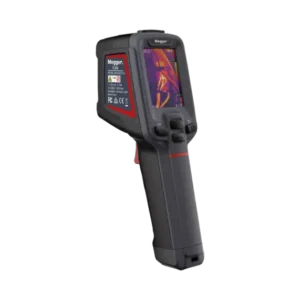
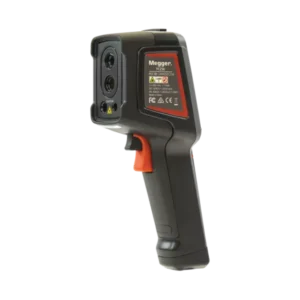
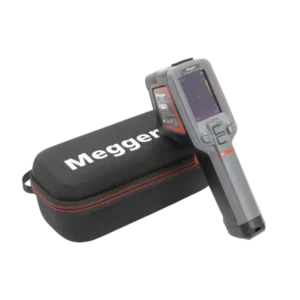
TC256 Thermal Camera | 256×192 Handheld Imager Australia
$790.00 .( $869.00 inc. GST )
100 in stock
For all your equipment calibration needs, visit our MyCalibration website.
 Free Delivery on orders over $1000
Shipping time may vary for certain products*

Product Enquiry
If you would like more information regarding this product, simply email us here.

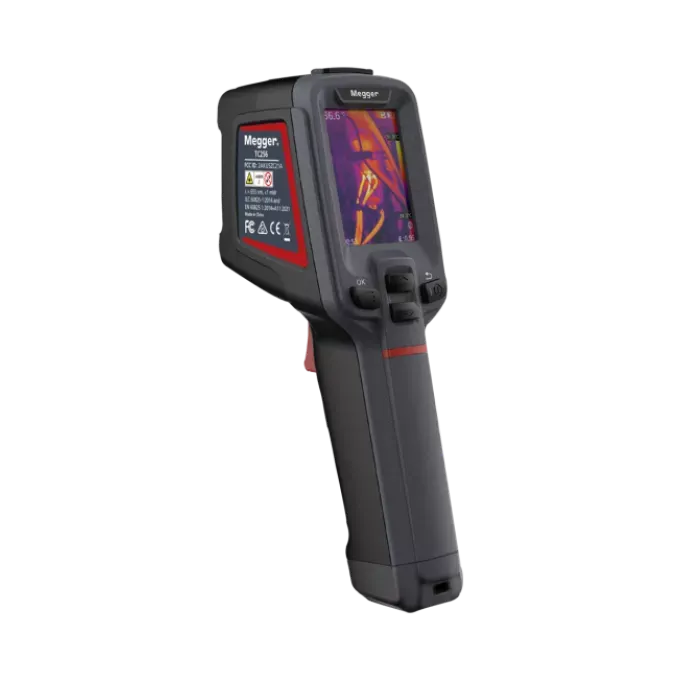
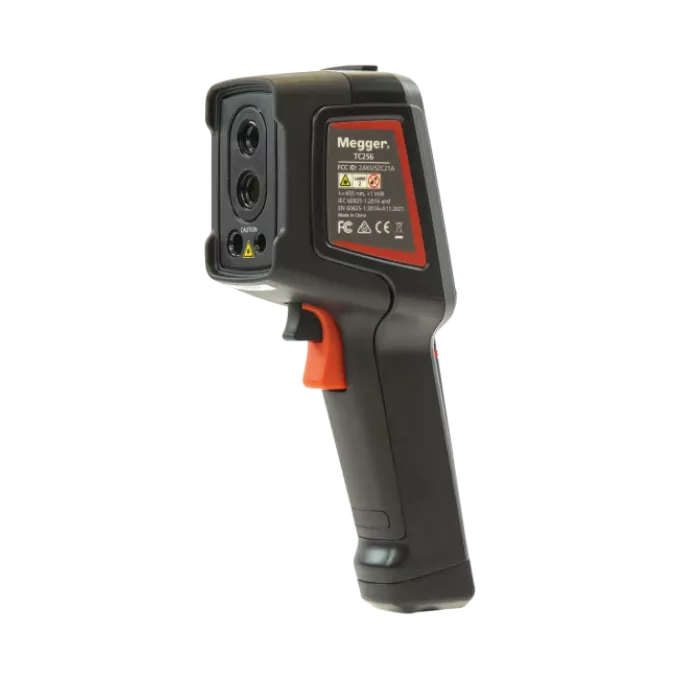
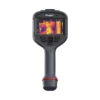
Spot a hot joint before it becomes a callback. The Megger TC256 is a 256×192 handheld thermal camera built for Australian trade work — switchboard scanning, solar PV checks, motor and HVAC maintenance. Super-resolution lifts detail to 512×384, six palettes sharpen faint faults, and an 11-hour battery lasts the day. WiFi, mobile app and 16 GB storage make reporting painless. Ships with an AU plug adapter and calibration certificate. Ready to scan out of the box.

The fault you can’t see is the one that burns the board
Most electrical and mechanical failures announce themselves long before they trip a breaker or stop a motor — they just do it in a temperature band your eyes can’t read. A loosening lug on a 415 V distribution board, an unbalanced phase, a tiring bearing, a shaded cell string on a rooftop array: every one of them runs hot first. By the time there’s smoke, a smell, or a nuisance trip, the damage is usually done and the job has turned into an after-hours emergency.
That’s the gap the Megger TC256 closes. It turns invisible heat into a clear, measurable image, so you can find the developing fault on a routine inspection instead of a breakdown callout. For Australian contractors, solar installers, and maintenance teams working to condition-based regimes, that shift — from reactive to predictive — is where thermal imaging earns its keep.
What the TC256 actually is
The TC256 is a handheld infrared thermal camera with a 256 × 192 pixel detector — a genuine step up from the 160×120 entry-level imagers a lot of trades start with. More pixels means more real temperature data points across the scene, so a warm terminal in a crowded switchboard reads as a defined hot spot rather than a vague smudge. Megger’s real-time IR-Perfclear processing and super-resolution reconstruction push the effective image to 512×384, sharpening edges and cutting noise so faint anomalies stand out.
Backing the resolution is the part that decides whether you trust what you’re seeing: thermal sensitivity. At 45 mK NETD, the TC256 resolves temperature differences of well under a tenth of a degree, which is what lets it separate a slightly warm connection from the conductor beside it — the difference between catching a fault early and walking past it.
Built around the way trades actually work
A thermal camera only helps if it’s quick to point, easy to read, and honest about what it found. The TC256 is built around that.
Four imaging modes, one trigger pull. Switch between pure infrared, visible light, picture-in-picture, and multi-image fusion (MIF). Fusion overlays thermal detail onto the visible scene so a hot spot is instantly tied to which breaker or which cable gland — no guessing, no “the warm one on the left” in your report. Six colour palettes (Iron Red, White Hot, Arctic, Rainbow 1 & 2, Hot Iron) let you pick the contrast that makes a given fault pop.
Aim and light, built in. A laser pointer puts a visible mark on the exact spot you’re measuring, and an onboard spotlight means you’re not fumbling a torch inside a dark riser cupboard or a roof cavity at the end of a string run.
Reads the room from -20 °C to 550 °C. Auto-switching ranges (-20 °C to 150 °C and 0 °C to 550 °C) cover everything from underfloor heating and refrigeration to seriously overloaded busbars, at ±2 °C or ±2 % accuracy. A full-screen threshold alarm flashes the moment anything in frame crosses your set limit — handy for fast pass/fail sweeps across a row of panels.
A full day on one charge. The non-removable lithium-ion battery runs around 11 hours and tops to 90 % in about 2.5 hours over USB-C — and it charges while you keep scanning. No mid-shift swap, no proprietary dock.
Reporting that doesn’t eat your evening
Findings are only worth as much as the report they end up in. The TC256 stores images and IRGD-format video to 16 GB of internal memory, with every JPG carrying its embedded temperature data. From there you’ve got options: pull files over USB-C into Megger’s ThermoLink PC application for analysis and professional reports, or connect over WiFi to the Thermography mobile app to stream live, share, and send results straight from site. Real-time video streaming to a PC also makes it a tidy training and second-opinion tool. OTA firmware updates keep the camera current without a trip back to the bench.
Why the TC256 is the sensible middle ground
There’s a real gap in the thermal market between throwaway entry imagers that can’t resolve a fault you’d act on, and high-end radiometric cameras priced for full-time thermographers. The TC256 sits deliberately in the middle: enough resolution, sensitivity and analysis (centre spot plus three fixed measurement areas, adjustable emissivity, reflected-temperature and distance compensation) to make confident calls, without paying for features a contractor or facilities team rarely touches. It’s the camera you actually carry on every job, not the one that stays in the ute because it’s too precious to risk.
Site-tough, and Australian-ready out of the box
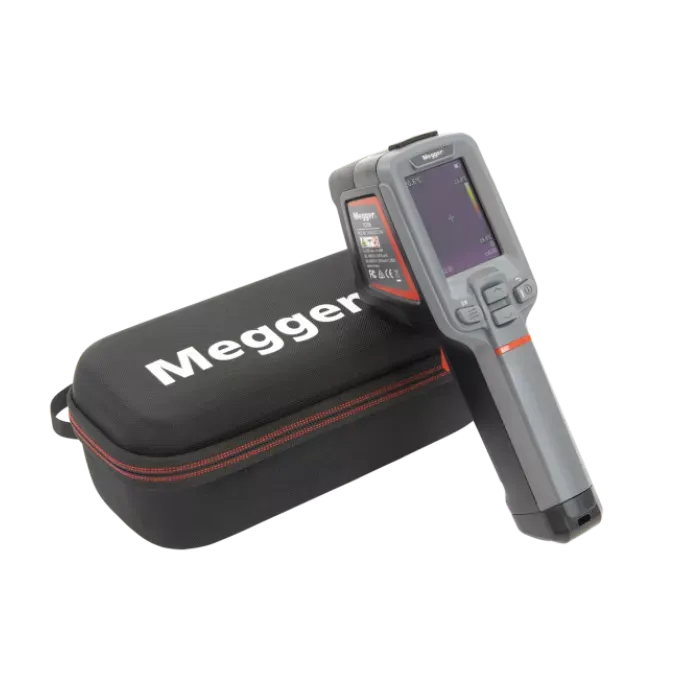
Field life is unkind to instruments. The TC256 carries an IP54 rating against dust and splashes, survives a 2 m drop test, and clears damp-heat, vibration, shock and impact testing — sensible insurance on a busy site. At 375 g it won’t weigh down your kit, and it ships in a rigid protective case with a wrist strap, USB-C cable, and a power adapter that includes an AU plug adaptor — so it’s ready for an Australian GPO straight out of the box, not after a trip to the adaptor drawer.
Every unit comes with a calibration certificate, and Megger recommends annual recalibration to keep your measurements defensible. For documentation that has to stand up — compliance reports, insurance, asset records — pair that with NATA-traceable recalibration through your supplier so your readings carry a recognised chain of accuracy. The camera is covered by a 2-year warranty (battery 1 year).
Technical Specifications
| Specification | Value | Why It Matters |
|---|---|---|
| Infrared resolution | 256 × 192 (12 µm pitch) | ~49,000 real temperature points per frame — defines small or early-stage faults that entry-level imagers blur out |
| Super resolution | Real-time reconstruction to 512 × 384 | Sharper edges and cleaner detail for confident fault identification and clearer report images |
| Detector type | VOx microbolometer, 7.5–14 µm | Long-wave uncooled sensor — the proven, maintenance-free standard for electrical and building thermography |
| Thermal sensitivity (NETD) | 45 mK | Resolves sub-0.1 °C differences — separates a warming connection from the conductor next to it |
| Temperature range | -20 °C to 550 °C (auto-switching: -20–150 °C / 0–550 °C) | Covers refrigeration and underfloor heating through to heavily loaded busbars without manual range changes |
| Measurement accuracy | ±2 °C or ±2 %, whichever is greater | Trade-grade accuracy for trending and pass/fail decisions |
| Field of view / IFOV | 25° × 19° / 1.71 mrad | Wide enough to frame a full switchboard, fine enough to isolate a single terminal |
| Min. focus distance | 0.1 m | Get in close on tight terminals and dense panels |
| D:S ratio | 585:1 | Accurate spot reads from a safe distance — useful around live equipment |
| Frame rate | 25 Hz / 9 Hz | Smooth live view for scanning moving machinery and rotating plant |
| Focus | Automatic | Point and shoot — faster routine sweeps, fewer blurred captures |
| Screen | 2.4″ colour LCD | Bright on-camera review so you confirm the capture before you leave |
| Image modes | IR, Visible Light, PIP, Multi-Image Fusion | Tie every hot spot to the exact asset in the visible scene |
| Colour palettes | 6 (Iron Red, White Hot, Arctic, Rainbow 1 & 2, Hot Iron) | Choose the contrast that makes a given fault clearest |
| Measurement tools | Centre spot + 3 fixed areas (S/M/L); threshold alarm | Quick multi-point analysis and instant pass/fail flagging on site |
| Adjustable parameters | Emissivity, reflected temperature, target distance | Compensate for shiny busbars, glass and panel surfaces for honest readings |
| Visible camera | 2 MP | Clear context photos for fusion and reporting |
| Laser / lighting | Laser pointer + spotlight | Precise targeting and visibility in dark risers, cavities and plant rooms |
| Internal storage | 16 GB | Hundreds of jobs before you offload — no SD card to lose |
| Image / video format | JPG (with temp data) / IRGD video | Radiometric files you can re-analyse, not just flat pictures |
| Connectivity | USB-C, WiFi, tripod mount (¼”-20) | PC transfer, wireless app sharing/streaming, and tripod-mounted monitoring |
| Software | ThermoLink (PC); Thermography app (iOS/Android) | Build reports on the desktop or share from your phone on site |
| Battery / runtime | Rechargeable Li-ion (non-removable) / ~11 hours | Full working day on one charge |
| Charging | USB-C; ~90 % in 2.5 hrs; charge-while-use | Top up from a power bank or laptop without downtime |
| Environmental | IP54; 2 m drop; damp-heat/vibration/shock/impact tested | Built for real site conditions |
| Operating temperature | -15 °C to 50 °C | Rated for Australian summers and cold-store work |
| Weight / size | 375 g / 194 × 61.5 × 76 mm | Light and compact enough to carry on every job |
| In the box | Camera, rigid case, wrist strap, power adapter with AU plug adaptor, USB-C cable, quick start guide, calibration certificate | Ready to scan immediately — AU-ready, no extras to buy |
| Warranty | Camera 2 years / Battery 1 year | Long-term backing on the core instrument |
| Part number | 1016-972 | — |
Applications & Use Cases
For electrical contractors and switchboard maintenance. Routine thermographic scans of 230 V single-phase and 415 V three-phase distribution boards catch the classics before they fail: loose or corroded terminations, overloaded or unbalanced phases, undersized conductors and failing breakers. A scheduled scan supports condition-based maintenance under your installation’s upkeep regime (AS/NZS 3000 installations) and gives you dated, measurable evidence that the board is healthy — or proof a repair is needed.
For solar PV installers and O&M teams. Walk an array and the TC256 reveals what a clamp meter can’t: hot cells, bypassed diodes, shaded or mismatched strings, and warm DC connectors and isolators. Thermographic inspection is a recognised technique for checking PV system health (in line with the inspection principles of IEC 62446-1) and helps you commission cleanly and keep residential, commercial and industrial systems (AS/NZS 5033 installations) performing.
For industrial and facilities maintenance. Trend motors, pumps, gearboxes, bearings and couplings to schedule interventions before unplanned downtime — the kind of predictive maintenance that underpins ISO 55000 asset-management practice. The 550 °C top range and threshold alarm suit busy plant rooms and heavy electrical infrastructure.
For HVAC and refrigeration technicians. Find blockages and imbalance in hydronic and ducted systems, verify underfloor heating loops, locate refrigerant and air leaks, and check compressor and condenser performance — the -20 °C low range covers cold-side work properly.
For building inspectors and energy assessors. Map heat loss, locate missing or slumped insulation, trace draughts around openings, and find hidden moisture and damp ingress behind finishes — clear visual evidence for client reports.
For TAFEs, RTOs and training departments. Live PC video streaming and a forgiving, point-and-shoot interface make the TC256 a practical teaching tool for thermography fundamentals and electrical fault-finding.
What is the Megger TC256 thermal camera used for? The Megger TC256 is a 256×192 handheld thermal imaging camera used to find heat-related faults in electrical, solar and mechanical systems. Common uses include scanning switchboards and distribution boards for loose or overheating connections, inspecting solar PV arrays for hot cells and faulty strings, monitoring motors and bearings for predictive maintenance, checking HVAC and refrigeration systems, and surveying buildings for heat loss and moisture. It measures from -20 °C to 550 °C at ±2 °C accuracy and ships Australian-ready with an AU plug adaptor.
Is the Megger TC256 good for solar panel inspection? Yes. Its 256×192 resolution (super-resolved to 512×384) and 45 mK sensitivity reveal hot cells, bypassed diodes, shaded or mismatched strings, and warm DC connectors across a PV array. Thermographic inspection follows the principles of IEC 62446-1 and suits AS/NZS 5033 residential, commercial and industrial systems, making the TC256 a practical commissioning and O&M tool for solar installers.
What’s the difference between the TC256 and a cheaper entry-level thermal camera? The main differences are resolution and sensitivity. Entry-level imagers are typically 160×120 and struggle to define small faults clearly. The TC256’s 256×192 detector (49,000+ pixels) with 45 mK NETD resolves much finer temperature detail, so early-stage faults read as defined hot spots rather than blurs. It adds super-resolution to 512×384, four image modes including fusion, WiFi and app reporting, 16 GB storage and an 11-hour battery — capability that supports confident, documented decisions without high-end pricing.
| Weight | .5 kg |
|---|
Be the first to review “TC256 Thermal Camera | 256×192 Handheld Imager Australia”
You must be logged in to post a review.
Technical Specifications
| Specification | Value | Why It Matters |
|---|---|---|
| Infrared resolution | 256 × 192 (12 µm pitch) | ~49,000 real temperature points per frame — defines small or early-stage faults that entry-level imagers blur out |
| Super resolution | Real-time reconstruction to 512 × 384 | Sharper edges and cleaner detail for confident fault identification and clearer report images |
| Detector type | VOx microbolometer, 7.5–14 µm | Long-wave uncooled sensor — the proven, maintenance-free standard for electrical and building thermography |
| Thermal sensitivity (NETD) | 45 mK | Resolves sub-0.1 °C differences — separates a warming connection from the conductor next to it |
| Temperature range | -20 °C to 550 °C (auto-switching: -20–150 °C / 0–550 °C) | Covers refrigeration and underfloor heating through to heavily loaded busbars without manual range changes |
| Measurement accuracy | ±2 °C or ±2 %, whichever is greater | Trade-grade accuracy for trending and pass/fail decisions |
| Field of view / IFOV | 25° × 19° / 1.71 mrad | Wide enough to frame a full switchboard, fine enough to isolate a single terminal |
| Min. focus distance | 0.1 m | Get in close on tight terminals and dense panels |
| D:S ratio | 585:1 | Accurate spot reads from a safe distance — useful around live equipment |
| Frame rate | 25 Hz / 9 Hz | Smooth live view for scanning moving machinery and rotating plant |
| Focus | Automatic | Point and shoot — faster routine sweeps, fewer blurred captures |
| Screen | 2.4″ colour LCD | Bright on-camera review so you confirm the capture before you leave |
| Image modes | IR, Visible Light, PIP, Multi-Image Fusion | Tie every hot spot to the exact asset in the visible scene |
| Colour palettes | 6 (Iron Red, White Hot, Arctic, Rainbow 1 & 2, Hot Iron) | Choose the contrast that makes a given fault clearest |
| Measurement tools | Centre spot + 3 fixed areas (S/M/L); threshold alarm | Quick multi-point analysis and instant pass/fail flagging on site |
| Adjustable parameters | Emissivity, reflected temperature, target distance | Compensate for shiny busbars, glass and panel surfaces for honest readings |
| Visible camera | 2 MP | Clear context photos for fusion and reporting |
| Laser / lighting | Laser pointer + spotlight | Precise targeting and visibility in dark risers, cavities and plant rooms |
| Internal storage | 16 GB | Hundreds of jobs before you offload — no SD card to lose |
| Image / video format | JPG (with temp data) / IRGD video | Radiometric files you can re-analyse, not just flat pictures |
| Connectivity | USB-C, WiFi, tripod mount (¼”-20) | PC transfer, wireless app sharing/streaming, and tripod-mounted monitoring |
| Software | ThermoLink (PC); Thermography app (iOS/Android) | Build reports on the desktop or share from your phone on site |
| Battery / runtime | Rechargeable Li-ion (non-removable) / ~11 hours | Full working day on one charge |
| Charging | USB-C; ~90 % in 2.5 hrs; charge-while-use | Top up from a power bank or laptop without downtime |
| Environmental | IP54; 2 m drop; damp-heat/vibration/shock/impact tested | Built for real site conditions |
| Operating temperature | -15 °C to 50 °C | Rated for Australian summers and cold-store work |
| Weight / size | 375 g / 194 × 61.5 × 76 mm | Light and compact enough to carry on every job |
| In the box | Camera, rigid case, wrist strap, power adapter with AU plug adaptor, USB-C cable, quick start guide, calibration certificate | Ready to scan immediately — AU-ready, no extras to buy |
| Warranty | Camera 2 years / Battery 1 year | Long-term backing on the core instrument |
| Part number | 1016-972 | — |
What resolution is the Megger TC256, and is 256×192 enough for electrical work? The TC256 has a native 256 × 192 infrared detector (around 49,000 temperature pixels) with super-resolution reconstruction to 512 × 384. That’s well above entry-level 160×120 imagers and is the practical sweet spot for switchboard scanning, solar PV and general maintenance — enough detail to isolate a single warm terminal or cell without the cost of a high-end thermographer’s camera.
How accurate is the TC256, and what can it measure? It measures from -20 °C to 550 °C with auto-switching ranges, at ±2 °C or ±2 % (whichever is greater). With 45 mK thermal sensitivity it can resolve temperature differences smaller than 0.1 °C — sensitive enough to separate a developing fault from the conductor next to it.
Does the TC256 have WiFi and a mobile app? Yes. It connects over WiFi to Megger’s Thermography app (iOS and Android) for live streaming, sharing and reporting from site, and over USB-C to the ThermoLink PC application for desktop analysis. It also has 16 GB of internal storage, so you can capture all day and offload later.
Will it work in Australia out of the box? Yes. The TC256 ships with a power adapter that includes an AU plug adaptor, so it’s ready for a standard Australian GPO with no extra purchase. It also comes with a calibration certificate; Megger recommends annual recalibration, which you can keep NATA-traceable through your supplier for compliance-grade documentation.
Is it tough enough for daily site use? It’s rated IP54 against dust and splashes, passes a 2 m drop test, and clears damp-heat, vibration, shock and impact testing. At 375 g in a rigid case, it’s built to live in the kit and get used every day.
How long does the battery last? Around 11 hours per charge — a full working day. It recharges to about 90 % in 2.5 hours over USB-C and can run while charging, so a power bank keeps you going.
What’s included in the kit? The camera, a rigid protective case, wrist strap, power adapter with AU plug adaptor, USB-C charging/data cable, quick start guide, and a calibration certificate (part number 1016-972).
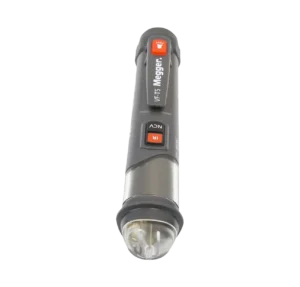
Educational Products Megger VF-T5 Voltage Detector & Infrared Thermometer | CAT IV
Electrical Testers
Electrical Testers
AC only Clamps Related Products


Next day delivery
Finance services
Price Match
Technical support
Product training
Calibration servises
Need help? Call our support team 1800 358 531
Reviews
There are no reviews yet.