



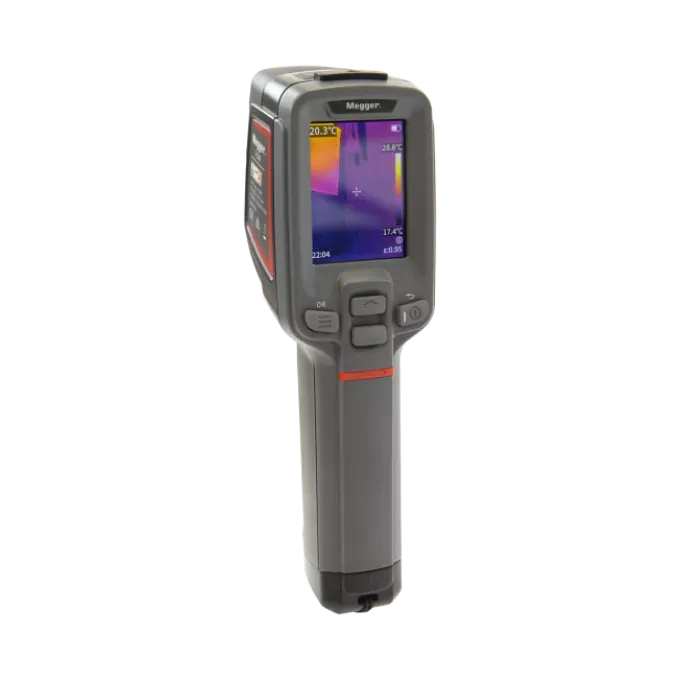
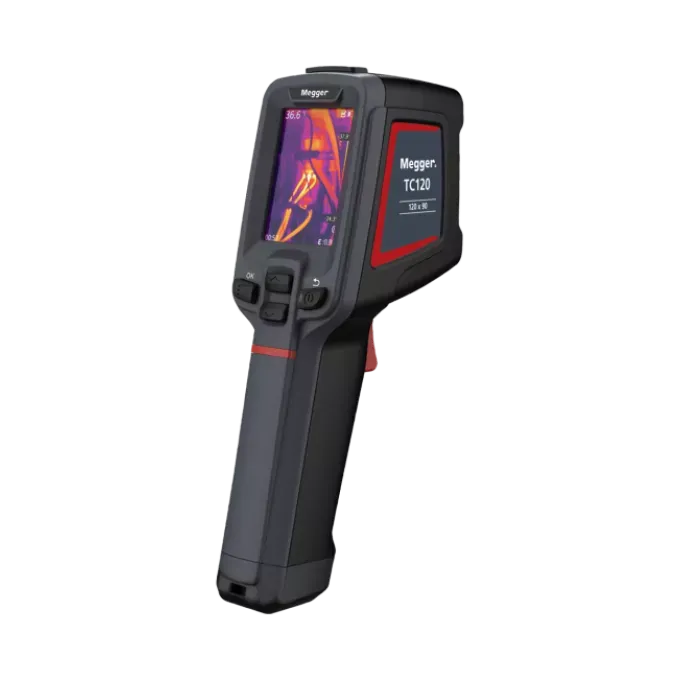
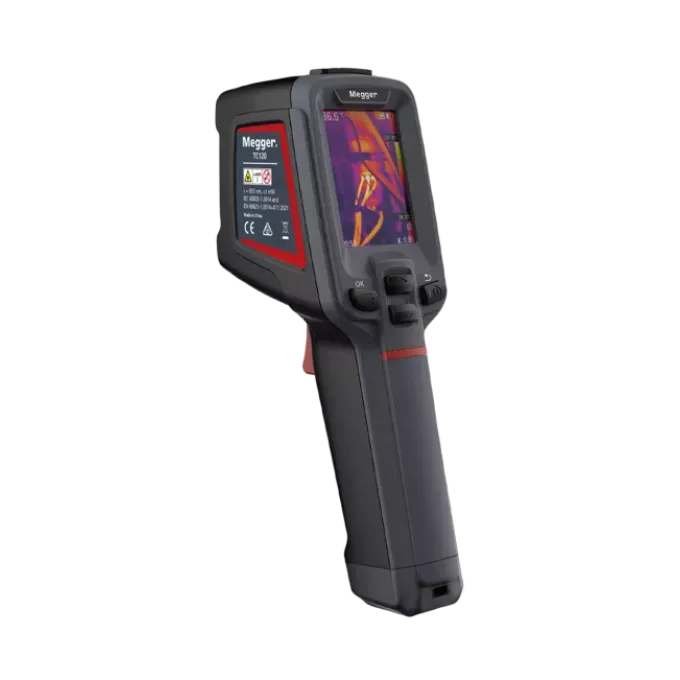
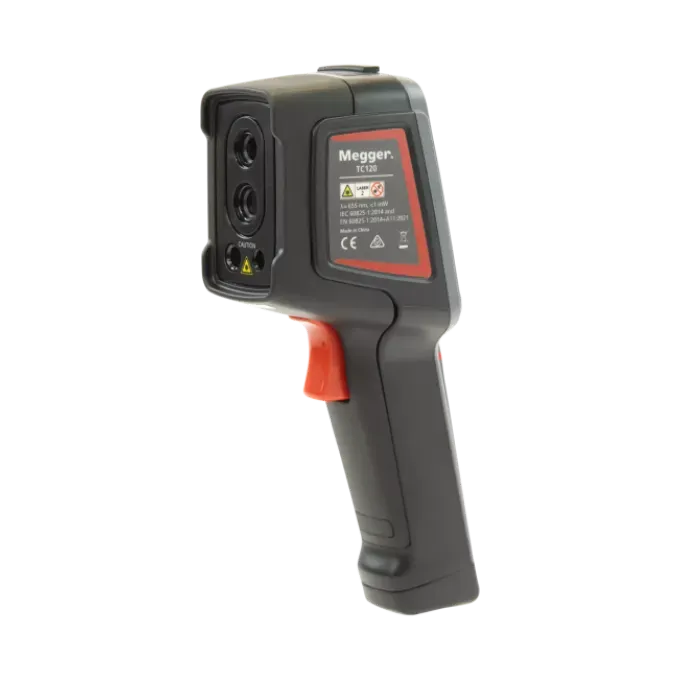
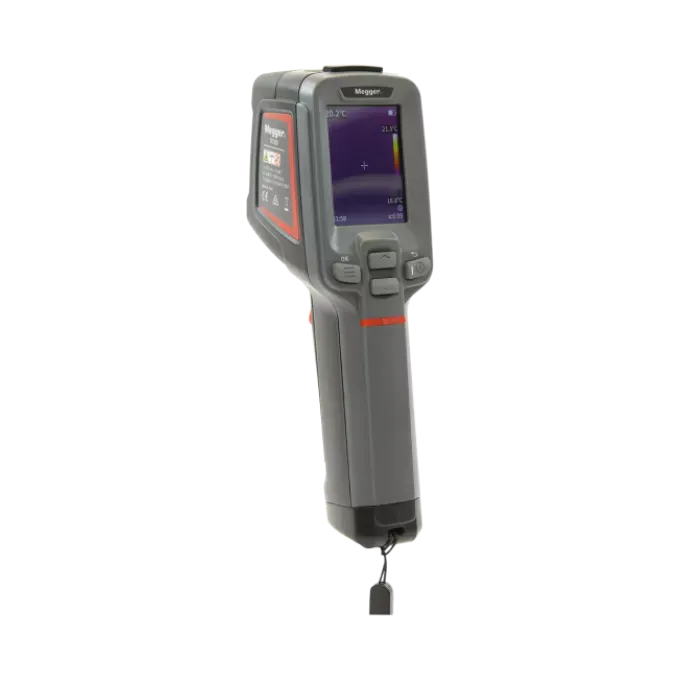
Megger TC120 Thermal Camera | 120×90 IR | Buy Australia
$500.00 .( $550.00 inc. GST )
100 in stock
For all your equipment calibration needs, visit our MyCalibration website.
 Free Delivery on orders over $1000
Shipping time may vary for certain products*

Product Enquiry
If you would like more information regarding this product, simply email us here.

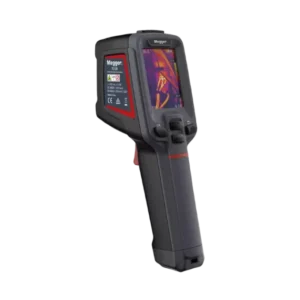
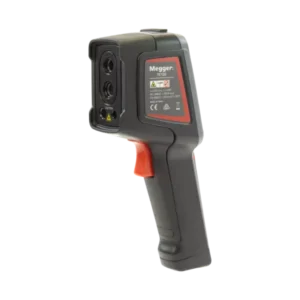
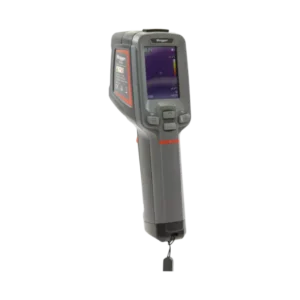
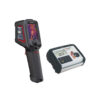
The Megger TC120 is a compact, trigger-grip infrared camera designed for electricians and maintenance technicians who need fast, reliable thermal inspections without complexity. Featuring a 120×90 pixel detector with super-resolution up to 240×180, a wide −20°C to 550°C measurement range, four imaging modes, and IP54 ingress protection with a 2 m drop rating, the TC120 is a capable entry point into thermal diagnostics — field-ready straight out of the box.

When You Can’t Afford to Miss a Hot Spot
Electrical faults don’t announce themselves. A loose termination overheating inside a switchboard, an underperforming motor winding running ten degrees hotter than its neighbours, a section of underfloor heating that stopped working six months ago — none of these will trip a breaker or show up on a standard multimeter until the situation becomes critical. By that point, you’re looking at unplanned downtime, a costly repair call-out, or worse.
For Australian electricians, facility managers, and maintenance teams working across residential, commercial, and industrial sites, the practical answer is thermal imaging. And the Megger TC120 makes that capability more accessible than ever before.
The TC120: Thermal Imaging That Gets Out of the Way
The TC120 is designed for one thing: making it easy to see heat. It doesn’t require a thermography qualification to operate, it doesn’t need calibrating before every job, and it fits comfortably in a tool bag alongside the rest of your kit.
The trigger-grip form factor puts the camera naturally in hand, while the compact 194 × 61.5 × 76 mm body and 355 g weight mean you can hold it steady for extended inspections without fatigue. Whether you’re scanning a 230 V residential distribution board, sweeping a commercial HVAC plant room, or checking connections in an industrial MCC, the TC120 is sized for the work.
The 2.4-inch colour LCD gives you a live thermal view as you move, and the six available colour palettes — Iron Red, White Hot, Arctic, Rainbow 1, Rainbow 2, and Hot Iron — let you pick the display that makes anomalies easiest to read in your current environment. Some sites read better in greyscale; others make fault patterns pop in a false-colour palette. The TC120 gives you the choice.
Resolution That Earns Its Place on the Job
The TC120 uses a 120×90 pixel VOx detector operating across the 7.5–14 µm waveband, with a 50°×38° field of view. For routine maintenance inspections — scanning a switchboard, checking a motor bank, or surveying heat loss in a building envelope — this resolution delivers clear, actionable images.
Real-time IR-Perfclear image processing runs in the background on every frame, reducing noise and enhancing detail to produce an image that’s cleaner than the raw detector output alone. Megger quotes a 4× improvement in effective image quality over unprocessed output.
When you need more detail — perhaps to clearly document a fault for a client report, or to distinguish adjacent components in a tight enclosure — the TC120’s super-resolution mode reconstructs the image to 240×180 pixels. That’s twice the linear resolution of the base sensor, achieved through intelligent frame processing rather than digital interpolation.
Thermal sensitivity (NETD) is rated at 60 mK, and the 25 Hz frame rate delivers smooth real-time imaging as you move the camera across a panel or along a cable run.
Measurement You Can Rely On
The TC120 measures surface temperatures from −20°C to 550°C, with automatic range switching between two bands: −20°C to 150°C for ambient and low-temperature work, and 0°C to 550°C for higher-temperature industrial applications such as motors, furnaces, and process equipment.
Measurement accuracy is rated at ±2°C or ±2% (whichever is greater) — the industry-standard specification for an entry-level thermal camera, and sufficient for identifying relative temperature differences and flagging anomalies that warrant further investigation.
The focus-free design means there’s no manual focus ring to adjust or forget: the 2.28 mm focal length lens provides a minimum object distance of 0.1 m and a distance-to-spot ratio of 130:1. Point and shoot — the image is always in focus.
Three user-configurable target areas (centre spot plus small, medium, or large fixed area) let you set up the display to track the measurement zones that matter for your job, and a full-screen temperature threshold alarm triggers both an image indicator and a flash when a user-set limit is exceeded.
Four Imaging Modes for Flexible Diagnosis
The TC120 supports four display modes to suit different inspection requirements:
Infrared (IR) mode displays the full thermal image in your chosen colour palette — the standard mode for locating heat anomalies.
Visible Light (VL) mode uses the onboard 2 MP digital camera to show a standard photographic image. Useful when you need a reference shot of a panel or component before or after the thermal scan.
Multi-Image Fusion (MIF) overlays the thermal image on the visible light image, blending the two so you can see heat patterns in the context of the physical equipment. This is particularly valuable when documenting faults in a report — the client can see exactly which component is running hot, not just a heat map.
Picture-in-Picture (PIP) embeds a thermal image window within the visible light frame, giving you spatial context while keeping the thermal data clearly visible.
The integrated laser pointer and onboard floodlight add targeting precision in low-light environments — useful when scanning inside switchrooms, server cupboards, or under-floor voids.
Built for Australian Field Conditions
The TC120 carries an IP54 ingress protection rating, resisting dust and directed water spray — appropriate for industrial sites, outdoor inspections, and the kind of environments Australian tradespeople actually work in.
It’s also been drop-tested to 2 m, with additional qualification testing including damp heat, vibration, shock, and impact. The non-removable lithium-ion battery is UN38.3 certified for transport compliance. These aren’t just marketing claims; they’re documented in the datasheet and the certification list covers CE, FCC, RoHS, KC, EAC, FDA, and Anatel.
Battery life is rated at 8 hours of operating time, with Type-C charging capable of reaching 90% capacity in 2.5 hours — fast enough to top up during a lunch break before an afternoon job. The Type-C port also handles data transfer, connecting the TC120 directly to a PC for image download and analysis via the ThermoLink PC application.
Onboard storage is 16 GB internal, saving thermal images as JPG files with embedded temperature data and video in IRGD format. Images can also be shared via a compatible mobile app for quick field reporting without needing to return to a desk.
The TC120 ships in a rigid protective carry case with wrist strap, power adapter with plug adaptors (including Australian plug), Type-C USB cable, quick start guide, and a calibration certificate. Annual recalibration is recommended to maintain measurement accuracy over the life of the instrument.
Who Reaches for a TC120?
Electrical contractors running periodic inspection and testing programs find the TC120 a practical addition for identifying thermal anomalies in switchboards, distribution boards, and cable terminations — particularly when combined with a multifunction installation tester for compliance-based work under AS/NZS 3000.
Industrial maintenance teams use it for predictive condition monitoring of motors, drives, couplings, and electrical switchgear — catching developing faults before they cause unplanned downtime. The 0°C to 550°C high-temperature range covers most rotating machine and process equipment applications.
Facility managers and building services teams rely on the TC120 for HVAC checks, heat loss surveys, and building envelope diagnostics — identifying areas of poor insulation, moisture ingress, or underfloor heating faults that aren’t visible to the naked eye.
Solar PV installers and O&M technicians use thermal cameras as part of commissioning and ongoing maintenance routines, scanning string combiner boxes, inverter connections, and array strings for hotspot defects — particularly relevant to AS/NZS 5033 and IEC 62446-1 documentation requirements.
IT and data centre technicians scan server racks, UPS systems, and cable trays for thermal anomalies that signal failing components or cooling issues before they escalate to service disruptions.
Where the TC120 Sits in the Megger Range
The TC120 is Megger’s entry-level thermal camera, designed for straightforward inspections and everyday maintenance tasks where an accessible, durable, and easy-to-operate instrument is the priority. If your work demands higher resolution for detailed component-level diagnosis, consider the Megger TC256, which steps up to 256×192 pixels with super-resolution to 512×384 and adds real-time video streaming capability. For critical infrastructure, high-voltage inspections, or advanced thermography reporting, the Megger TC640 offers 640×480 resolution with Android-based onboard analysis and Wi-Fi/Bluetooth connectivity.
Understanding which model fits your application is something our team is well placed to help with — contact us for a no-obligation recommendation.
Why Buy Through Us
We’re a specialist Australian test and measurement supplier, not a general catalogue retailer. When you order a Megger TC120 through us, you’re backed by a team that understands the instrument, the applications it’s used for, and the compliance context it operates in. We supply instruments ready for Australian conditions, and we offer NATA-traceable calibration services to keep your equipment within specification over its working life. The TC120 ships with a 2-year camera warranty and 1-year battery warranty — and we’re here to support you if you need to use it.
Technical Specifications Table
| Specification | Value | Why It Matters |
|---|---|---|
| Infrared Resolution | 120 × 90 pixels | Delivers clear thermal images for routine electrical, HVAC, and building inspections |
| Super Resolution | 240 × 180 pixels | Reconstructed from multiple frames — doubles linear detail for documentation and reporting |
| Detector Type | VOx, 7.5–14 µm | Vanadium oxide microbolometer; proven, stable detector technology across the full thermal waveband |
| Thermal Sensitivity (NETD) | 60 mK | Detects temperature differences as small as 0.06°C — sufficient for identifying meaningful heat anomalies |
| Frame Rate | 25 Hz / 9 Hz | 25 Hz provides smooth real-time imaging when scanning panels or moving across equipment |
| Focal Length | 2.28 mm | Fixed focus-free lens — no adjustment required, ready to shoot from 0.1 m minimum distance |
| Field of View | 50° × 38° | Wide FOV suits panel-level and room-level scanning; covers a switchboard face in one shot |
| IFOV | 7.46 mrad | Spatial resolution of each pixel — determines smallest detectable object at a given distance |
| Min. Object Distance | 0.1 m | Close-focus capability for tight enclosures and compact equipment |
| D:S Ratio | 130:1 | At 1.3 m distance, the spot measurement is 10 mm — practical for board-level fault finding |
| Measurement Range | −20°C to 550°C (auto-switching) | Covers ambient conditions through to high-temperature motor and process equipment |
| Measurement Accuracy | ±2°C or ±2% (whichever is greater) | Industry-standard entry-level accuracy — suitable for relative comparison and anomaly detection |
| Focusing Mode | Focus-free | No user adjustment required — eliminates a common source of error and speeds up inspections |
| Image Modes | IR, Visible Light, Multi-Image Fusion, Picture-in-Picture | Four modes to suit different inspection and reporting needs |
| Colour Palettes | 6 (Iron Red, White Hot, Arctic, Rainbow 1, Rainbow 2, Hot Iron) | Select the palette that makes anomalies most visible in your working environment |
| Image Adjustment | Automatic, Semi-automatic, Manual level/span | Manual mode useful for locked-range comparisons across a site survey |
| Target Analysis | Centre spot; 3 fixed area sizes (Small/Medium/Large) | Configurable measurement zones for common inspection tasks |
| Alarm | Full-screen temperature threshold (image + flash) | Audible/visual alert when a surface temperature exceeds a user-set limit |
| Display | 2.4″ colour LCD | Clear live view in the field; readable in typical workshop/site lighting |
| Digital Camera | 2 MP | Provides visible light reference images for fusion mode and standalone documentation |
| Laser | Laser pointer (indication) | Helps correlate the thermal target with the physical component |
| Storage | 16 GB internal | Holds thousands of images; no SD card to lose or forget |
| Image Format | JPG with embedded temperature data | Standard format compatible with ThermoLink and common image viewing software |
| Video Format | IRGD (with temperature data) | Full radiometric video for detailed post-analysis in ThermoLink |
| Connectivity | Type-C USB; UNC ¼”-20 tripod mount | USB for charging and data transfer; tripod mount for fixed-position monitoring |
| PC Software | ThermoLink | Windows-based analysis, image processing, and report generation |
| Battery Type | Rechargeable lithium-ion (non-removable) | Integrated battery; UN38.3 certified for air freight compliance |
| Battery Life | 8 hours | Full day’s use on a single charge for typical inspection work |
| Charging | Type-C; charges while operating; 90% in 2.5 hours | Fast top-up capability; can use portable power bank in the field |
| Operating Temperature | −15°C to 50°C | Rated for Australian summer conditions and cool-climate winter work |
| IP Rating | IP54 | Dust resistant; protected against water spray — suitable for industrial and outdoor use |
| Drop Rating | 2 m | Drop-tested to 2 metres — practical field durability standard |
| Certifications | CE, FCC, RoHS, KC, EAC, FDA, Anatel | Internationally certified; ⚠️ RCM mark not confirmed from datasheet — verify before citing for AU regulatory purposes |
| Weight | 355 g | Comfortable single-hand operation for extended inspections |
| Dimensions | 194 × 61.5 × 76 mm | Compact trigger-grip body; fits standard tool bags |
| Part Number | 1016-971 | — |
| Warranty | Camera: 2 years; Battery: 1 year | Manufacturer warranty covering both the instrument and power cell |
| Box Contents | TC120 camera, rigid carry case, wrist strap, power adapter (with AU/UK/EU plugs), Type-C USB cable, quick start guide, calibration certificate | Arrives ready for use with all required accessories |
Query target: What is the Megger TC120 used for?
The Megger TC120 is a compact handheld thermal camera used for non-contact temperature inspection in electrical, HVAC, building, and industrial maintenance applications. It detects infrared heat signatures to reveal hot spots, poor connections, overloaded circuits, insulation failures, heat loss, moisture ingress, and equipment anomalies — without requiring the system to be shut down or physically contacted. Common applications include scanning electrical switchboards and distribution boards, monitoring motors and drives, diagnosing HVAC systems, surveying building insulation, checking solar PV connections, and identifying air leaks. It is suited to electricians, industrial maintenance teams, facility managers, and anyone who needs a straightforward, portable thermal inspection tool for everyday field use.
Query target: What resolution does the Megger TC120 have?
The Megger TC120 has a native infrared resolution of 120×90 pixels, captured by a VOx detector operating across the 7.5–14 µm thermal waveband. This is enhanced by onboard super-resolution processing that reconstructs the image to 240×180 pixels in real time. The camera also carries a 2 MP visible light camera for standard photographic reference images. The 50°×38° field of view and focus-free lens (minimum object distance 0.1 m) make it suited to panel-level and component-level inspection without manual focus adjustment.
Query target: What temperature range does the Megger TC120 measure?
The Megger TC120 measures surface temperatures from −20°C to 550°C, with automatic switching between two measurement bands: −20°C to 150°C for ambient and low-temperature applications, and 0°C to 550°C for higher-temperature industrial inspections such as motors, transformers, and process equipment. Measurement accuracy is rated at ±2°C or ±2% (whichever is greater). The thermal sensitivity (NETD) is 60 mK, meaning the camera can detect temperature differences as small as 0.06°C between adjacent surfaces.
Query target: Is the Megger TC120 waterproof or dustproof?
The Megger TC120 carries an IP54 ingress protection rating, meaning it is protected against dust ingress sufficient to prevent interference with normal operation, and against water spray from any direction. It has also been tested to withstand a 2 m drop and has passed damp heat, vibration, shock, and impact qualification testing. This makes it suitable for use in industrial workshops, outdoor inspections, and the variable conditions typical of Australian trade and maintenance work. The battery is UN38.3 certified for air transport.
Query target: How does the Megger TC120 connect to a computer?
The Megger TC120 connects to a PC via its Type-C USB port, which handles both data transfer and battery charging simultaneously. Images (stored as JPG with embedded temperature data) and radiometric video (in IRGD format) are transferred to the ThermoLink PC application for analysis, report generation, and sharing. The camera also supports mobile app file sharing for quick field reporting. Internal storage is 16 GB — sufficient for thousands of thermal images without needing an SD card.
Query target: How long does the Megger TC120 battery last?
The Megger TC120 uses a built-in rechargeable lithium-ion battery rated for 8 hours of operating time — sufficient for a full day’s inspections on a single charge. The battery charges via the Type-C USB port and can reach 90% capacity in approximately 2.5 hours. It is capable of charging while the camera is in use, allowing operation from a portable power bank during extended field sessions. The battery carries a 1-year warranty separate from the 2-year camera warranty.
Query target: How does the Megger TC120 compare to the TC256?
The Megger TC120 and TC256 are both entry and mid-range thermal cameras in Megger’s new range, but they differ in resolution and capability. The TC120 offers 120×90 native resolution (super-resolution to 240×180), focus-free operation, and four imaging modes, making it well suited to routine inspections and everyday maintenance tasks. The TC256 steps up to 256×192 native resolution (super-resolution to 512×384) and adds real-time video streaming and IR-Prefclear image enhancement technology, providing finer thermal detail for more demanding diagnostic work. Both share the same −20°C to 550°C measurement range, IP54 rating, 2 m drop test, Type-C connectivity, and ThermoLink PC software. The right choice depends on the level of image detail required for your inspection tasks and reporting needs.
| Weight | .5 kg |
|---|
Be the first to review “Megger TC120 Thermal Camera | 120×90 IR | Buy Australia”
You must be logged in to post a review.
Technical Specifications Table
| Specification | Value | Why It Matters |
|---|---|---|
| Infrared Resolution | 120 × 90 pixels | Delivers clear thermal images for routine electrical, HVAC, and building inspections |
| Super Resolution | 240 × 180 pixels | Reconstructed from multiple frames — doubles linear detail for documentation and reporting |
| Detector Type | VOx, 7.5–14 µm | Vanadium oxide microbolometer; proven, stable detector technology across the full thermal waveband |
| Thermal Sensitivity (NETD) | 60 mK | Detects temperature differences as small as 0.06°C — sufficient for identifying meaningful heat anomalies |
| Frame Rate | 25 Hz / 9 Hz | 25 Hz provides smooth real-time imaging when scanning panels or moving across equipment |
| Focal Length | 2.28 mm | Fixed focus-free lens — no adjustment required, ready to shoot from 0.1 m minimum distance |
| Field of View | 50° × 38° | Wide FOV suits panel-level and room-level scanning; covers a switchboard face in one shot |
| IFOV | 7.46 mrad | Spatial resolution of each pixel — determines smallest detectable object at a given distance |
| Min. Object Distance | 0.1 m | Close-focus capability for tight enclosures and compact equipment |
| D:S Ratio | 130:1 | At 1.3 m distance, the spot measurement is 10 mm — practical for board-level fault finding |
| Measurement Range | −20°C to 550°C (auto-switching) | Covers ambient conditions through to high-temperature motor and process equipment |
| Measurement Accuracy | ±2°C or ±2% (whichever is greater) | Industry-standard entry-level accuracy — suitable for relative comparison and anomaly detection |
| Focusing Mode | Focus-free | No user adjustment required — eliminates a common source of error and speeds up inspections |
| Image Modes | IR, Visible Light, Multi-Image Fusion, Picture-in-Picture | Four modes to suit different inspection and reporting needs |
| Colour Palettes | 6 (Iron Red, White Hot, Arctic, Rainbow 1, Rainbow 2, Hot Iron) | Select the palette that makes anomalies most visible in your working environment |
| Image Adjustment | Automatic, Semi-automatic, Manual level/span | Manual mode useful for locked-range comparisons across a site survey |
| Target Analysis | Centre spot; 3 fixed area sizes (Small/Medium/Large) | Configurable measurement zones for common inspection tasks |
| Alarm | Full-screen temperature threshold (image + flash) | Audible/visual alert when a surface temperature exceeds a user-set limit |
| Display | 2.4″ colour LCD | Clear live view in the field; readable in typical workshop/site lighting |
| Digital Camera | 2 MP | Provides visible light reference images for fusion mode and standalone documentation |
| Laser | Laser pointer (indication) | Helps correlate the thermal target with the physical component |
| Storage | 16 GB internal | Holds thousands of images; no SD card to lose or forget |
| Image Format | JPG with embedded temperature data | Standard format compatible with ThermoLink and common image viewing software |
| Video Format | IRGD (with temperature data) | Full radiometric video for detailed post-analysis in ThermoLink |
| Connectivity | Type-C USB; UNC ¼”-20 tripod mount | USB for charging and data transfer; tripod mount for fixed-position monitoring |
| PC Software | ThermoLink | Windows-based analysis, image processing, and report generation |
| Battery Type | Rechargeable lithium-ion (non-removable) | Integrated battery; UN38.3 certified for air freight compliance |
| Battery Life | 8 hours | Full day’s use on a single charge for typical inspection work |
| Charging | Type-C; charges while operating; 90% in 2.5 hours | Fast top-up capability; can use portable power bank in the field |
| Operating Temperature | −15°C to 50°C | Rated for Australian summer conditions and cool-climate winter work |
| IP Rating | IP54 | Dust resistant; protected against water spray — suitable for industrial and outdoor use |
| Drop Rating | 2 m | Drop-tested to 2 metres — practical field durability standard |
| Certifications | CE, FCC, RoHS, KC, EAC, FDA, Anatel | Internationally certified; ⚠️ RCM mark not confirmed from datasheet — verify before citing for AU regulatory purposes |
| Weight | 355 g | Comfortable single-hand operation for extended inspections |
| Dimensions | 194 × 61.5 × 76 mm | Compact trigger-grip body; fits standard tool bags |
| Part Number | 1016-971 | — |
| Warranty | Camera: 2 years; Battery: 1 year | Manufacturer warranty covering both the instrument and power cell |
| Box Contents | TC120 camera, rigid carry case, wrist strap, power adapter (with AU/UK/EU plugs), Type-C USB cable, quick start guide, calibration certificate | Arrives ready for use with all required accessories |
Q1: What is the Megger TC120 thermal camera? The Megger TC120 (Part No. 1016-971) is a compact, handheld infrared thermal camera designed for electrical, HVAC, building, and industrial maintenance inspections. It features a 120×90 pixel VOx detector with super-resolution to 240×180, a −20°C to 550°C measurement range, four imaging modes, IP54 protection, a 2 m drop rating, and 8-hour battery life. It connects to a PC via Type-C USB using the ThermoLink software application and ships complete with a rigid carry case, calibration certificate, and power adapter including an Australian plug.
Q2: What imaging modes does the TC120 support? The TC120 supports four display modes: Infrared (IR) for thermal-only viewing, Visible Light (VL) for standard photographic reference, Multi-Image Fusion (MIF) which overlays the thermal image on the visible light image, and Picture-in-Picture (PIP) which embeds a thermal window within the visible image. Six colour palettes — Iron Red, White Hot, Arctic, Rainbow 1, Rainbow 2, and Hot Iron — are available to suit different inspection conditions.
Q3: Does the TC120 need to be calibrated? Megger recommends annual calibration to maintain measurement accuracy over the life of the instrument. The TC120 is supplied with a calibration certificate as a standard box inclusion. For Australian workplaces where test equipment calibration is required for compliance purposes, we offer NATA-traceable recalibration services — contact us for pricing and turnaround times.
Q4: What is IR-Perfclear technology? IR-Perfclear is Megger’s real-time image processing technology applied to every frame captured by the TC120. It is designed to reduce detector noise and enhance image detail, producing a cleaner, sharper thermal image than unprocessed raw output. Megger rates the improvement at approximately 4× better effective image quality compared to processing-free output.
Q5: Can the TC120 record video? Yes. The TC120 supports both photo and video recording. Thermal video is saved in IRGD format, which retains full radiometric temperature data in every frame — meaning you can analyse temperatures in the recorded footage after the fact using ThermoLink PC software. Still images are saved as JPG files with embedded temperature information. Internal storage is 16 GB.
Q6: Is the TC120 suitable for solar PV inspections? The TC120 is frequently used for solar PV commissioning and operational maintenance — scanning string combiner boxes, inverter input terminals, and module connections for hotspot defects. The −20°C to 550°C range and focus-free operation suit rooftop and ground-mount array conditions. For solar sites where IEC 62446-1 or AS/NZS 5033 documentation is required, the ThermoLink software supports structured report generation from captured images.
Q7: What is the distance-to-spot ratio of the TC120? The TC120 has a D:S ratio of 130:1 and an IFOV of 7.46 mrad. This means at a distance of 1.3 m, the measurement spot is approximately 10 mm in diameter. At 2.6 m, the spot is approximately 20 mm. For switchboard inspections at typical working distances of 0.5–1.5 m, this provides adequate spatial resolution to distinguish between adjacent terminals or circuit breakers.
Q8: Can the TC120 be mounted on a tripod? Yes. The TC120 includes a UNC ¼”-20 standard tripod mounting socket, allowing it to be mounted on any compatible camera tripod or flexi-arm for fixed-position monitoring or hands-free operation.
Q9: What software comes with the TC120? The TC120 is compatible with ThermoLink, Megger’s PC application for thermal image analysis, video playback, data management, and report generation. ThermoLink runs on Windows and is available via the Megger website. Images and videos are transferred to the PC via the supplied Type-C USB cable. A compatible mobile app supports quick field sharing of images directly from the camera.
Q10: How does the TC120 differ from the TC256P? The TC256P is a pocket-format thermal camera with 256×192 pixel resolution (super-resolution to 512×384), a touchscreen interface, and an ultra-compact body designed for technicians who move frequently between sites or work in confined spaces. The TC120 uses a traditional trigger-grip form factor with a physical button layout and offers 120×90 native resolution. Both carry IP54 and 2 m drop ratings and connect via Type-C USB. The TC256P is the better choice when portability and higher resolution are the priority; the TC120 suits users who prefer a conventional ergonomic grip and need a cost-effective entry into thermal imaging.
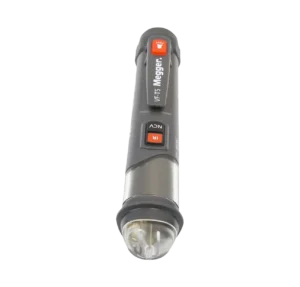
Educational Products Megger VF-T5 Voltage Detector & Infrared Thermometer | CAT IV
Electrical Testers
Electrical Testers
AC only Clamps Related Products


Next day delivery
Finance services
Price Match
Technical support
Product training
Calibration servises
Need help? Call our support team 1800 358 531
Reviews
There are no reviews yet.