



Megger Electrician Starter Kit: MFT1815, TPT420 & DCM310 Clamp Meter
$1,300.00 .( $1,430.00 inc. GST )
10 in stock

For all your equipment calibration needs, visit our MyCalibration website.
 Free Delivery on orders over $1000
Shipping time may vary for certain products*

Product Enquiry
If you would like more information regarding this product, simply email us here.

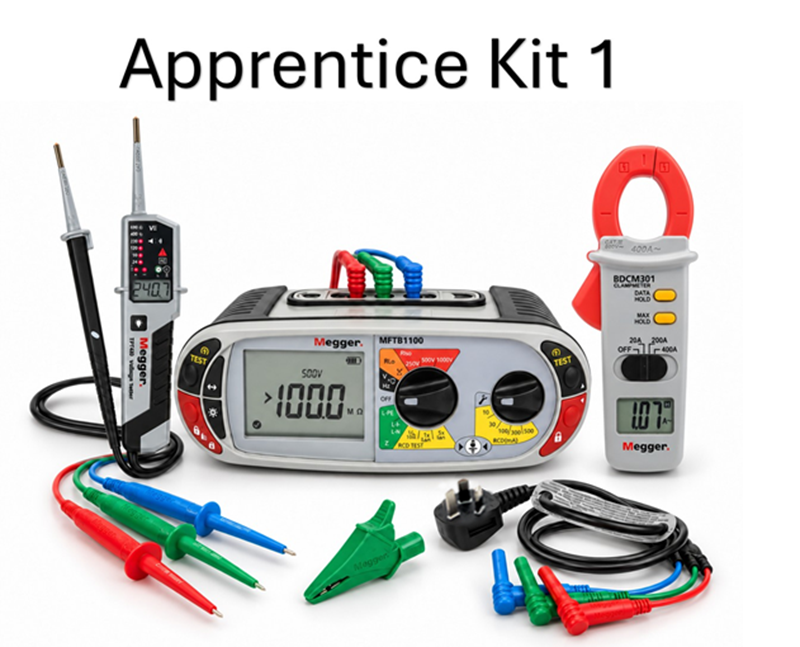
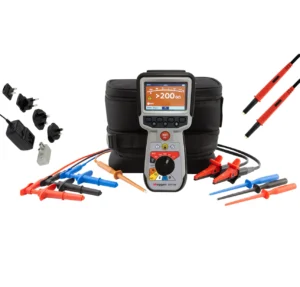
Set up your first professional test bag with one Megger kit. Starter Kit 1 pairs the MFT1815 multifunction installation tester with the TPT420 two-pole voltage tester and DCM310 400 A AC clamp meter. Cover insulation, continuity, loop and RCD testing, confirm voltage before you work, then check load current on conductors up to 27 mm. Built for apprentices, newly licensed electricians and small contracting crews.
 Megger MFT1800 Series Datasheet
Your first test kit has to do more than get you through the week
Buying test gear for the first time is harder than it looks. An insulation tester here, a loop tester there and a cheap clamp from the hardware store can leave you with three different interfaces, three sets of leads and no confidence that the lot will hold up on site. You also end up replacing the weakest instrument within a year or two, which is the expensive way to build a kit.
The other trap is buying only for the verification paperwork. Plenty of real jobs start with a simpler question: is this circuit dead, and if it’s live, how much current is it actually pulling? A tripping breaker, a board that runs warm or a customer adding another air conditioner all call for a load reading as well as a set of test results.
The Megger Basic Kit, Electrician Starter Kit 1, is built around that full sequence. It puts three instruments from the one manufacturer in your bag, with a separate job for each:
- Prove: the TPT420 tells you whether voltage is present.
- Verify: the MFT1815 runs the installation tests on the circuit.
- Measure: the DCM310 shows the load current once the circuit is back in service.
Ready to test right out of the box, and with room to grow as your work gets more demanding.
MFT1815: one tester for the core installation tests
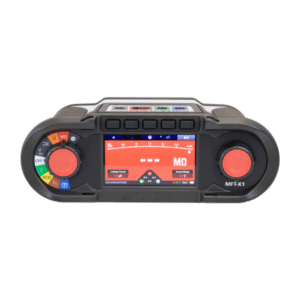
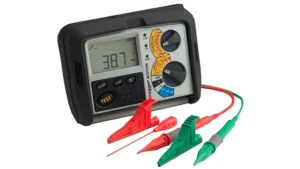
The MFT1815 is the entry point to Megger’s MFT1800 multifunction range, and it replaces a handful of single-function testers with a single instrument for low-voltage installation work. Two colour-coded rotary switches take you straight to the test you want. There are no menus to dig through, which matters when you’re still building good habits and don’t want to second-guess which range you’ve selected.
Insulation resistance at 250 V, 500 V and 1000 V. The display shows the actual test voltage next to the MΩ reading, so you can see what the circuit received as well as the result. Input protection handles live circuits up to 600 V, even with the insulation test locked on. If a hazardous voltage is present, the screen shows it, the tester warns you with a beep, and further testing is blocked.
Continuity at 200 mA. Testing starts automatically when the probes make contact, so you can keep both hands on the probes. An adjustable buzzer threshold speeds up runs through a board.
Loop and fault current. Non-trip testing lets you take L-PE loop readings on RCD-protected circuits without dropping the circuit you’re working on, and the MFT1815 also provides higher-current two-wire L-N and L-L testing. Prospective fault current is displayed up to 20 kA, alongside the loop value.
RCD testing. Half, 1x and 5x rated current tests, plus fast ramp and an auto-test routine that steps through the sequence. It handles Type AC, A and S devices and programmable RCDs, at 10, 30, 100, 300 and 500 mA ratings. Touch voltage is shown from 0 to 253 V.
Supply checks. Voltage from 10 to 600 V, frequency and phase rotation are all available from the same instrument.
The physical design suits real job sites. Dual TEST and LOCK buttons at each end make it comfortable for left or right-handed use. It can stand on the floor, sit on a ladder shelf or hang from the neck strap. A rubber overmould and IP54 protection give it a fighting chance against dust, splashes and the back of the ute. It’s rated 600 V CAT III and 300 V CAT IV.
Know where the MFT1815 stops. This is the entry-level model. Type B RCD testing, three-phase RCD testing with no earth, 2x rated current RCD testing, 15 mA continuity and earth electrode testing all sit with higher models in the range. If you work on solar or industrial sites where those functions are routine, talk to us about stepping up to an MFT1825 before you buy.
TPT420: the two-pole tester you reach for first
Before anything else gets connected, you need to know what’s live. The TPT420 gives you two ways to read the answer: 13 LEDs for an at-a-glance indication and a four-digit LCD with 1 V resolution. It covers 12 to 1000 V AC and 12 to 1500 V DC, so it’s not limited to the mains. Megger also lists automotive, fire alarm and solar/PV systems among its applications.
Three features earn it a permanent spot in the top of the bag:
- Voltage warning with flat batteries. The tester continues to warn of dangerous voltage even when its batteries are exhausted.
- Low-current testing between phase and earth. It’s designed to work below the tripping threshold of RCDs, RCBOs and safety breakers, helping you avoid dropping a circuit by accident.
- Simple phase rotation. The check doesn’t require crossing the probes, covering 120 to 400 V phase to phase at 50/60 Hz.
You also get continuity indication, a single-pole voltage test (100 to 1000 V AC), an audible signal and an LED torch for dim switchboards and roof spaces. The tester is rated CAT IV 1000 V and IP64, and it comes with GS38 probe shrouds, a storage pouch and two AAA batteries.
Your safe isolation procedure still comes first. A voltage tester should itself be checked against a known source before and after the test, and this kit doesn’t include a proving unit. If you don’t already have one, add the Megger MPU690 to your order.
DCM310: load current without breaking the circuit
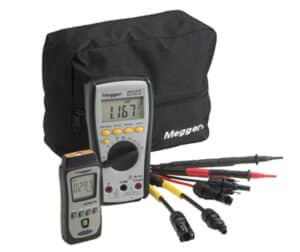
The DCM310 is what separates this kit from Starter Kit 2. It’s a dedicated AC current clamp with a closing jaw that takes conductors up to 27 mm in diameter, large enough for the majority of general electrical contracting work. It measures up to 400 A across 20 A, 200 A and 400 A ranges at 50 to 60 Hz. The 20 A range matters more than the headline figure, because it gives you better resolution on the small circuits you’ll see most often.
Clamp around a single conductor and you have your reading, with no leads to connect and no need to open the circuit. Some of the everyday uses:
- Checking how heavily a final subcircuit is loaded before adding to it
- Comparing current across phases at a sub-board
- Confirming that a motor, heater or air conditioner is drawing roughly what you expect
- Chasing a breaker that trips under load
- Recording a current reading during commissioning
Data Hold freezes the display, which is handy when the jaw is buried in a tight board and you can’t see the screen. Max Hold captures the highest value measured over a period, so you can leave it on a cycling load and come back to the peak. Treat that as a load-monitoring aid. It’s not a dedicated inrush function, as the meter updates its reading about 2.5 times per second.
It’s worth being clear about the scope. The DCM310 is a current-only meter. It doesn’t measure voltage or resistance, and its safety rating is CAT III 600 V. If you’d rather carry one instrument that handles voltage, resistance and current, Starter Kit 2 with the DCM330 fork multimeter is the better fit.
The meter is pocket-sized at 250 g and runs on one 9 V battery, with a rated life of about 580 hours on an alkaline cell. It’s supplied with a carry case. Megger notes that rechargeable batteries aren’t suitable.
Is Starter Kit 1 right for you?
A good fit if you are:
- An apprentice building a personal kit ahead of licensing
- A newly licensed electrician setting up on your own
- A small contractor equipping a new team member
- Doing residential and light commercial work where load checks are routine
- A maintenance electrician who needs a straightforward installation tester plus a clamp
Look at another option if you:
- Need Type B or three-phase RCD testing, or earth electrode tests: look at a higher MFT1800 model
- Want a meter that also measures voltage and resistance: choose Starter Kit 2
- Need to work on conductors above 400 A, or need True RMS current: ask us for a suitable clamp
- Are a training provider buying for a cohort: see our Megger student kits
Support after the sale
Test gear only earns its keep when you can trust the reading. The MFT1815 is supplied with a factory calibration certificate, and registering it with Megger extends the warranty to three years. When recalibration comes due, our team can help with that too. Unsure about a function, a course requirement or an upgrade path? Talk to us before you order, and we’ll help you get the right gear sorted.
Request a quote today for the Megger Basic Kit, Electrician Starter Kit 1, including multiple kits for a crew or apprentice intake.
What’s in the Kit
| Instrument | Model | Supplied with |
|---|---|---|
| Multifunction installation tester | Megger MFT1815-AU | 3-wire lead set with prods and clips, AU/NZ plug test lead, SP5 switched probe, neck strap, quickstart guide, calibration certificate, 6 x AA batteries |
| Two-pole voltage tester | Megger TPT420 | Pouch, GS38 shrouds, 2 x AAA batteries |
| AC clamp meter | Megger DCM310 | Carry case, battery, user manual |
Technical Specifications
Megger MFT1815 Multifunction Installation Tester
| Specification | Value | Why It Matters |
|---|---|---|
| Insulation test voltages | 250 V, 500 V, 1000 V | Covers common low-voltage insulation test requirements |
| Insulation range and accuracy | 10 kΩ to 999 MΩ at 1000 V; ±3% ±2 digits | Gives a clear result from fault level through to healthy insulation |
| Live circuit input protection | Up to 600 V | Helps protect the instrument from accidental connection to a live circuit |
| Continuity test current | 205 mA ±5 mA | Provides a substantial test current for bonding and conductor checks |
| Continuity accuracy | 0.01 to 99.9 Ω ±2% ±2 digits; 100 Ω to 99.9 kΩ ±5% ±2 digits | Resolves low conductor resistances |
| Loop testing | 2-wire and 3-wire non-trip L-PE; 2-wire high current L-N and L-L | Lets you test RCD-protected circuits without routinely tripping them |
| Loop display range | 0.01 to 999 Ω | Covers low-impedance circuits through to high fault-path readings |
| PFC / PSCC | Up to 20 kA | Displays the fault current available at the test point |
| RCD test multiples | 1/2x, 1x, 5x, fast ramp, auto test | Automates the routine RCD test sequence |
| RCD types | AC, A, S, programmable | Suits common device types; excludes Type B |
| RCD ratings | 10, 30, 100, 300, 500 mA | Covers personal protection through to higher-rated devices |
| Touch voltage | 0 to 253 V | Shows fault voltage alongside RCD results |
| Supply measurement | 10 to 600 V; 15 to 400 Hz; phase rotation | Checks the supply without changing instruments |
| Safety rating | 600 V CAT III / 300 V CAT IV | Sets the limits for where the tester can be connected |
| Ingress protection | IP54 | Protects against dust and water splashes |
| Display | Backlit digital with analogue arc | Shows precise values and fluctuating readings together |
| Power | 6 x AA alkaline (supplied) | Easy to replace on the road |
| Weight and dimensions | 1 kg with batteries; 150 x 85 x 235 mm | Light enough to carry on a neck strap |
| Operating temperature | -10 to +55 °C | Suits a wide range of Australian site conditions |
| Warranty | 3 years on registration | Protects your investment; register with Megger to activate |
Megger TPT420 Voltage Tester
| Specification | Value | Why It Matters |
|---|---|---|
| Voltage range | 12 to 1000 V AC; 12 to 1500 V DC | Covers mains, low-voltage and high-voltage DC work |
| Safety rating | CAT IV 1000 V | High overvoltage rating for work on low-voltage systems |
| Ingress protection | IP64 | Handles dust and water splashes |
| Display | 13 LEDs and 4-digit LCD with 1 V resolution | Gives a quick indication and a precise value |
| Battery-free voltage warning | Yes | Warns of dangerous voltage with exhausted batteries |
| Frequency range | 40 to 400 Hz | Covers mains and other AC supplies |
| Peak current | Under 3.5 mA at 1000 V | Low-current design supports non-trip phase-earth testing |
| Continuity indication | 0 to 500 kΩ, visual and audible | Provides quick checks without another meter |
| Phase rotation | 120 to 400 V phase to phase, 50/60 Hz | Simple direction check with no probe crossing |
| Single-pole test | 100 to 1000 V AC, 50/60 Hz | Useful for quick phase identification |
| Weight and dimensions | About 207 g; about 255 x 67 x 30 mm | Pocket-friendly for daily carry |
| Power | 2 x AAA (supplied) | Easy to replace on the road |
Megger DCM310 AC Clamp Meter
| Specification | Value | Why It Matters |
|---|---|---|
| AC current ranges | 20 A, 200 A, 400 A at 50 to 60 Hz | Low range improves resolution on small circuits |
| Accuracy, 0 to 19.99 A | ±(3.0% + 0.05 A) | Useful detail on lightly loaded circuits |
| Accuracy, 20 to 199.9 A | ±(2.0% + 0.5 A) | Suitable for general load checks |
| Accuracy, 200 to 400 A | ±(2.0% + 5 A) | Covers larger feeders within jaw capacity |
| Conductor size | Up to 27 mm diameter | Fits most general contracting cable sizes |
| Functions | Data Hold, Max Hold | Captures readings in awkward spots and over a load cycle |
| Display | 2000-count LCD; about 2.5 readings per second | Easy to read for steady loads |
| Safety rating | CAT III 600 V | Check this limit before connecting to any installation |
| Battery | 9 V PP3/6LR61; about 580 hours alkaline | Long service between changes; not for rechargeable cells |
| Weight and dimensions | 250 g; 56 x 180 x 32 mm | Pocket-sized |
| Operating temperature | 0 to 50 °C (humidity limits apply) | Check limits for hot roof-space or outdoor use |
| Warranty | 1 year | Standard manufacturer cover |
What is included in the Megger Electrician Starter Kit 1? The kit includes the Megger MFT1815 multifunction installation tester, the TPT420 two-pole voltage tester and the DCM310 400 A AC clamp meter, along with each instrument’s standard accessories. It doesn’t include a proving unit.
What is a good first test kit for an electrician in Australia? A practical first kit covers three jobs: voltage indication, installation testing and current measurement. Starter Kit 1 does this with three Megger instruments, using a multifunction tester for insulation, continuity, loop and RCD tests, plus a voltage tester and a clamp meter. Check your course or employer’s requirements before buying.
What’s the difference between Megger Starter Kit 1 and Starter Kit 2? Both include the MFT1815 and TPT420. Kit 1 adds the DCM310, a current-only clamp meter measuring up to 400 A on conductors up to 27 mm. Kit 2 adds the DCM330, a 200 A fork multimeter for conductors up to 16 mm that also measures voltage and resistance.
Can the MFT1815 test an RCD without Type B support? Yes. It tests Type AC, A and S devices and programmable RCDs, with half, 1x and 5x rated current tests plus ramp and auto-test routines. For Type B testing, you’ll need a higher MFT1800 model.
Does the Megger DCM310 measure voltage? No. The DCM310 is a current-only clamp meter. It measures AC current up to 400 A and has Data Hold and Max Hold functions. Use the TPT420 in this kit for voltage indication.
Frequently Asked Questions
1. Who is the Megger Electrician Starter Kit 1 designed for? It suits apprentices, newly licensed electricians and small contractors who need installation testing, voltage indication and load current measurement from a single kit.
2. Does this kit include a proving unit? No. The kit contains the MFT1815, TPT420 and DCM310. Add a proving unit such as the Megger MPU690 if you don’t already have one.
3. Can the MFT1815 test earth electrodes? No. Earth electrode testing is available on higher models in the MFT1800 range, not the MFT1815. It does provide earth loop testing and fault current measurement.
4. Will the MFT1815 trip an RCD during a loop test? Its non-trip L-PE loop tests are designed for RCD-protected circuits. High-current loop tests aren’t intended for that purpose, so choose the correct test for the circuit.
5. What size cable will the DCM310 clamp around? The jaw accepts conductors up to 27 mm in diameter. Clamp around one conductor at a time for a valid current reading.
6. Is the DCM310 a True RMS clamp meter? Megger’s specifications available to us don’t list it as True RMS. If you regularly measure non-linear loads such as drives or switch-mode equipment, ask us about a True RMS clamp.
7. Is the kit calibrated out of the box? The MFT1815 is supplied with a factory calibration certificate. Contact us before ordering if you need certificates for the other instruments or accredited calibration.
8. What safety ratings apply to this kit? Each instrument has its own rating: MFT1815 600 V CAT III / 300 V CAT IV, TPT420 CAT IV 1000 V and DCM310 CAT III 600 V. Work within the rating of the specific instrument you’re connecting.
Be the first to review “Megger Electrician Starter Kit: MFT1815, TPT420 & DCM310 Clamp Meter”
You must be logged in to post a review.
Installation Testers Megger Electrician Starter Kit: MFT1815, TPT420 & DCM330 Fork Multimeter
Installation Testers
Installation Testers
Installation Testers
Installation Testers Related Products




Next day delivery
Finance services
Price Match
Technical support
Product training
Calibration servises
Need help? Call our support team 1800 358 531
Reviews
There are no reviews yet.