



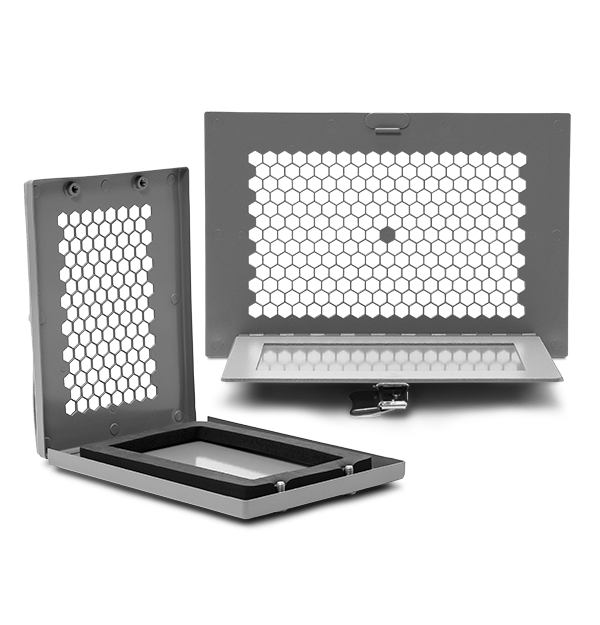
FLIR Large Format IR Inspection Windows | IRW-12PC, IRW-24PC, IRW-6PS, IRW-12PS, IRW-24PS
Price range: $999.00 through $1,760.00
For all your equipment calibration needs, visit our MyCalibration website.
 Free Delivery on orders over $1000
Shipping time may vary for certain products*

Product Enquiry
If you would like more information regarding this product, simply email us here.

Scan energised switchgear without opening the door. FLIR’s IRW large format IR inspection windows give thermographers a wide rectangular view into live panels, with an IP2x reinforcing grille and lockable cover. Choose aluminium (IP65, 12 or 24 in) for indoor boards, or stainless steel (IP67, 6, 12 or 24 in) for outdoor and harsher sites. Works with IR, UV and visual inspection tools. Limited lifetime warranty. Request a quote today.
 Datasheet
Getting a Clean Thermal Scan Shouldn’t Mean Opening the Door
Every thermographer knows the routine. The scan itself takes minutes, but getting to it can take days: permits, PPE, a second person, and sometimes a shutdown that nobody on site wants to schedule. Then the door comes off a live board, and you’re working closest to the equipment at the very moment you’re trying to find out whether something in there is failing.
Opening up has a technical downside too. Pull a door and you change the airflow and heat inside the enclosure, so what you’re imaging isn’t quite how that board normally runs. And plenty of components never get checked at all, because they sit behind panels that are too hard or too disruptive to open on a routine round.
An infrared inspection window deals with both problems. It’s a permanent, sealed viewing port built into the enclosure, so you can inspect through it with the door shut and the assets undisturbed.
A Much Bigger View Into the Board
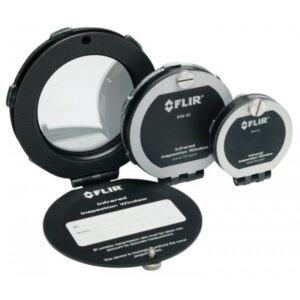
The FLIR IRW large format series takes a different approach from small round windows. Instead of a crystal lens, it uses an impact-resistant polymer optic, and that material is what makes a window this size practical. The largest model has a viewing aperture 53 cm wide, which can cover a long row of terminations or a full run of busbar joints from one port.
That matters when you’re building an inspection route. A wider view can mean fewer windows per panel and fewer blind spots, and it brings in components that a smaller port might not reach. Before you commit, map your targets against the aperture sizes below and confirm the sightlines on the actual board.
The optic isn’t only for thermal work. It transmits visual, ultraviolet, midwave IR and longwave IR, so the same port can support a look-through visual check or a UV inspection as well as your regular thermal route.
Behind the polymer sits a reinforcing metal grille that meets the IP2x standard for maximum opening size. In plain terms, that’s the finger-safe protection level, designed to keep a fingertip or an object of 12.5 mm or larger out of the live compartment. A lockable cover protects the viewing pane between inspections from dust, knocks and flying debris.
Aluminium or Stainless Steel: Which One Do You Need?
The material choice comes down to where the window will live.
Aluminium body (IRW-12PC, IRW-24PC) is FLIR’s recommendation for indoor installations. It’s rated IP65 / NEMA 4X, with a maximum operating temperature of 200°C. It’s also the lighter option, which helps if you’re fitting a batch across a plant room, MCC or switch room.
Powder-coated stainless steel body (IRW-6PS, IRW-12PS, IRW-24PS) is the one FLIR recommends for outdoor work. It steps up to IP67 / NEMA 6 and a 273°C maximum operating temperature, and it uses a stainless steel reinforcing grille. It suits kiosks, pad-mounted transformers, and sites where weather, washdown or corrosive atmospheres would be hard on a lighter build. The stainless versions also carry a broader list of IEEE and IEC approvals, covered further down.
Quick rule of thumb: indoors in a controlled switch room, start with aluminium. Outdoors or anywhere harsh, go stainless. The 6 in size is available here in stainless only.
Choosing the Right Size
The 6, 12 and 24 in names refer to the window’s approximate overall width. The viewing aperture is smaller, so always size your window from the aperture.
| Size | Models | Overall (H × W) | Viewing aperture (H × W) | A good fit for |
|---|---|---|---|---|
| 6 in | IRW-6PS | 21.8 × 16 cm | 15 × 9.1 cm | Narrow, tall sections and compact outdoor enclosures |
| 12 in | IRW-12PC, IRW-12PS | 20.6 × 30.5 cm | 12.7 × 23.6 cm | Single breaker sections and grouped terminations |
| 24 in | IRW-24PC, IRW-24PS | 21.8 × 61 cm | 15 × 53 cm | Long busbar runs and wide switchgear sections |
Built to Stay Put for the Long Haul
An IR window becomes part of the enclosure, so it needs to last as long as the switchgear around it. FLIR specifies these windows with fully impact-resistant optics, 316 stainless steel fixing hardware and a UL 94 5VA-rated gasket. The polymer has been shown to stand up to acids, alkalis, UV, moisture, humidity, vibration and high-frequency noise, and the optic is rated from −40°C to 325°C.
The window suits any system voltage, including medium and high voltage applications, and FLIR lists it as automatically grounded. It still needs to be installed with proper electrical clearances, and your usual earth continuity checks still apply.
FLIR backs the range with a limited lifetime warranty.
Getting Accurate Temperatures Through the Window
This is the part that catches people out. Any window between your camera and the target absorbs some of the infrared signal, and if you don’t compensate for it, your temperature readings will come in low.
FLIR’s installation manual asks you to determine the transmission rate of the window you’re fitting and write it on the IR window label supplied in the box. That label also has space for the number of targets and their emissivity, plus a pre-printed barcode so each window can be uniquely identified. Enter the transmission value in your camera before you measure.
The fixed, stable transmission of the optic is what makes repeat readings comparable over time, which is the basis of good trending. Because the value can vary with your camera, measure it with the instrument you’ll be using on the route, and redo the check if you change cameras. Also note that the reinforcing grille sits across the viewing area, so it’s worth trialling your camera and lens on the first window you fit.
Installation: Read This Before You Cut
Caution: These dimensions are not installation dimensions. Do NOT cut prior to receiving your FLIR window and installation template.
Each window goes onto a flat, vertical surface using the fitting template. FLIR’s manual calls for a nibbler or angle grinder, a drill with an 8 mm (5/16 in) bit, a centre punch, a deburring tool, a 7/16 socket or wrench, and an anti-corrosion treatment for the cut edges, plus gloves, safety glasses and your site PPE.
Plan the job for a shutdown, with the panel isolated and the door removed if you can, so swarf stays well away from live parts. Cutting into a board can also affect its IP rating, arc performance or type-test status, so talk to the board manufacturer or your engineer first.
Where These Windows Earn Their Keep
- Industrial switch rooms and MCCs: add wide-view ports to high-priority sections and shorten routine thermal rounds.
- Utility and distribution assets: monitor switchgear and transformers, with stainless models for outdoor kiosks and pad-mounted gear.
- Data centres and critical power: check power distribution with less disturbance to live, high-availability systems.
- Food and beverage manufacturing: keep inspection routes running on plant that’s expensive to stop.
- Ships, offshore and port facilities: the range carries Lloyd’s, ABS and DNV approvals for maritime and offshore use.
Approvals and Certifications
FLIR lists the following approvals. They differ by body material, so check the right column for your project.
| Approval | Aluminium (PC) | Stainless steel (PS) |
|---|---|---|
| UL / cUL | UL 50V, 50E, 1558, 508A | UL 50V, 50E, 746C, 746A-2012, 1558, 508A |
| CSA | C22.2 No. 14-13 | C22.2 No. 14-13, No. 14-10, No. 94-M91, No. 94.1-07, No. 94.2-07 |
| IEEE | C37.20.2.a.3.6 (impact and load) | C37.20.7 Type 2B; C37.20.2.a.3.6 (impact and load) |
| IEC | Not listed | 62271-200, 60298 Appendix A, 60068-2-6:2007, 60068-2-3, 60068-2-78:2012 |
| Marine | Lloyd’s Type Approval, ABS, DNV | Lloyd’s Type Approval, ABS, DNV |
| Quality system | BSI ISO 9001 | Not listed |
| Enclosure rating | IP65 / NEMA 4X | IP67 / NEMA 6 |
These are mainly North American, marine and IEC approvals. If your job specifies a particular Australian standard or a type-tested board, confirm acceptance with the board manufacturer or your engineer before you cut.
Technical Specifications
Specifications by variation
| Specification | IRW-12PC | IRW-24PC | IRW-6PS | IRW-12PS | IRW-24PS |
|---|---|---|---|---|---|
| Body material | Aluminium | Aluminium | Powder-coated stainless steel | Powder-coated stainless steel | Powder-coated stainless steel |
| Recommended use | Indoor | Indoor | Outdoor | Outdoor | Outdoor |
| Overall height | 20.6 cm (8.1 in) | 21.8 cm (8.6 in) | 21.8 cm (8.6 in) | 20.6 cm (8.1 in) | 21.8 cm (8.6 in) |
| Overall width | 30.5 cm (12.0 in) | 61 cm (24.0 in) | 16 cm (6.3 in) | 30.5 cm (12.0 in) | 61 cm (24.0 in) |
| Aperture height | 12.7 cm (5.0 in) | 15 cm (5.9 in) | 15 cm (5.9 in) | 12.7 cm (5.0 in) | 15 cm (5.9 in) |
| Aperture width | 23.6 cm (9.3 in) | 53 cm (20.9 in) | 9.1 cm (3.6 in) | 23.6 cm (9.3 in) | 53 cm (20.9 in) |
| Cut-out, long × short side (use the supplied template) | 262 × 164 mm | 568 × 176 mm | 177 × 119 mm | 262 × 164 mm | 568 × 176 mm |
| IP / NEMA rating | IP65 / NEMA 4X | IP65 / NEMA 4X | IP67 / NEMA 6 | IP67 / NEMA 6 | IP67 / NEMA 6 |
| Max. operating temperature | −40°C to 200°C | −40°C to 200°C | −40°C to 273°C | −40°C to 273°C | −40°C to 273°C |
| Reinforcing grille | Aluminium | Aluminium | Stainless steel | Stainless steel | Stainless steel |
| Approx. weight | 0.9 kg (2 lb) | 1.8 kg (4 lb) | Not published | 2.3 kg (5 lb) | 4.5 kg (10 lb) |
Caution: These dimensions are not installation dimensions. Do NOT cut prior to receiving your FLIR window and installation template.
Common specifications and why they matter
| Specification | Value | Why It Matters |
|---|---|---|
| Optic material | UL 746 compliant polymer; transmits visual, UV and IR | Impact resistance allows a large window, and one port can serve several inspection methods |
| Optic temperature range | −40°C to 325°C | Applies to the optic only. The body’s lower maximum operating temperature sets the limit for the window as a whole |
| Inspection spectrum | Midwave IR, longwave IR, UV, visual | Works with common thermal cameras and other inspection tools, subject to a sightline check |
| Grille rating | IP22 / IP2x | Keeps fingers and objects of 12.5 mm or larger out of the live compartment |
| Voltage range | Any, including medium and high voltage applications | Can be specified across LV, MV and HV assets. Electrical clearances still apply |
| Automatically grounded | Yes | Designed to bond with the enclosure as fitted. Confirm with your usual earth continuity check |
| Gasket | UL 94 5VA TPE; −40°C to 273°C | Maintains the seal and adds flame-resistance credentials |
| Hardware | 316 stainless steel | Resists corrosion over the long service life of a fixed installation |
| Cover | Lockable | Protects the pane from debris, dust and impact between inspections |
| Compatibility | Acids, alkalis, UV, moisture, humidity, vibration, high-frequency noise | Helps keep the optic stable in harsh industrial settings |
| Warranty | Limited lifetime | Suits a component meant to stay in place for the life of the equipment |
What’s in the box
- FLIR IRW large format IR window (selected model)
- Fitting template and installation instructions
- IR window label
- Fitting hardware
| SKU | Variation name | Body Material | Size | Variation description |
|---|---|---|---|---|
| IRW-12PC | FLIR Aluminium Large Format IR Inspection Window 12 in | Aluminium | 12 in | Indoor use. IP65 / NEMA 4X, 23.6 × 12.7 cm (W × H) viewing aperture, up to 200°C. |
| IRW-24PC | FLIR Aluminium Large Format IR Inspection Window 24 in | Aluminium | 24 in | Indoor use. IP65 / NEMA 4X, 53 × 15 cm (W × H) viewing aperture, up to 200°C. |
| IRW-6PS | FLIR Stainless Steel Large Format IR Inspection Window 6 in | Stainless Steel | 6 in | Outdoor use. IP67 / NEMA 6, 9.1 × 15 cm (W × H) viewing aperture, up to 273°C. |
| IRW-12PS | FLIR Stainless Steel Large Format IR Inspection Window 12 in | Stainless Steel | 12 in | Outdoor use. IP67 / NEMA 6, 23.6 × 12.7 cm (W × H) viewing aperture, up to 273°C. |
| IRW-24PS | FLIR Stainless Steel Large Format IR Inspection Window 24 in | Stainless Steel | 24 in | Outdoor use. IP67 / NEMA 6, 53 × 15 cm (W × H) viewing aperture, up to 273°C. |
What is an infrared inspection window?
An infrared inspection window is a permanent viewing port fitted to an electrical enclosure. It lets a technician inspect live equipment with a thermal camera while the door stays closed. FLIR’s IRW large format windows use a rectangular polymer optic that also passes UV and visible light.
Which FLIR IR window should I use outdoors?
Use a stainless steel IRW-xPS model. FLIR recommends the IRW-6PS, IRW-12PS and IRW-24PS for outdoor applications. They’re rated IP67 / NEMA 6, with a maximum operating temperature of 273°C. FLIR recommends the aluminium IRW-xPC models, rated IP65 / NEMA 4X, for indoor use.
What size IR window do I need for switchgear?
Choose the size by viewing aperture, not the nominal size. Height by width, the IRW 6 in aperture is 15 × 9.1 cm, the 12 in is 12.7 × 23.6 cm, and the 24 in is 15 × 53 cm. Check that every target is visible from your likely camera position.
Do you need to adjust a thermal camera when using an IR window?
Yes. An IR window reduces the infrared energy reaching the camera, so readings will be low unless you compensate. Determine the window’s transmission rate, record it on the supplied label, and enter it in your camera’s settings before measuring.
Does an IR window remove the need for arc flash PPE?
Not automatically. Keeping the door closed reduces exposure during inspection, but PPE requirements come from your site’s risk assessment and safety procedures. An IR window also doesn’t make a board arc-rated by itself, so have the installation and work method reviewed by your safety lead.
FAQ
What’s the difference between the FLIR IRW-xPC and IRW-xPS?
The IRW-xPC has an aluminium body and aluminium grille, is rated IP65 / NEMA 4X, and operates up to 200°C. FLIR recommends it for indoor use. The IRW-xPS has a powder-coated stainless steel body and stainless grille, is rated IP67 / NEMA 6, and operates up to 273°C. FLIR recommends it for outdoor use.
Which thermal cameras work with FLIR IRW large format windows?
The windows are specified for midwave and longwave infrared, as well as ultraviolet and visual inspection. They aren’t limited to one camera model, but you’ll need to determine the transmission rate with your own camera and check the view through the reinforcing grille.
Does the 6 in, 12 in or 24 in size refer to the viewing area?
No. It refers to the window’s approximate overall width. For example, the 24 in models are 61 cm wide overall, with a 53 cm wide viewing aperture. Use the aperture dimensions when working out what you’ll be able to see.
Can I cut the panel using the dimensions on this page?
No. These dimensions are not installation dimensions. Do NOT cut prior to receiving your FLIR window and installation template. The cut-out sizes listed are only there to help you check whether a window could fit your panel.
What tools do I need to install a FLIR IRW window?
FLIR’s manual lists a nibbler or angle grinder, a drill with an 8 mm (5/16 in) bit, a centre punch, a deburring tool, a 7/16 socket or wrench, and an anti-corrosion treatment for cut metal. You’ll also need gloves, safety glasses and your site’s required PPE.
Can these windows be used on medium and high voltage equipment?
Yes. FLIR lists the voltage range as any and specifies the series for medium and high voltage applications. The installation still needs to maintain the correct electrical clearances, so have it reviewed by the board manufacturer or a qualified engineer.
Are these windows approved for marine and offshore use?
FLIR lists Lloyd’s Type Approval, American Bureau of Shipping (ABS) and DNV approval for both body materials, with DNV covering maritime, vessel and offshore applications. If your vessel or class society has a specific requirement, confirm the current certificate before ordering.
Do they meet Australian standards?
FLIR’s published documentation lists UL, cUL, CSA, IEEE, IEC and marine approvals, but doesn’t list a specific Australian standard. If your project specifies one, confirm acceptance with your engineer or the board manufacturer. Our team can help you source the manufacturer documents you need.
| Product Variations | IRW-6PS, IRW-12PS, IRW-24PS, IRW-12PC, IRW-24PC |
|---|
Be the first to review “FLIR Large Format IR Inspection Windows | IRW-12PC, IRW-24PC, IRW-6PS, IRW-12PS, IRW-24PS”
You must be logged in to post a review.
All Thermal Imagers / Infrared Cameras
All Thermal Imagers / Infrared Cameras
All Thermal Imagers / Infrared Cameras FLIR E6 Pro Thermal Infrared Camera | with Ignite™ Cloud 240 × 180px
All Thermal Imagers / Infrared Cameras FLIR E5 Pro Thermal Infrared Camera |- Pro-Series with MSX, 160 × 120
All Thermal Imagers / Infrared Cameras
All Thermal Imagers / Infrared Cameras
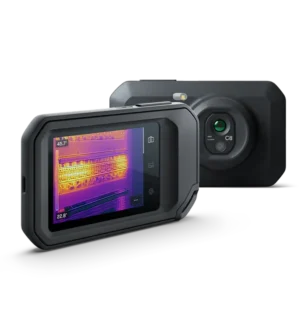
All Thermal Imagers / Infrared Cameras FLIR C8 Compact Thermal Imaging Camera | 320×240 pixels High-ResolutionRelated Products

Next day delivery
Finance services
Price Match
Technical support
Product training
Calibration servises
Need help? Call our support team 1800 358 531
Reviews
There are no reviews yet.