



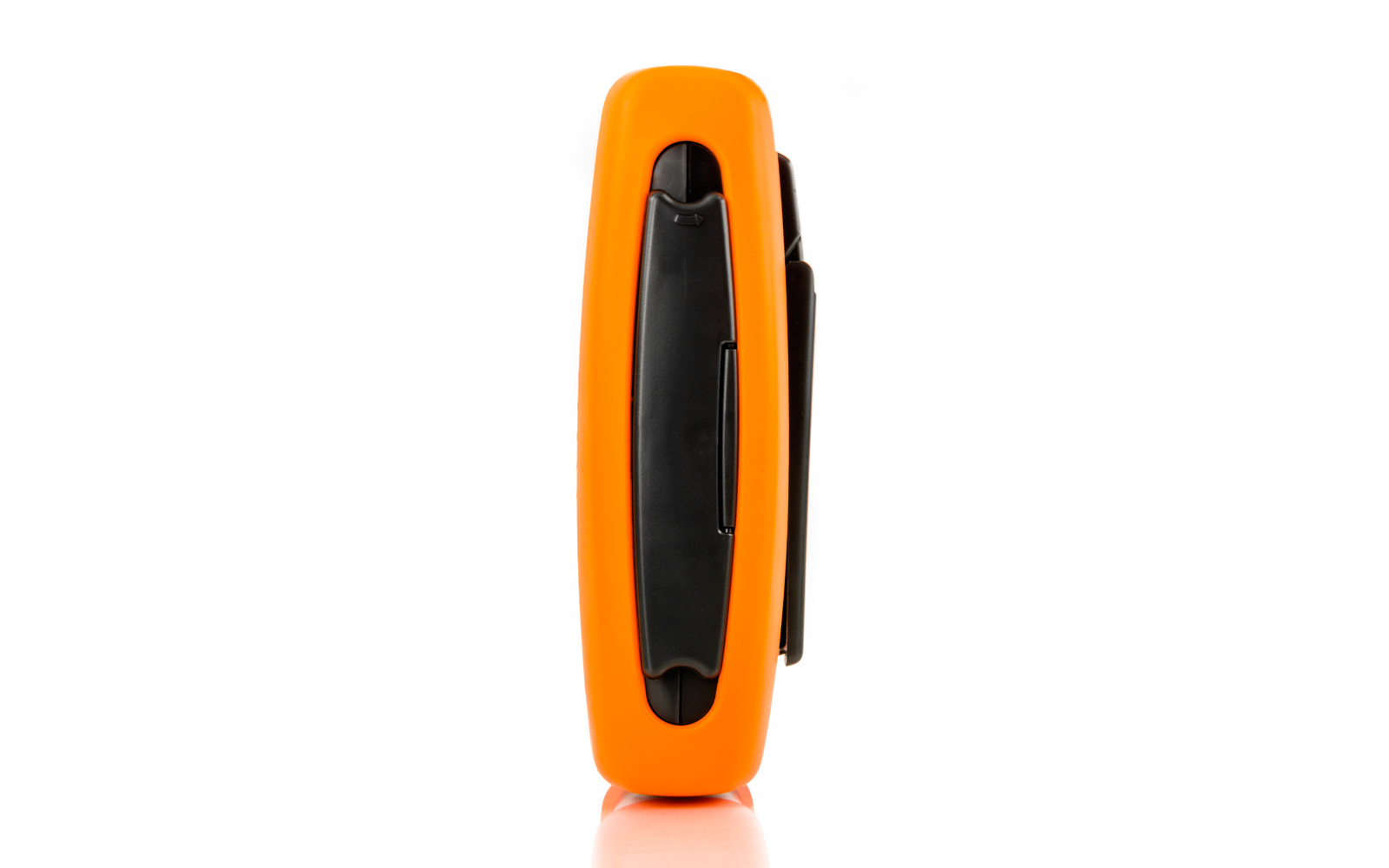
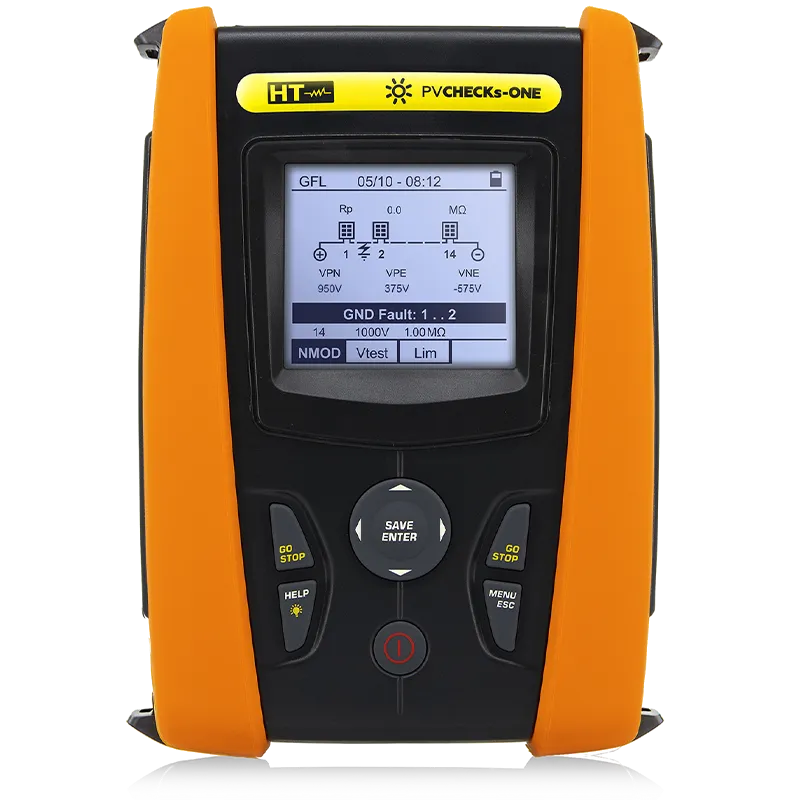
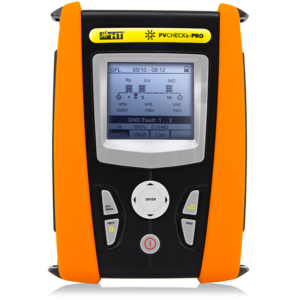
HT Instruments PVCHECKs PV Commissioning Tester
$2,400.00 .( $2,640.00 inc. GST )
For all your equipment calibration needs, visit our MyCalibration website.
 Free Delivery on orders over $1000
Shipping time may vary for certain products*

Product Enquiry
If you would like more information regarding this product, simply email us here.

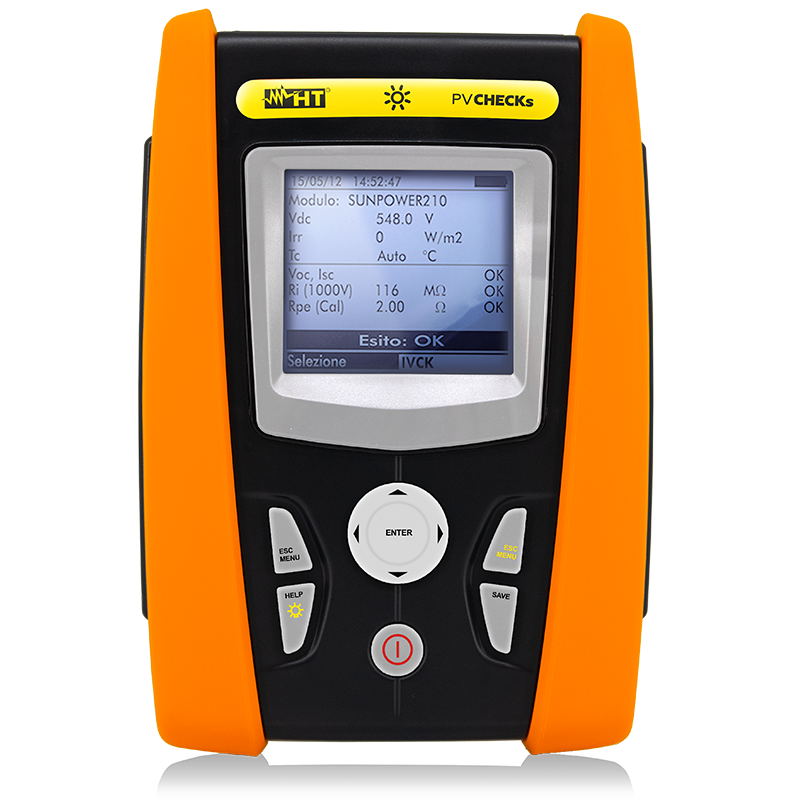
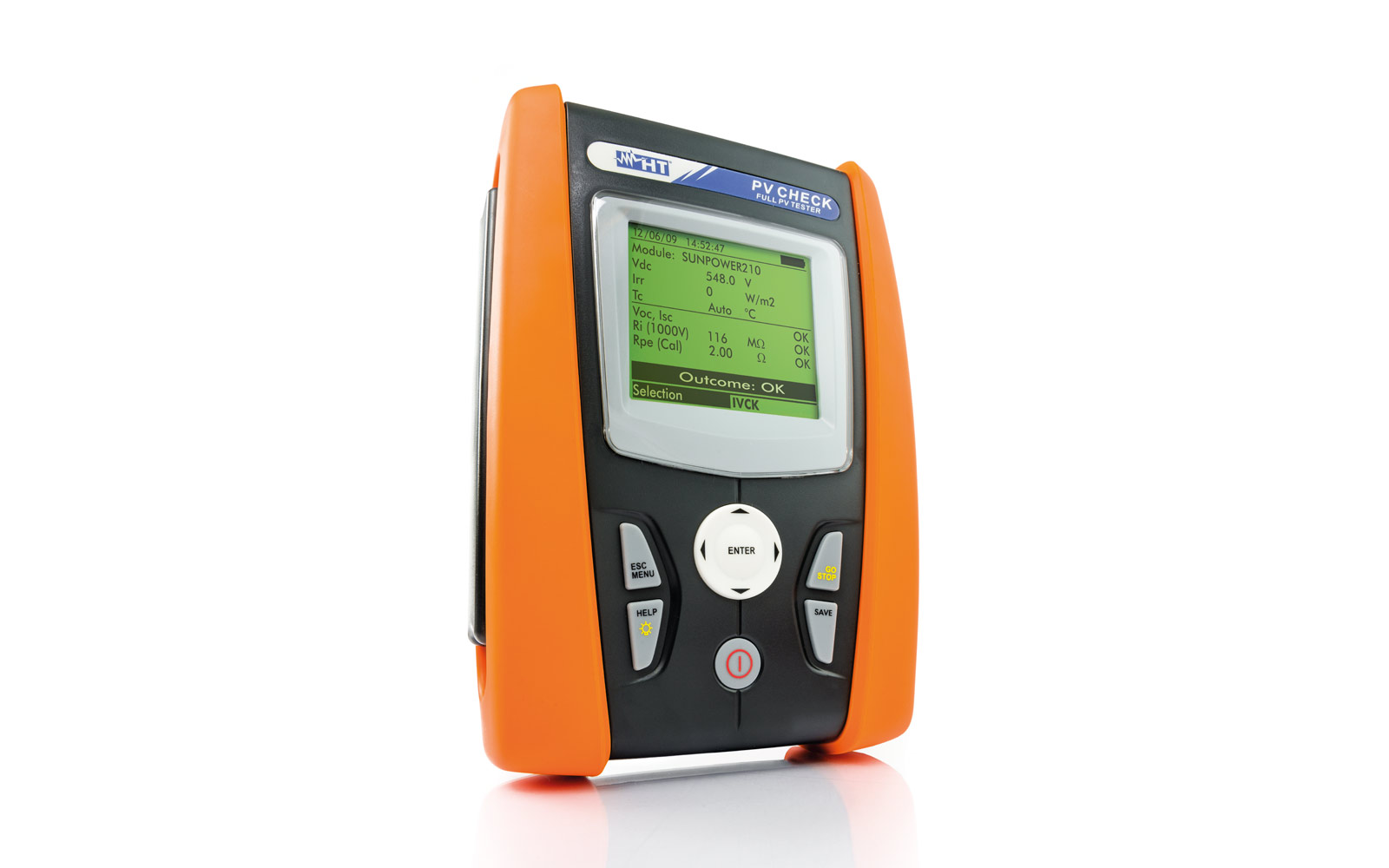
The HT Instruments PVCHECKs is a handheld PV commissioning tester that measures insulation resistance up to 1000 V DC, Voc and Isc (up to 15 A), protective conductor continuity at 200 mA and DC-side power in one test sequence. No external short-circuit switch needed. Built around IEC/EN 62446 for solar installers and electrical contractors, with MC4 adapters, test leads, carry bag and calibration report in the kit. Request a quote for stock and delivery across Australia.
 PVCheck Brochure
PVCheck Datasheet
PVCheck User Manual
Commissioning a PV system shouldn’t take a bag full of separate testers
If you’ve commissioned a string of panels before, you know the routine. An insulation tester for the DC cables, a multimeter for Voc, a clamp or a short-circuit switch for Isc, a low-ohms meter for the earth bonding, and a notebook to tie it all together. Each swap of gear is another chance to make a wiring mistake on a live DC array, and another few minutes on a roof in the sun.
The HT Instruments PVCHECKs pulls those checks into one instrument. It’s a multifunction PV tester designed around the commissioning and verification tests described in IEC/EN 62446, covering the DC side of a photovoltaic system: insulation resistance, open-circuit voltage, short-circuit current, protective conductor continuity and DC power/efficiency.
One instrument, one test sequence, and your gear sorted.
Insulation testing without the short-circuit switch
This is the headline feature. Traditionally, testing the insulation resistance of a PV array means shorting the positive and negative conductors together with an external switch, then testing between that shorted pair and earth. It works, but it’s one more piece of kit and one more thing to get wrong.
PVCHECKs measures insulation resistance of a module, a string or a whole PV field with no external switch to short-circuit the positive and negative terminals. One button, whole field. In FIELD mode, the result gives you three values: the total parallel resistance, the positive pole resistance and the negative pole resistance. That split matters when you’re chasing a fault, because it tells you which side of the array the problem lives on.
Test voltages are selectable at 250 V, 500 V and 1000 V DC, so you can match the test to the system voltage and your test plan. Timer mode is also available when you want a classic timed insulation test.
Voc and Isc under operating conditions, up to 15 A
The second half of commissioning is proving the strings actually perform. PVCHECKs measures open-circuit voltage (Voc) and short-circuit current (Isc) on modules and strings under operating conditions, with Isc measurement up to 15 A.
Add irradiance and cell temperature measurement and the instrument can refer the results to Standard Test Conditions (STC). That gives you a like-for-like number to compare against the module database and against the other strings you’ve already tested. The display shows the result straight away, both in absolute terms and compared with previously tested strings, so a weak string stands out while you’re still on site.
For the irradiance and temperature side, HT Instruments offers optional accessories: the SOLAR-02 remote unit (irradiance, temperature and tilt, linked to the tester by wireless RF), the HT304k reference cell, and the PT300N panel temperature probe. These are optional extras and are not part of the base instrument.
Automatic IVCK test sequence
PVCHECKs includes an automatic IVCK test that runs Voc, Isc, insulation and continuity measurements on a PV module or string in a single sequence, with or without irradiance measurement. HT Instruments states that everything IEC/EN 62446 requires can be measured in about 30 seconds with its AUTOTEST function. On a site with dozens of strings, that adds up to real time saved, and fewer opportunities to miss a test.
Continuity of protective conductors at 200 mA
The earth bonding of a PV array is a safety-critical connection, and PVCHECKs checks it with a test current of at least 200 mA DC (up to 2 Ω, test leads included). It’s built into the same instrument, so you don’t need to carry a separate low-ohms tester for this one job.
DC-side power and efficiency checks
Once the array is connected to the inverter, PVCHECKs can analyse the performance of the DC section under real operating conditions. It measures DC voltage and current at the same time, and with irradiance and module temperature added it reports the power loss on the DC side. The DC current measurement uses an external clamp, and the HT4004 (optional) is the matching AC/DC clamp for the job.
You can log with a selectable integration period from 5 seconds to 60 minutes, and the instrument can track up to five parameters at once.
A typical PVCHECKs workflow on site
Here’s how the instrument fits into a real commissioning day. Every step below uses functions listed in the manufacturer’s datasheet.
- Set up the module. Pick the PV module from the on-board database (or add it from your PC with TopView) so the instrument knows what to compare your readings against.
- Check the earth bonding. Run the continuity test on the protective conductors with the 200 mA test current, using the supplied leads.
- Test insulation. Choose 250, 500 or 1000 V DC and run the FIELD, STRING or Timer test, depending on whether you’re checking the whole array, a single string or a specific circuit.
- Check the strings. Connect through the MC4 adapters and run the IVCK test for Voc and Isc. Add the optional irradiance and temperature accessories if you want results referred to STC.
- Look at the live system. With the array connected to the inverter, run the DC power and efficiency test using an external DC clamp and the irradiance and temperature accessories.
- Save and download. Store the results (up to 999 tests), then pull them into your PC through the optical/USB cable for reporting.
That’s one instrument and one set of connections for the whole DC-side sequence. Fewer lead swaps means less time on the roof and fewer chances for a wiring slip.
Faultfinding on existing systems
PVCHECKs isn’t just a handover tool. On an array that’s already running, the same functions help you chase down underperformance. A weak string shows up when its Voc and Isc are compared with the strings you’ve already tested. A drifting insulation reading, split into positive and negative pole values, tells you which side of the array to inspect first. And the DC-side power and efficiency check shows whether the array is delivering what the irradiance and module temperature say it should. For maintenance teams and service contractors, that’s a handy first-pass diagnostic before you escalate to more specialised equipment.
Module database: from your PC to your tester
PVCHECKs stores a custom database of PV modules. You can add, modify or delete modules directly on the instrument, or manage the list on your PC using the TopView software, which is included. When you’re testing a site with a specific module model, calling up its parameters beats typing them in every time.
Built for the field
- Display: 128 x 128 pixel LCD with backlight, plus on-screen help
- Memory: up to 999 stored tests, with a PC interface and Windows software for downloading results and building reports
- Power: 6 x AA alkaline batteries, with approximately 120 hours of battery life in the DC efficiency test (per the manufacturer’s datasheet)
- Size and weight: 235 x 165 x 75 mm and 1.2 kg with batteries, with a soft carry bag in the kit
- Connections: banana leads, with an MC4 banana-to-MC4 adapter set (male/female) supplied so you can plug straight into the most common PV connector
What’s in the box
According to the manufacturer, the standard accessories listed for the PVCHECKs are:
- User manual and quick guide
- Calibration report
- BORSA2051 carry bag
- KITPCMC4 banana to MC4 adapters (male/female)
- KITGSC4 cable set with alligator clips (black, red, green, blue; 2 m; 20 A / 1000 V; CAT III 1000 V)
- C2006 optical/USB cable and downloadable TopView software
Optional accessories sold separately include the SOLAR-02 remote unit, HT304k reference cell, PT300N temperature probe, HT4004 DC clamp, KITPCMC3 (MC3) adapters, KITPVEXT25M 25 m extension cable set, 607-IECN magnetic test connector, M304 mechanical inclinometer and the SP-0400 shoulder strap set.
Safety ratings: read these before you connect
The PVCHECKs is rated CAT III 300 V to ground, with a maximum of 1000 V DC between inputs. Pollution degree 2, double insulation. The supplied lead set is rated CAT III 1000 V. Always confirm your site voltages against these ratings, and follow the instrument’s user manual.
Know before you buy: module efficiency limit
One important note from the manufacturer for IVCK testing:
Do not use the instrument for IVCK tests on PV modules with efficiency >19%. Check the technical characteristics of the PV modules before carrying out the tests in order to avoid possible damage to the instrument
Many modern modules exceed 19% efficiency, so check your module datasheets against this limit before you commit. Not sure? Ask us. It takes two minutes and saves a headache on site.
Who is the PVCHECKs for?
- Solar installers commissioning residential, commercial and ground-mount systems
- Electrical contractors adding PV verification to their service offering
- Maintenance teams troubleshooting underperforming strings on existing arrays
- TAFE, RTO and training providers teaching PV commissioning with a purpose-built tester
Standards and compliance
The PVCHECKs is designed around the test requirements of IEC/EN 62446 (PV system verification and performance checks, including IVCK), and its safety and continuity/insulation functions refer to IEC/EN 61557-1, -2 and -4. Instrument safety is to IEC/EN 61010-1, and the manufacturer declares conformity with the EU Low Voltage Directive (2014/35/EU), EMC Directive (2014/30/EU), RoHS (2011/65/EU) and WEEE (2012/19/EU) directives.
Why buy your PVCHECKs from us
We’re not just a box-shifter. We understand the tools you work with, and we’ll help you match the right tester, accessories and calibration support to your jobs. Need the irradiance kit, a clamp for DC power measurement, or a MC3 adapter set? We’ll quote it all together so you get a complete testing setup, not a surprise missing lead on the day.
Request a quote for stock, delivery and accessory bundles.
Technical Specifications
Source: HT Instruments PVCHECKs datasheet Rel. 3.01, 15/05/25. Accuracy is ±[% reading + digits] at 23 °C ± 5 °C, <80 %RH.
| Specification | Value | Why It Matters |
|---|---|---|
| Insulation test voltages | 250 V, 500 V, 1000 V DC | Match the test voltage to the system and your test plan |
| Insulation range (Timer mode) | 0.01 to 199 MΩ (res. 0.01 / 0.1 / 1 MΩ) | Wide range for classic timed insulation checks |
| Insulation accuracy (Timer mode) | ±(5.0% rdg + 5 dgt) | Know how far to trust a pass/fail result |
| Insulation range (FIELD / STRING mode) | 0.1 to 99 MΩ (res. 0.1 MΩ up to 1.9 MΩ, then 1 MΩ) | Whole-array insulation measurement without a short-circuit switch |
| Insulation accuracy (FIELD / STRING mode) | ±(20.0% rdg + 5 dgt); add 5 dgt in FIELD mode if Max(R+, R-) / Min(R+, R-) ≥ 100 | Understand the tolerance in field-mode measurements |
| Insulation test current | >1 mA into 1 kΩ per volt of nominal test voltage; short-circuit current <15 mA (peak) | Sets the test load and current limit on the DC conductors under test |
| Minimum VPN to start STRING test | 15 V | Confirms the string is live enough to test |
| Continuity range | 0.00 to 199 Ω (res. 0.01 / 0.1 / 1 Ω) | Covers protective conductor and bonding checks |
| Continuity accuracy | ±(2.0% rdg + 2 dgt) | Reliable low-ohms readings |
| Continuity test current | >200 mA DC up to 2 Ω (test leads included), res. 1 mA, ±(5.0% rdg + 5 dgt); open loop voltage 4 to 10 V | 200 mA test current for protective conductor checks |
| Voc (@ OPC) range | 5.0 to 999 V (res. 0.1 V up to 199.9 V, then 1 V) | Verifies string voltage against expected values |
| Voc (@ OPC) accuracy | ±(1.0% rdg + 2 dgt) | Tight enough to spot a missing or reversed module |
| Isc (@ OPC) range | 0.10 to 15.00 A (res. 0.01 A) | Covers typical string currents |
| Isc (@ OPC) accuracy | ±(1.0% rdg + 2 dgt) | Spot underperforming strings |
| Voc and Isc (@ STC) accuracy | ±(4.0% rdg + 2 dgt) | Extrapolated to Standard Test Conditions for like-for-like comparison |
| Minimum VPN voltage to start IVCK test | 15 V | Ensures the string is generating enough to test |
| DC voltage (performance test) | 5.0 to 999.9 V, ±(1.0% rdg + 2 dgt) | DC-side power analysis |
| DC power (Vmeas > 150 V) | By external clamp; ±(1.5% rdg + 3 dgt) below 10% of clamp FS, ±1.5% rdg at or above 10% FS | Measures generated DC power and efficiency |
| Irradiance (via HT304k, optional) | 1 to 40.0 mV input, ±(1.0% rdg + 0.1 mV) | Needed for STC correction and DC efficiency tests |
| Temperature (via PT300N, optional) | -20.0 to 100.0 °C, ±(1.0% rdg + 1 °C) | Module temperature for STC correction |
| Recording | Selectable integration period 5 s to 60 min; up to 5 parameters | Logs performance over time |
| Display | 128 x 128 pixel custom LCD, backlit | Readable on site, with on-screen help |
| Memory | Up to 999 tests | Store a full site’s results |
| PC interface | Optical/USB, TopView software (Windows) | Download results and build reports |
| Remote unit link (SOLAR-02) | Wireless RF, 2.400 to 2.4835 GHz, max distance 1 m | Cable-free irradiance and temperature data |
| Power supply | 6 x 1.5 V AA alkaline (LR06) | Easy to replace in the field |
| Battery life | Approx. 120 hours (DC efficiency test) | Full jobs without worrying about charge |
| Safety rating | CAT III 300 V to ground; max 1000 V DC between inputs | Know your limits before connecting |
| Protection and insulation | IP40, double insulation, pollution degree 2 | Indoor/protected-use enclosure |
| Operating environment | 0 to 40 °C, <80 %RH, up to 2000 m | Typical working conditions |
| Storage | -10 to 60 °C (batteries removed), <80 %RH | Safe transport and storage |
| Dimensions and weight | 235 x 165 x 75 mm; 1.2 kg with batteries | Portable on a roof |
| Reference standards | IEC/EN 61010-1, IEC/EN 61326-1, IEC/EN 61010-031, IEC/EN 62446, IEC/EN 61557-1, -2, -4 | Design basis for safety and PV testing |
| Manufacturer code | HV00PVCS | Reference for ordering and support |
What does the HT Instruments PVCHECKs test?
The PVCHECKs tests the DC side of a solar PV system. It measures insulation resistance (250, 500 and 1000 V DC), open-circuit voltage and short-circuit current up to 15 A, protective conductor continuity at 200 mA, and DC-side power and efficiency, following the test approach of IEC/EN 62446.
How do you test insulation resistance on a solar array without a short-circuit switch?
The PVCHECKs measures PV insulation resistance without an external switch to short-circuit the positive and negative conductors. In FIELD mode it returns the total parallel resistance plus separate positive and negative pole values, so you can see which side of the array has the problem.
What is an IVCK test on a PV string?
An IVCK test is a functionality check that measures a string’s open-circuit voltage (Voc) and short-circuit current (Isc) under operating conditions. The PVCHECKs automates it in one sequence with insulation and continuity measurements, and can refer results to STC when irradiance and temperature are measured.
Does the PVCHECKs trace full I-V curves?
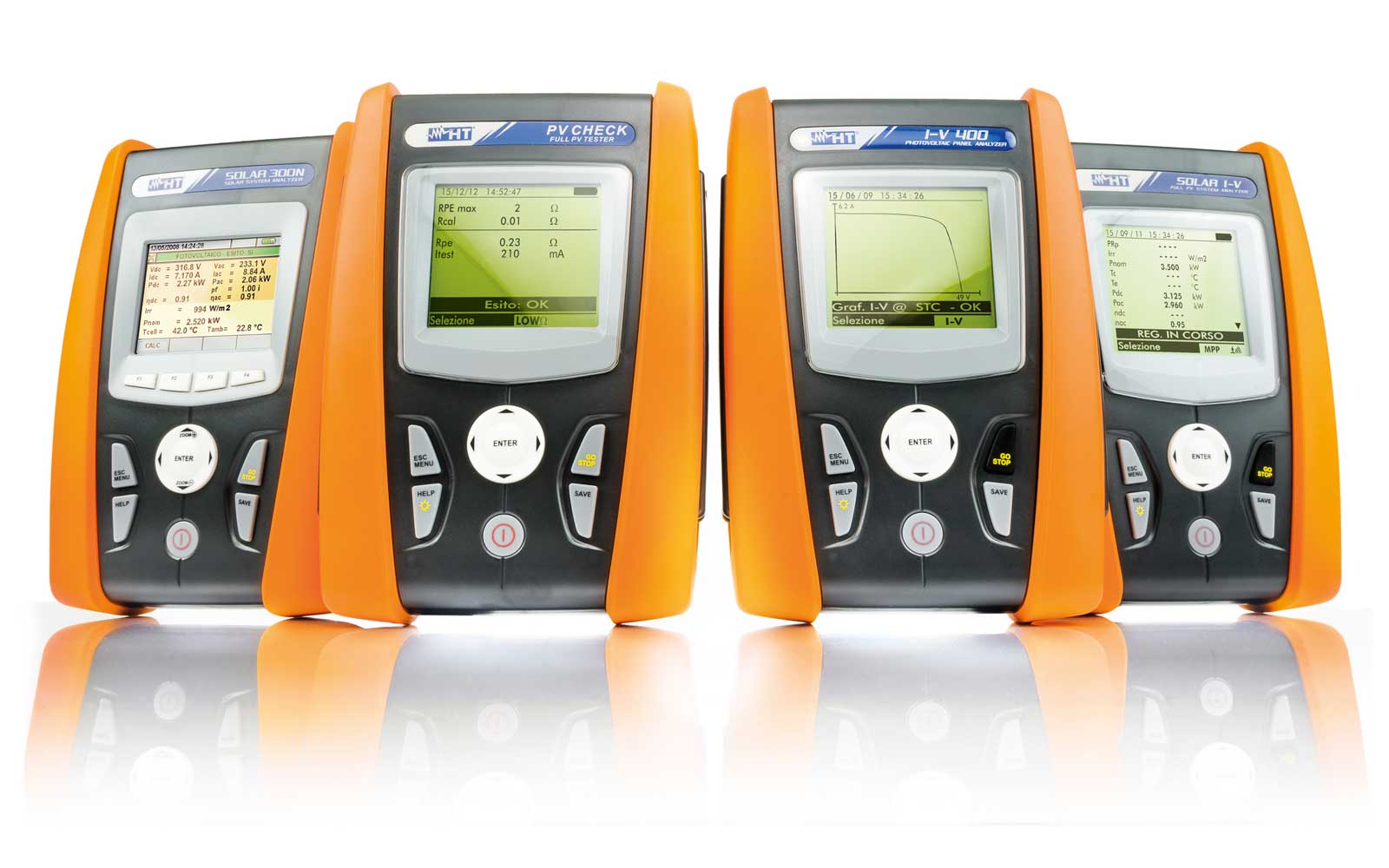
No. The PVCHECKs measures Voc and Isc only, not a full I-V curve. If you need complete I-V curve tracing, HT Instruments lists separate I-V curve tracers (such as the I-V500w and SOLAR I-Ve) in its photovoltaic range.
Can the PVCHECKs test modules above 19% efficiency?
The manufacturer warns not to use the instrument for IVCK tests on PV modules with efficiency above 19%, because of possible damage to the instrument. Check your module datasheets before testing and contact us if you’re unsure.
What accessories do you need for irradiance and temperature measurement?
For STC-referred results and DC efficiency tests, HT Instruments offers the SOLAR-02 remote unit or the HT304k reference cell, plus the PT300N temperature probe. DC power measurement also needs an external DC clamp such as the HT4004. All are optional extras.
Be the first to review “HT Instruments PVCHECKs PV Commissioning Tester”
You must be logged in to post a review.
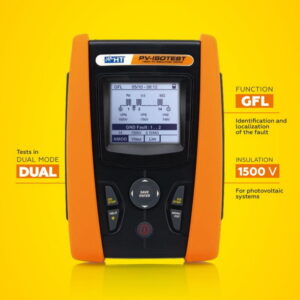
HT Instruments HT Instruments PV-ISOTEST Multifunction Tester for Photovoltaic Systems Up to 1,500V DCRelated Products

Next day delivery
Finance services
Price Match
Technical support
Product training
Calibration servises
Need help? Call our support team 1800 358 531


Reviews
There are no reviews yet.