


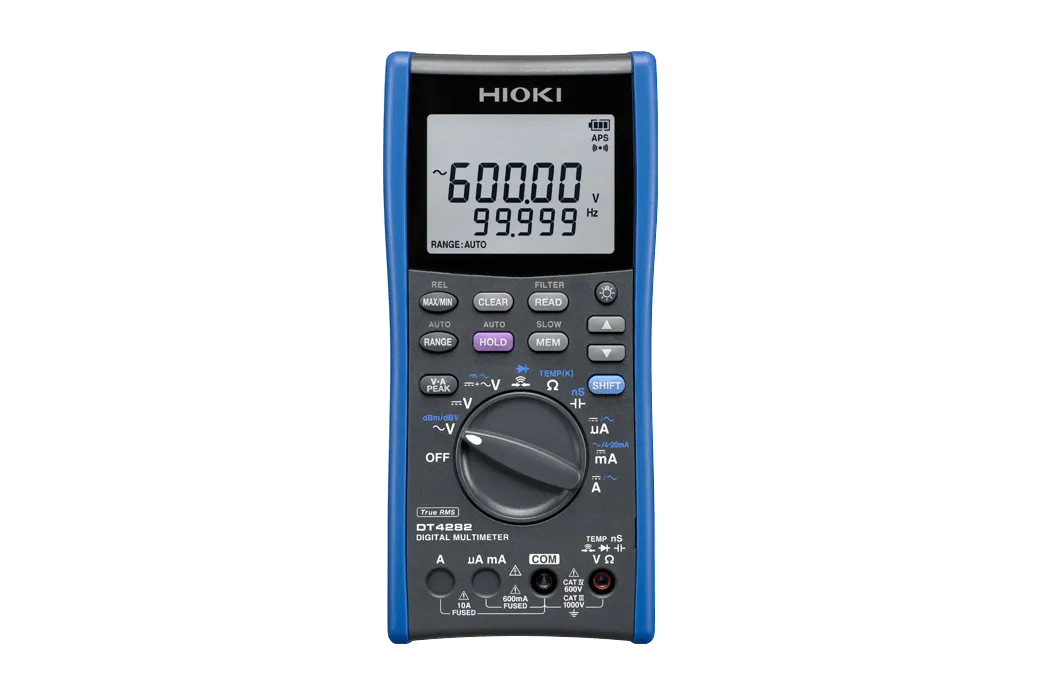
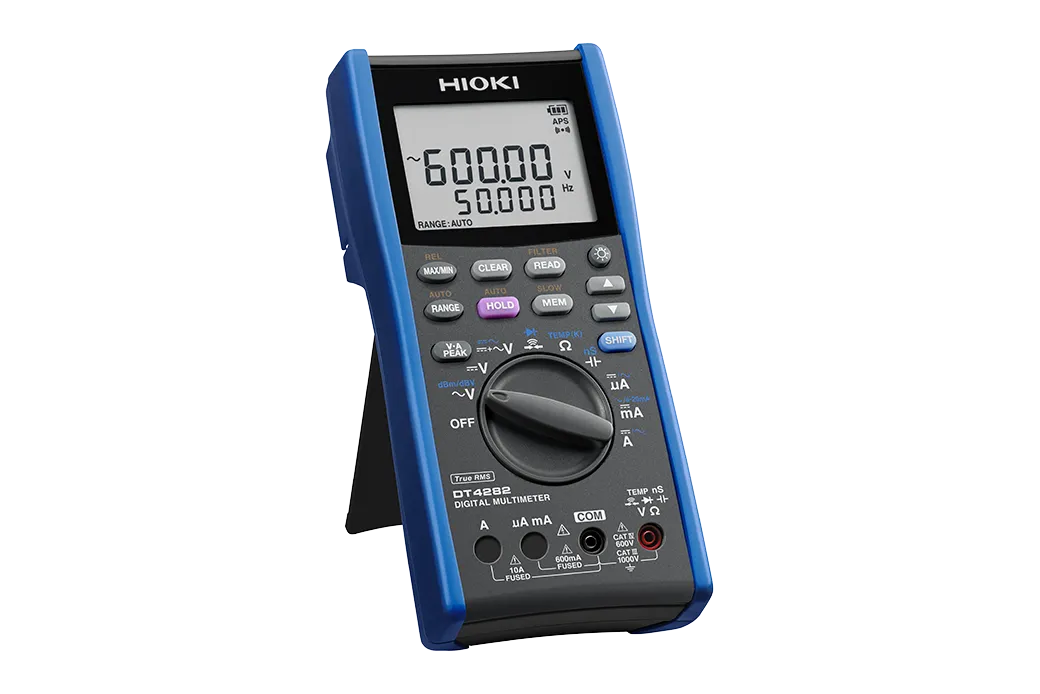
Hioki DT4282 Digital Multimeter | 60,000 Count True RMS
$720.00 .( $792.00 inc. GST )
For all your equipment calibration needs, visit our MyCalibration website.
 Free Delivery on orders over $1000
Shipping time may vary for certain products*

Product Enquiry
If you would like more information regarding this product, simply email us here.

The Hioki DT4282 is a 60,000 count true RMS digital multimeter built for laboratories, R&D benches and calibration work where a 6,000 count field meter simply isn’t accurate enough. It delivers ±0.025% DC voltage basic accuracy, direct 10 A current input, a 600.00 nS conductance range and terminal shutters that physically block lead misinsertion. Rated CAT IV 600 V / CAT III 1000 V, made in Japan, and backed by a three-year Hioki warranty.

Hioki DT4282 Digital Multimeter — 60,000 Count True RMS DMM with 10 A Direct Input
When “close enough” stops being good enough
Most electrical work is comfortably served by a 6,000 count meter with 0.3% DC accuracy. Verify the supply is dead, check a 230 V circuit, confirm a motor winding, move on. But there’s a point where that instrument quietly becomes the weakest link in your measurement chain — and it’s usually the moment you stop checking a value and start characterising one.
You see it in a calibration lab, where the meter under test and the reference need a genuine accuracy ratio between them. You see it on an R&D bench, where a 5 mV shift across a shunt is the difference between a passing prototype and a redesign. You see it on a commissioning job when a 4–20 mA transducer loop is drifting and nobody can tell whether the fault is the sensor, the loop or the meter reading it. And you see it in gas appliance servicing, where a flame rectification current of 2 or 3 microamps has to be resolved reliably before you can sign off on a burner.
In every one of those situations, the honest answer to “is this reading real?” depends on whether your instrument has enough resolution and enough guaranteed accuracy to tell a genuine change from measurement noise. The Hioki DT4282 exists for exactly that gap.
What the DT4282 actually is
The DT4282 sits at the top of Hioki’s DT4200 series as one of the two high-end models in the DT4280 range. It’s a handheld-format instrument with bench-class specifications: a 60,000 count, five-digit main display with a second sub-display, ±0.025% rdg. ±2 dgt. basic DC voltage accuracy, and a measurement engine fast enough to update the display five times per second while still holding those numbers.
The distinction that matters most when you’re choosing between the two high-end models is current. The DT4282 is the direct-input variant — it measures DC and AC current from 600.00 µA all the way to 10.000 A straight through its own terminals, across six ranges. It also adds a 600.00 nS conductance range that no other model in the series carries. Its sibling, the DT4281, tops out at 600 mA direct and relies on clamp-on probes for higher currents, which suits field electrical work but not a bench.
So the DT4282’s identity is clear: it’s the one you buy when the current you need to measure is going to run through the meter, and when you need the resolution to see what’s happening at both ends of the scale.
Resolution and accuracy, and why the numbers matter
A 60,000 count display means the DT4282 resolves 1,000 times more finely than a typical 6,000 count meter in the same range — and it holds that resolution with a guaranteed ±0.025% rdg. ±2 dgt. on DC volts. In practical terms, on the 6.0000 V range you’re reading to 100 µV increments with an accuracy specification that stays meaningful at that resolution. That’s the difference between “the reading wobbled” and “the reading moved by 400 µV, consistently, when I loaded the circuit.”
Resistance carries a ±0.03% rdg. ±2 dgt. basic accuracy across eight ranges from 60.000 Ω to 600.0 MΩ. The low end is fine enough for connection and contact resistance work; the high end reaches into the insulation-adjacent territory where you’re checking leakage paths on a component rather than a whole installation. And when even 600 MΩ isn’t enough, the conductance range picks up where resistance leaves off, reading down to 600.00 nS with ±1.5% rdg. ±10 dgt. — useful for characterising very high-impedance components and contamination paths that read as an open circuit on an ordinary meter.
Frequency measurement runs from under 1 Hz to 500.00 kHz with ±0.005% rdg. ±3 dgt., which is precise enough to be genuinely useful for verifying VSD carrier and output frequencies, generator sets against Australia’s 50 Hz nominal, and signal timing on control boards.
True RMS, and the filter that makes inverter measurements honest
Distorted waveforms are the norm now, not the exception. Between switch-mode supplies, LED drivers, VSDs and solar inverters, the current waveform on a modern site rarely looks like the textbook sine wave that averaging meters assume. The DT4282 uses true RMS measurement with a crest factor allowance of 3, so a peaky, harmonic-rich current is reported as the heating-equivalent value it actually is rather than an averaged approximation that can read substantially low.
The low-pass filter goes a step further. Measuring the output of a VSD or inverter with an ordinary meter gives you a number that includes the switching harmonics — technically the RMS of everything present, but not what you want when you’re trying to confirm the fundamental the motor actually sees. Switching the DT4282’s analogue low-pass filter in strips the high-frequency content so you can read the fundamental on its own, the way a power meter would. Hioki specifies the filter for use on the 600 V AC and 1000 V AC ranges, with accuracy defined for frequencies at or below 100 Hz when the filter is engaged, so treat it as a mains-fundamental tool rather than a general-purpose noise reducer.
Peak measurement and combined DC + AC voltage measurement round the picture out. Together they let you look at ripple riding on a DC bus — the classic case being a DC charging system where you need to know both the DC level and the AC component superimposed on it, and where a rising ripple figure is often the first evidence of a failing capacitor bank.
Current measurement from microamps to ten amps
The six current ranges span 600.00 µA / 6000.0 µA / 60.000 mA / 600.00 mA / 6.0000 A / 10.000 A, in both DC and AC.
At the bottom, the 600.00 µA DC range is what makes the DT4282 practical for gas appliance work. Flame rectification currents from a sensor rod are tiny, and a technician trying to diagnose an intermittent lockout needs to see whether the flame current is marginal or genuinely healthy. A meter that resolves flame current in single microamps turns that from guesswork into a measurement.
At the top, the 10 A direct input handles the everyday reality of bench and panel work where you’d rather break the circuit and measure through the meter than fit a clamp. Note the terminal ratings carefully: the mA/COM pair is rated 600 mA DC or AC, and the A/COM pair is rated 10 A DC or AC. Getting the lead in the right terminal for the current you expect is the whole ballgame, which is exactly the problem Hioki’s shutter mechanism was designed around.
Safety that’s built into the hardware, not the instruction manual
The DT4282 is rated CAT IV 600 V and CAT III 1000 V — the measurement categories defined by IEC 61010 to describe where an instrument can safely be used. CAT IV covers the origin of the installation and the service entrance; CAT III covers distribution boards, fixed installation wiring and permanently connected equipment. In Australian terms, that rating supports work at the point of supply and through switchboards on 230 V single-phase and 415 V three-phase systems.
A caution worth reading twice: a category rating is a rating for the location, not a licence for any voltage. Using an instrument below the category required for where you’re standing is one of the most common causes of serious arc-flash incidents, and no amount of headroom on the voltage number compensates for the wrong category. If the job is at the service entrance, it needs CAT IV. Check the rating on your test leads and probe tips too — the supplied L9300 lead is CAT IV 600 V / CAT III 1000 V with its finger guard extended and drops to CAT II 1000 V when the guard is slid back, and accessory tips carry their own individual ratings that can be lower than the meter’s.
The terminal shutter mechanism is the standout physical safeguard. The shutters are mechanically linked to the rotary switch: select a voltage function and only the V and COM terminal openings are exposed; select a current function and only the A and COM openings open. Inserting a lead into the wrong terminal isn’t discouraged, it’s physically impossible. For anyone who has ever put a lead into the current jack while the meter was set to volts, the value of that is immediate and obvious.
Beyond the shutters, the instrument is drop-tested from one metre onto concrete, sealed to IP40, carries an O-ring around the rotary switch to keep dust out of the mechanism, and warns the operator with a red backlight and audible alert on excessive input. Replaceable fuses (Z5053 11 A/1000 V for the A path, Z5054 630 mA/1000 V for the mA path) mean a mistake costs you a fuse, not an instrument.
Recording, reporting and repeatability
The DT4282 stores up to 400 readings in internal memory, captured one at a time with the MEM key. That alone changes how a long inspection run works — you record as you go instead of juggling a clipboard, then transcribe once you’re back at the desk.
With the optional DT4900-01 Communication Package, that data comes off the meter over USB, and live readings can be streamed to a PC in real time, graphed at an interval you choose, and saved as text for import into whatever reporting template you use. Hioki’s design detail here is worth noting: the link between the computer and the meter is optically coupled, so the PC is electrically isolated from the measurement circuit. You’re not creating a path from a live board to your laptop.
Auto-hold, manual hold, MAX/MIN capture, relative display and adjustable display refresh rate all serve the same end — getting a stable, readable, recordable number out of a measurement that’s moving. The optional Z5020 magnetic strap hangs the meter on a switchboard door so both hands stay free.
Built in Japan, warranted for three years
Hioki develops, designs and manufactures almost the whole digital multimeter range at its head office in Nagano Prefecture, and backs the DT4282 with a three-year warranty. Accuracy is specified for a one-year period, which is the practical driver behind an annual calibration interval for any instrument being used for compliance or reporting work.
Where the DT4282 earns its place
- Calibration laboratories and metrology support — as a working reference for checking field instruments, where the accuracy ratio between reference and unit under test has to be defensible.
- R&D and design verification benches — characterising prototype power supplies, drive circuits and sensor front-ends across current ranges spanning five decades on a single instrument.
- Solar and inverter commissioning — reading true RMS AC output, isolating the fundamental with the low-pass filter, and checking DC bus ripple with combined DC + AC measurement.
- Process instrumentation and control — 4–20 mA and 0–20 mA loops read directly, with percentage-equivalent display converting loop current straight to the 0–100% span the process value actually represents.
- Gas appliance and burner servicing — flame rectification current diagnosis on the 600.00 µA range.
- HVAC and building services maintenance — K-type thermocouple temperature from -40.0 °C to 800.0 °C with the optional DT4910 probe, alongside capacitance from 1.000 nF to 100.0 mF for motor-run and start capacitor checks.
- TAFE and RTO electrical training programs — an instrument students can learn genuine measurement discipline on, with shutters that forgive the classic beginner’s error.
Two things to check before you order
First, the DT4282 does not support clamp-on current probes. Hioki’s 9010-50, 9018-50 and 9132-50 AC clamp probes work with the DT4281, not the DT4282. If your work involves measuring currents above 10 A on conductors you can’t break into, the DT4281 is the correct model in this pair. If your current measurement happens through the meter, the DT4282 is.
Second, the current terminals are fused and directional. Plan which terminal you’ll use before the leads go in — the shutters will stop you inserting into the wrong one, but they won’t stop you selecting a 10 A range for a circuit that should have gone through mA.
Ready to measure, backed by people who use these instruments
Every DT4282 ships complete with the L9300 test lead set, four LR6 (AA) alkaline batteries and the instruction manual — battery-in, lead-on, ready to work. We stock the full accessory ecosystem alongside it: the DT4910 K-type thermocouple, DT4900-01 communication package, L4930 connection cable set with its range of interchangeable tips, carrying cases, magnetic strap and replacement fuse sets.
We can also arrange calibration services for instruments used in compliance and reporting work, and we’re happy to talk through whether the DT4282 or the DT4281 is the better fit before you commit. Talk to us about your application — we’d rather get you the right meter first time than process a return later.
Technical Specifications
| Specification | DT4282 | Why It Matters |
|---|---|---|
| Display | 5-digit main and sub display, max. 60,000 counts, backlit | Dual display lets you read voltage and frequency at the same time; 60,000 counts resolves changes a 6,000 count meter can’t see |
| DC voltage | 60.000 mV to 1000.0 V, 6 ranges. Basic accuracy ±0.025% rdg. ±2 dgt. | Bench-class accuracy in a handheld body — suitable as a working reference for checking field instruments |
| AC voltage (true RMS) | 60.000 mV to 1000.0 V, 6 ranges. 20 Hz to 100 kHz. Basic accuracy 45–65 Hz: ±0.2% rdg. ±25 dgt. | True RMS with a crest factor 3 allowance reports distorted waveforms accurately instead of reading low |
| DC + AC voltage | 6.0000 V to 1000.0 V, 4 ranges. 20 Hz to 100 kHz. Basic accuracy 45–65 Hz: ±0.3% rdg. ±30 dgt. | Reads ripple superimposed on a DC bus — the standard method for assessing DC charging system health |
| DC current | 600.00 µA to 10.000 A, 6 ranges. Basic accuracy ±0.05% rdg. ±5 dgt. | Direct 10 A input with a 600 µA floor covers burner flame current through to full bench loads on one meter |
| AC current (true RMS) | 600.00 µA to 10.000 A, 6 ranges. Basic accuracy 45–65 Hz: ±0.6% rdg. ±5 dgt. Frequency characteristics 20 Hz to 20 kHz (600 µA to 600 mA ranges) | Distorted load currents measured honestly across five decades |
| AC clamp-on probe support | Not supported on DT4282 | Choose the DT4281 if clamp-based current measurement above 10 A is required |
| Resistance | 60.000 Ω to 600.0 MΩ, 8 ranges. Basic accuracy ±0.03% rdg. ±2 dgt. | Contact and connection resistance at the low end, leakage-path investigation at the high end |
| Conductance | 600.00 nS. ±1.5% rdg. ±10 dgt. (DT4282 only) | Characterises very high-impedance paths that read as open circuit on ordinary meters |
| Capacitance | 1.000 nF to 100.0 mF, 9 ranges. Basic accuracy ±1.0% rdg. ±5 dgt. | Covers small signal-path capacitors through to large motor-run and DC link capacitors |
| Frequency | 99.999 Hz to 500.00 kHz, 5 ranges. ±0.005% rdg. ±3 dgt. Measures from 0.5 Hz | Verifies 50 Hz mains stability, generator output and VSD frequencies with genuine precision |
| Temperature | K-type thermocouple, -40.0 °C to 800.0 °C. Add ±0.5% rdg. ±3 °C to probe error | Motor, bearing and duct temperature checks without a separate instrument (DT4910 probe sold separately) |
| Continuity check | Threshold selectable 20 / 50 / 100 / 500 Ω. Response 10 ms or more | A selectable threshold means the buzzer reflects the circuit you’re actually testing, not a fixed assumption |
| Diode test | Open-terminal voltage ≤4.5 V, test current ≤1.2 mA, forward threshold 0.15 V to 3 V in seven steps | Enough open-circuit voltage to forward-bias series junctions and LEDs that a low-voltage meter can’t turn on |
| Peak measurement | DC V: signal width ≥4 ms (single), ≥1 ms (repeated). AC V and DC/AC A: ≥1 ms (single), ≥250 µs (repeated) | Captures inrush and transient peaks that a normal reading averages away |
| Low-pass filter | Analogue filter, 630 Hz cut-off. Use on 600 V AC and 1000 V AC ranges only; accuracy defined ≤100 Hz with filter on, +2% rdg. added | Isolates the inverter fundamental so you read what the motor sees, not the switching harmonics |
| dB conversion | dBm with standard impedance 4 Ω to 1200 Ω in 20 steps (default 600 Ω); dBV also available | Direct decibel readout for audio and telecoms line work |
| 4–20 mA percentage display | 4–20 mA and 0–20 mA converted to 0–100% | Loop current read as the process value it represents — no mental arithmetic on a ladder |
| Other functions | Display hold, auto hold, MAX/MIN, relative display, adjustable sampling, over-input warning with red backlight and buzzer, terminal misinsertion shutters | Field-usability features that turn an unstable reading into a recordable number |
| Internal memory | 400 readings | Record through an inspection run and transcribe once, not at every point |
| PC communication | USB via optional DT4900-01 Communication Package (optically isolated); Windows 10 / 11 | Real-time display, interval graphing and text export, with the PC electrically isolated from the circuit |
| Display refresh | 5 times/s (capacitance 0.05–2 times/s depending on value; temperature 1 time/s) | Fast enough to see a value settle, adjustable when the reading is noisy |
| Safety rating | CAT IV 600 V, CAT III 1000 V (terminal-to-ground) | Supports work from the service entrance through to distribution boards — always match the category to the location |
| Max. rated voltage between terminals | V–COM: 1000 V DC/AC | Hard limit — exceeding it is an instrument and operator hazard |
| Max. rated current between terminals | mA–COM: 600 mA DC/AC; A–COM: 10 A DC/AC | Choose the terminal before the leads go in; both paths are fuse-protected |
| Replacement fuses | Z5053 (11 A / 1000 V, 2 pcs), Z5054 (630 mA / 1000 V, 2 pcs) | Field-replaceable — a wrong-terminal mistake costs a fuse, not the meter |
| Applicable standards | Safety: EN 61010. EMC: EN 61326 | Designed and tested to recognised international instrument safety and EMC standards |
| Ingress protection | IP40; O-ring sealed rotary switch | Keeps dust out of the switch mechanism, a common failure point in site-used meters |
| Drop resistance | Drop-tested from 1 m onto concrete | Survives the reality of a meter that lives in a toolbag |
| Operating temperature / humidity | -15 °C to 55 °C (humidity derated above 40 °C, non-condensing) | Workable across Australian conditions from alpine mornings to plant rooms |
| Storage temperature | -30 °C to 60 °C, ≤80% RH non-condensing | — |
| Power supply | 4 × LR6 (AA) alkaline. Approx. 100 hours continuous use | Standard AA cells you can buy anywhere, with auto power save |
| Dimensions / mass | 93 mm W × 197 mm H × 53 mm D; 650 g including batteries and test lead holder | Handheld format with bench-instrument performance |
| Included accessories | Test Lead L9300 ×1, instruction manual ×1, LR6 alkaline battery ×4 | Ready to test out of the box |
| Accuracy guarantee period | 1 year | Drives a sensible 12-month calibration interval for compliance work |
| Warranty | 3 years (Hioki) | Manufactured at Hioki’s Nagano, Japan head office |
What is the Hioki DT4282 used for? The Hioki DT4282 is a high-accuracy 60,000 count true RMS digital multimeter used in laboratories, R&D benches, calibration work and precision field diagnostics. It measures DC and AC voltage, direct current up to 10 A, resistance to 600 MΩ, conductance, capacitance, frequency, temperature and diode/continuity, with ±0.025% basic DC voltage accuracy. It is rated CAT IV 600 V and CAT III 1000 V.
What is the difference between the Hioki DT4281 and DT4282? Both are high-end DT4280 series meters sharing the same ±0.025% DC voltage accuracy, 60,000 count display and CAT IV 600 V / CAT III 1000 V rating. The DT4282 measures current directly up to 10 A and adds a 600.00 nS conductance range, making it suited to laboratory and R&D work. The DT4281 measures direct current only to 600 mA but supports Hioki AC clamp-on probes for measurements from 10 A to 1000 A, making it suited to field electrical work. The DT4282 does not support clamp-on probes.
Is the Hioki DT4282 a true RMS multimeter? Yes. The DT4282 uses true RMS measurement for AC voltage, DC + AC voltage and AC current, with a crest factor allowance of 3. This gives accurate readings on the distorted waveforms produced by variable speed drives, switch-mode supplies, LED drivers and solar inverters, where an averaging meter can read significantly low.
What CAT rating does the Hioki DT4282 have? The DT4282 is rated CAT IV 600 V and CAT III 1000 V between input terminals and ground, with a maximum 1000 V DC/AC between the V and COM terminals. The supplied L9300 test lead is CAT IV 600 V / CAT III 1000 V with the finger guard extended and CAT II 1000 V with it retracted. Always match the instrument and lead category to the location being tested, not just the expected voltage.
Can the Hioki DT4282 measure 10 A directly? Yes. The DT4282 accepts direct current input up to 10.000 A DC or AC through the A and COM terminals across six ranges starting at 600.00 µA, with a basic DC current accuracy of ±0.05% rdg. ±5 dgt. The A–COM path is protected by a Z5053 11 A / 1000 V fuse, and the separate mA–COM path is rated 600 mA and protected by a Z5054 630 mA / 1000 V fuse.
How accurate is the Hioki DT4282? Basic DC voltage accuracy is ±0.025% rdg. ±2 dgt., with resistance at ±0.03% rdg. ±2 dgt., DC current at ±0.05% rdg. ±5 dgt., frequency at ±0.005% rdg. ±3 dgt. and 45–65 Hz AC voltage at ±0.2% rdg. ±25 dgt. Accuracy is guaranteed for one year, which is why an annual calibration interval is standard practice for instruments used in compliance or reporting work.
Does the Hioki DT4282 connect to a computer? Yes, with the optional DT4900-01 Communication Package. It connects over USB and allows real-time display of measurements on a PC, interval graphing, and saving of results as text files. The connection uses optical isolation so the computer is electrically isolated from the measurement circuit. It also stores up to 400 readings in internal memory for later download.
Related Products

Next day delivery
Finance services
Price Match
Technical support
Product training
Calibration servises
Need help? Call our support team 1800 358 531