


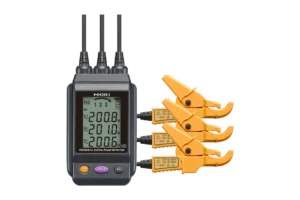
Hioki PD3259-50 Digital Phase Detector | Non-Contact 3-Phase
$1,300.00 .( $1,430.00 inc. GST )
For all your equipment calibration needs, visit our MyCalibration website.
 Free Delivery on orders over $1000
Shipping time may vary for certain products*

Product Enquiry
If you would like more information regarding this product, simply email us here.

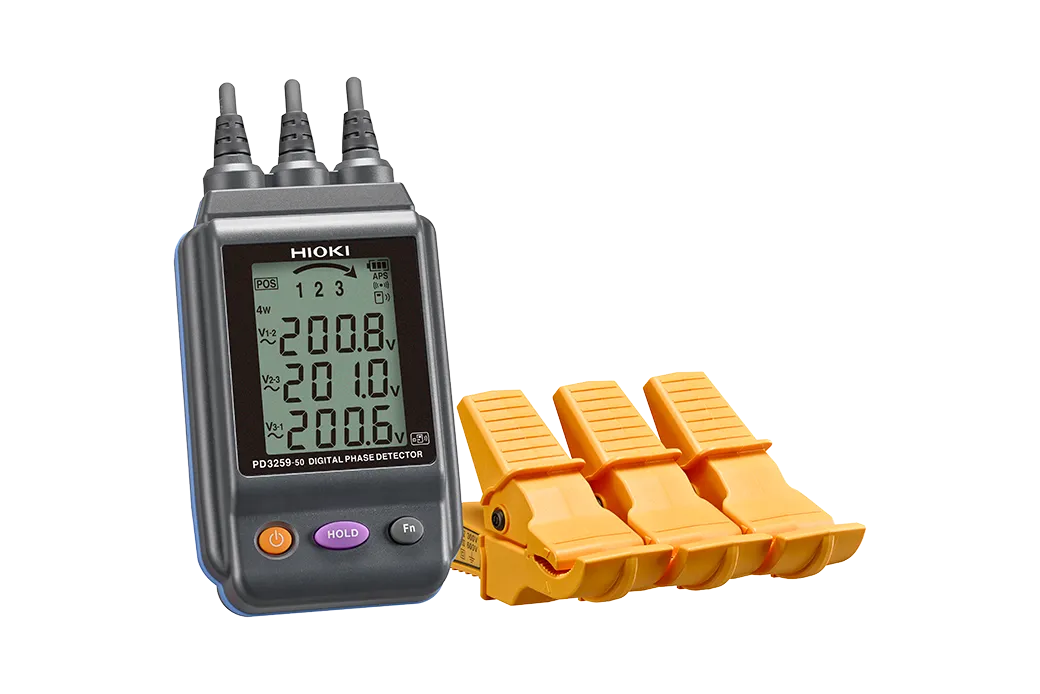
Checking phase rotation on a live three-phase panel without exposing yourself to bare conductors is non-negotiable on a safe worksite. The Hioki PD3259-50 Digital Phase Detector eliminates that risk entirely — just clip three sensors onto the insulated cables and instantly read phase sequence, all three line-to-line voltages, and frequency on a single large display. CAT IV 600 V rated, IP54 sealed, and Bluetooth-ready via the optional Z3210 adapter. The only phase tester that does it all without touching metal.

The Problem With Traditional Phase Checking on Live Three-Phase Circuits
Ask any experienced sparky what they dislike most about commissioning or maintaining three-phase switchgear, and “phase checking” is almost always on the list. The traditional process is slow, fiddly, and carries real exposure risk. First, you’d use a separate phase detector to determine rotation — probes touching live conductors. Then you’d pull out a multimeter and take three separate line voltage readings: V1-2, V2-3, and V3-1. Four individual measurement steps, four separate chances for an arc flash incident, four data points you then have to record manually.
On a busy industrial job — a factory switchboard upgrade, a new 415 V motor installation, or a commercial building’s main distribution board — that kind of workflow is inefficient and, frankly, riskier than it needs to be. Transient overvoltages at CAT IV measurement points can reach 8,000 V. One lapse in probe placement is all it takes.
The Hioki PD3259-50 was built to eliminate that problem from the ground up.
What the PD3259-50 Actually Does
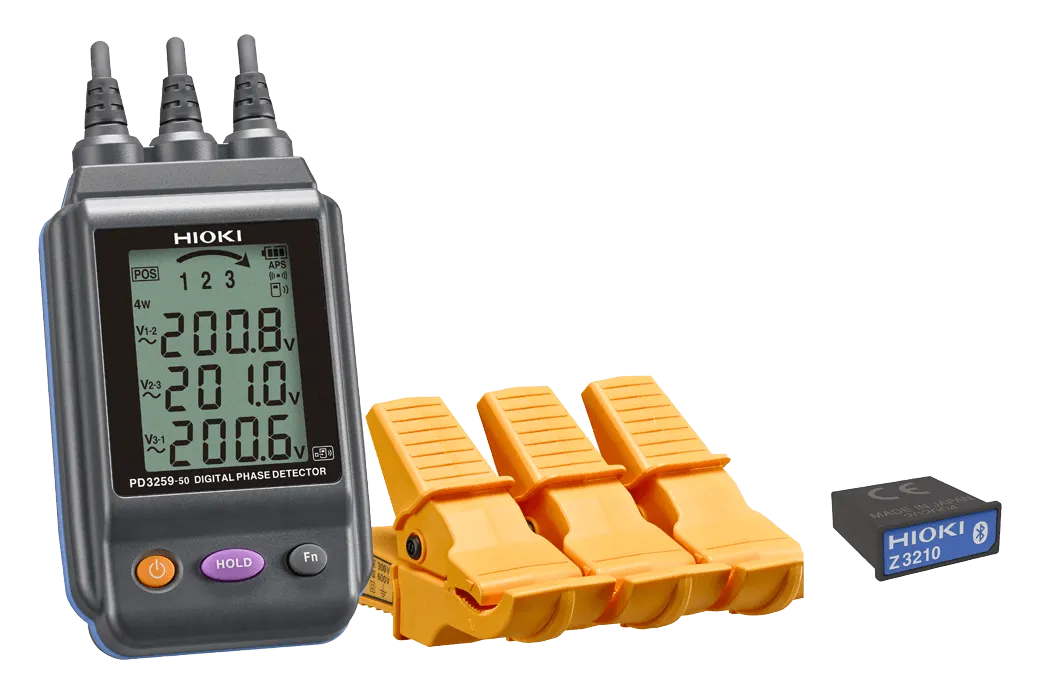
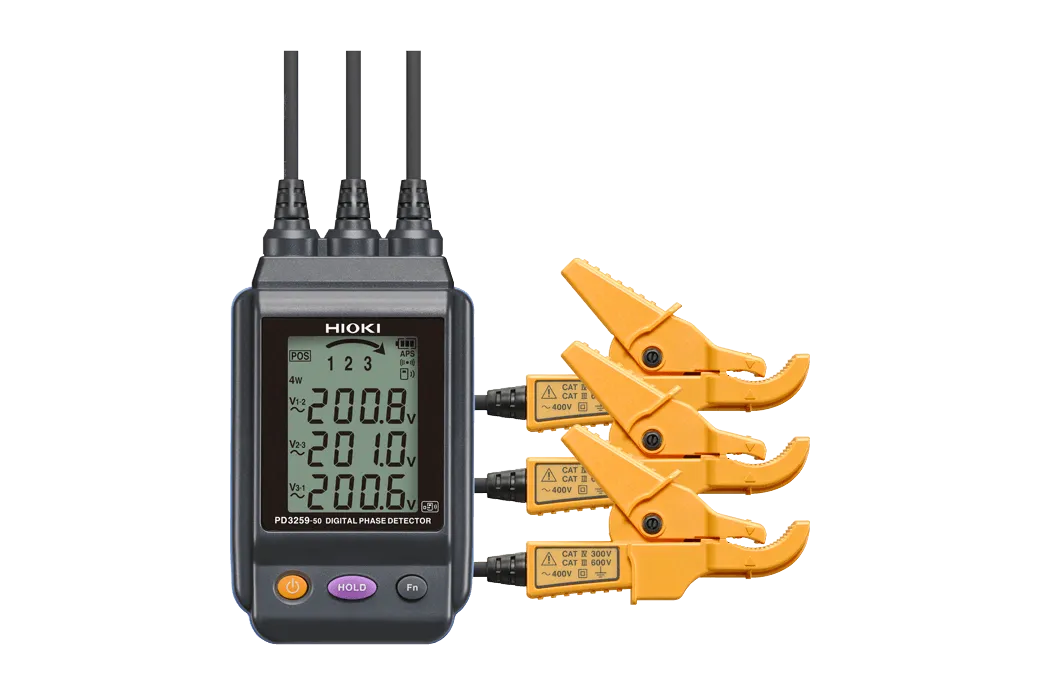
The PD3259-50 is a non-contact digital phase detector that combines phase sequence detection and three-phase voltage measurement into a single, simultaneous measurement step. Three colour-coded clamp sensors attach to the outside of the insulated cable — no stripping, no exposed metal contact, no probes near live conductors. The instrument detects the electric field through the insulation itself.
From that one clip-on step, the large backlit LCD displays:
- Phase sequence — positive (correct rotation) or negative (reversed rotation), with an intuitive arrow indicator and audible buzzer
- All three line-to-line voltages simultaneously (V1-2, V2-3, V3-1)
- Voltage to ground for each phase
- Frequency — critical for confirming supply quality on Australian 50 Hz networks
- Ground phase prediction — identifies which phase is grounded in a three-phase 3-wire configuration
- Open phase detection — flags if one phase of the three-phase circuit is missing
What used to require four separate measurement steps now takes one. That’s not marketing copy — it’s a fundamental workflow change that saves time on every single three-phase job.
Safety First: Why Non-Contact Matters at CAT IV
The PD3259-50 carries a CAT IV 600 V safety rating — the highest category applicable to measurements at the service entry point, incoming supply, and primary distribution panels. At a 600 V CAT IV measurement point, the instrument is designed to withstand transient overvoltages up to 8,000 V without insulation breakdown.
Critically, the sensor design exposes no metal parts during measurement. Every contact surface that touches the cable is fully insulated plastic. For sparkies working on live 415 V three-phase distribution equipment — particularly in commercial and industrial environments where safe work distances are tight — this is a meaningful safety improvement over traditional phase detectors and separate multimeter probe work.
The instrument body (excluding the voltage sensors) is also IP54 rated, meaning it handles dust ingress and water splashing from any direction. On Australian construction sites, in HVAC plant rooms, or in outdoor switchyards, that level of environmental protection is an everyday practical requirement, not a luxury.
Drop it once? No drama — the PD3259-50 is certified drop-proof onto concrete from 1 metre.
Bluetooth Connectivity and Digital Reporting
Modern electrical compliance work in Australia means documentation. Whether it’s an IEC 62446-1 PV system commissioning report, AS/NZS 3000 switchboard verification records, or a workplace OHS safety log, measurement data needs to end up on paper (or PDF) accurately and efficiently.
The PD3259-50 supports optional Bluetooth® wireless data transfer via the Hioki Z3210 Wireless Adapter (available as the PD3259-90 bundle). Once fitted, the Z3210 connects the instrument to Hioki’s free GENNECT Cross app on iOS or Android. From there you can:
- View live measurement values on your smartphone or tablet
- Photograph the measurement site and overlay data directly onto the image
- Check voltage unbalance rates and vector diagrams — genuinely useful for diagnosing motor load issues or supply problems
- Export PDF reports and CSV data for client handover or compliance filing
- Save hand-written digital annotations to the measurement file
For teams managing multiple sites or commissioning contractors who need job-card-quality documentation on the fly, this workflow integration is a real differentiator. The Z3210 also supports Excel Direct Input — hold the reading on the instrument, tap a cell in your Excel spreadsheet on a connected laptop, and the value enters automatically. No transcription errors.
Understanding What You’re Reading: Key Display Functions
Positive phase sequence — The display shows phases in clockwise order (1, 2, 3) with a green arrow indicator and intermittent buzzer. This is what you want to see before energising a motor. Reversed phases will spin motors backwards.
Negative phase sequence — Phases appear in counterclockwise order. Red backlight activates and the buzzer produces a continuous alarm tone. On a switchboard commissioning job, this is the instrument telling you to stop and check wiring before you close that breaker.
Open phase — If the instrument detects that one phase of the three-phase circuit is absent, the icon for that phase disappears from the display. Invaluable for fault-finding on distribution boards where a single phase fuse has blown.
Ground phase prediction — In a three-phase 3-wire (delta) system, the instrument identifies if one phase is grounded, displaying “N” beneath that phase number. Useful for understanding the earthing configuration of the supply you’re working on.
Voltage unbalance — Via GENNECT Cross, you can view the unbalance percentage and vector diagram. For facilities maintenance teams monitoring motor supply quality, or solar installers verifying three-phase inverter output balance, this moves the PD3259-50 firmly into power quality analysis territory.
Where the PD3259-50 Fits in Your Work
Three-phase motor installations: Before energising any new motor circuit, confirm phase rotation is correct to prevent mechanical damage from reverse rotation. The PD3259-50 does this in seconds on the incoming supply cables before the motor is even connected.
Main switchboard commissioning: Verify incoming supply rotation and voltage balance at the distribution board during initial energisation. Simultaneous three-phase voltage display means you check everything in one step.
Solar and renewable energy installations: CEC-accredited solar installers working on three-phase grid-connect systems can confirm grid phase rotation and voltage at the point of connection to the grid (CAT IV rated for service entry measurements), and verify inverter output voltage balance — all within IEC 62446-1 documentation requirements.
Industrial plant maintenance: Facility engineers and maintenance electricians performing periodic inspections on three-phase switchgear, motor control centres, and distribution boards. The IP54 rating and drop-proof design handle the reality of industrial environments.
HVAC and mechanical services commissioning: Three-phase HVAC equipment (chillers, compressors, AHUs) requires correct phase rotation for proper operation. Commission and verify in one measurement step without exposing probes to live busbars.
Building services and fitout: Electricians on commercial fitouts who need to document panel commissioning for AS/NZS 3000 compliance and hand over to the building owner — the GENNECT Cross PDF reporting workflow was built for exactly this.
TECHNICAL SPECIFICATIONS TABLE
| Specification | Value | Why It Matters |
|---|---|---|
| Detection Functions | Positive/negative phase sequence, open phase, ground phase prediction (3-phase 3-wire and 4-wire) | Complete phase circuit analysis in one measurement — not just rotation, but open phase faults and earthing configuration |
| Voltage Measurement Range | 90.0 V to 520.0 V AC (three-phase, 45–66 Hz) | Covers Australian 415 V three-phase (nominal 400 V) and international supply voltages with headroom |
| Voltage Accuracy | ±2.0% rdg ±8 dgt | Reliable enough for commissioning verification and compliance documentation |
| Frequency Measurement | 45 Hz to 66 Hz (±0.5% rdg ±1 dgt) | Confirms supply frequency — relevant for verifying 50 Hz Australian network compliance at switchboard commissioning |
| Measurement Targets | Covered (insulated) cables, metal portions; cable OD 6–30 mm | Works on the standard cable sizes found in commercial and industrial installations — no need to strip insulation or touch conductors |
| Safety Rating | CAT IV 600 V | Approved for measurement at the service entry point and main distribution panels — the highest-risk measurement locations on any site |
| Environmental Protection | IP54 (instrument body, EN60529) | Resistant to dust ingress and water splashing — suitable for outdoor switchyards, construction sites, and plant rooms |
| Drop Proof | 1 m onto concrete (1 time) | Handles the realities of fieldwork where instruments get dropped |
| Response Time / Display Update | 3 s or less / 500 ms | Fast enough for efficient commissioning workflow without waiting for readings to settle |
| Display | Large backlit LCD with red negative-phase backlight | Readable in both dark electrical cupboards and bright outdoor environments; negative phase warning is unmissable |
| Buzzer | Intermittent (positive), continuous (negative) | Audio confirmation means you don’t need to keep looking at the display — useful when your hands are full |
| Wireless | Optional Bluetooth® via Z3210 Wireless Adapter | Enables real-time data transfer to GENNECT Cross app and Excel Direct Input for documentation |
| Power Supply | 4 × AA (LR6) alkaline batteries | Standard AA batteries available anywhere — no proprietary cells to hunt down on a job |
| Battery Life | 5 hours continuous (backlight off, without Z3210) | Covers a full working day of commissioning activity |
| Dimensions | 84 mm W × 146 mm H × 46 mm D | Compact enough for a tool bag; large enough to handle comfortably in thick work gloves |
| Weight | 590 g (inc. batteries) | Solid instrument feel without being cumbersome |
| Cord Length | 0.5 m (50 cm) | Sufficient reach to clip all three sensors onto cables in a standard distribution board |
| Operating Temperature | −25°C to 65°C, 80% RH (non-condensing) | Wide range covers Australian climate extremes from alpine substations to tropical north Queensland |
| Storage Temperature | −25°C to 65°C | Same range as operating — no need to bring it inside before storage |
| Safety Standards | EN61010 (Safety), EN61326 Class A (EMC) | Compliant with international safety and EMC standards accepted by Australian regulators |
| Warranty | 3 years product, 1 year accuracy guarantee | Industry-leading warranty reflecting Hioki’s build quality confidence |
Included Accessories: Carrying case C0203, 4 × AA alkaline batteries, colour clips (White ×2, Red ×2, Blue ×2, Yellow ×2), spiral tube (black ×1), instruction manual
Available Options: Wireless Adapter Z3210 (Bluetooth® connectivity), Magnetic Strap Z5020 (hands-free wall/panel mounting), GENNECT Cross app (free, iOS & Android)
Bundle Option: PD3259-90 includes the Z3210 Wireless Adapter as a set.
APPLICATION USE CASES
1. Three-Phase Motor Circuit Commissioning
Before a new motor goes live — whether it’s a 415 V pump, conveyor drive, or industrial compressor — the incoming phase rotation must be confirmed. Connecting a motor with reversed phase sequence will run it backwards, potentially destroying mechanical equipment or safety systems. The PD3259-50 confirms rotation in seconds at the motor starter or MCC panel, without probes near live busbars.
2. Commercial and Industrial Switchboard Energisation
When an electrical contractor energises a new main switchboard or distribution board during a commercial fitout or industrial plant upgrade, AS/NZS 3000 compliance requires verifying the incoming supply before loads are connected. The PD3259-50 provides simultaneous phase sequence and three line voltage readings in a single measurement step — exactly what’s needed for commissioning records.
3. Solar PV System Commissioning (Three-Phase Grid-Connect)
CEC-accredited solar installers commissioning three-phase grid-connect systems under IEC 62446-1 need to verify grid phase rotation and line voltages at the point of connection. The PD3259-50’s CAT IV 600 V rating makes it appropriate for measurements at the service entry and main switchboard. The GENNECT Cross Bluetooth reporting workflow integrates directly into commissioning documentation.
4. Fault-Finding on Three-Phase Distribution Boards
When a phase fuse or MCB trips on a distribution board, the open phase detection function immediately identifies which phase is absent — without the technician needing to probe each phase individually. This shortens fault diagnosis time and keeps the technician away from live conductors during the identification process.
5. Industrial Maintenance and Planned Inspection Programs
Facilities maintenance engineers on scheduled inspection rounds of motor control centres, switchgear, and distribution boards can use the voltage unbalance data (via GENNECT Cross) to identify supply quality issues before they cause motor failures. A consistent 3–5% voltage unbalance on a critical production motor is an early warning — the PD3259-50 surfaces that data where a standard phase detector cannot.
6. HVAC and Mechanical Services Commissioning
Three-phase HVAC plant — chillers, air handling units, commercial refrigeration compressors — requires correct phase rotation for compressor and fan motor operation. Mechanical services commissioning agents can verify rotation at the supply point before energising plant, avoiding the cost and delay of mechanical damage from reverse rotation startup.
7. Building Services Documentation and Client Handover
Project electricians on commercial and residential building projects who need to produce commissioning documentation for the building owner, base building contractor, or certifier. The GENNECT Cross PDF report, complete with site photos and measured data, provides a professional, defensible commissioning record that supports AS/NZS 3000 verification.
Query: What does a digital phase detector do?
A digital phase detector identifies whether the three phases of an AC power supply are connected in the correct rotational sequence (positive/clockwise) or reversed sequence (negative/counterclockwise). It is used before energising three-phase motors, switchboards, or other equipment to prevent damage from reverse rotation. Advanced models like the Hioki PD3259-50 also measure all three line-to-line voltages and detect open phase faults simultaneously in a single non-contact measurement step.
Query: How do I check phase rotation without touching live wires?
The Hioki PD3259-50 Digital Phase Detector uses non-contact clamp sensors that detect voltage through the outer insulation of the cable — no metal contact required. You simply clip the three colour-coded sensors onto the covered cables. The instrument detects the electric field through the insulation and simultaneously displays phase sequence, all three line voltages, and frequency. This approach eliminates probe contact with live conductors, reducing arc flash exposure risk at CAT IV measurement locations.
Query: What is the difference between CAT III and CAT IV phase detectors?
CAT IV instruments are rated for measurements at the service entry point of a building — the point where the supply connects from the utility network. At 600 V to ground, a CAT IV location can experience transient overvoltages up to 8,000 V. CAT III instruments are rated for measurements inside the building’s fixed installation (distribution boards, wiring, outlets) and can only withstand up to 6,000 V transients at 600 V. Using a CAT III instrument at a CAT IV location risks insulation breakdown and electric shock. The Hioki PD3259-50 is rated CAT IV 600 V, making it appropriate for both service entry and internal distribution measurements.
Query: Can a phase detector measure voltage as well?
Most basic phase detectors only indicate rotation direction. The Hioki PD3259-50 Digital Phase Detector measures all three line-to-line voltages and voltage to ground simultaneously while also detecting phase sequence. It displays three voltage readings, the phase sequence (positive or negative), and the supply frequency on a single screen in one measurement step — replacing the need for a separate multimeter to take voltage readings.
Query: What is open phase detection on a phase detector?
Open phase detection identifies when one of the three phases in a three-phase circuit is missing — for example, when a phase fuse has blown or a phase conductor is disconnected. On the Hioki PD3259-50, if one phase is absent, its icon disappears from the display, giving an immediate visual indication without requiring separate testing of each individual phase. This speeds up fault diagnosis on three-phase distribution boards significantly.
Query: What is GENNECT Cross and how does it work with the PD3259-50?
GENNECT Cross is a free app from Hioki (available on iOS and Android) designed for use with Hioki measuring instruments. When used with the optional Z3210 Wireless Adapter attached to the PD3259-50, it enables Bluetooth® wireless transfer of measurement data to a smartphone or tablet. From the app, users can view live readings, photograph measurement sites and overlay data on the images, check voltage unbalance rates and vector diagrams, and generate PDF or CSV reports for compliance documentation.
Query: How do I commission a three-phase motor with a phase detector?
To commission a three-phase motor safely: clip the three sensors of a phase detector like the Hioki PD3259-50 onto the incoming supply cables at the motor starter or MCC. The instrument will display the phase sequence — positive (correct rotation, green arrow indicator) or negative (reversed rotation, red backlight and continuous buzzer). If the sequence is negative, swap any two of the three phase conductors at the starter to reverse rotation. Confirm positive sequence before energising the motor. The PD3259-50 also displays all three supply voltages simultaneously, so you can verify balanced supply voltage at the same time.
TECHNICAL SPECIFICATIONS TABLE
| Specification | Value | Why It Matters |
|---|---|---|
| Detection Functions | Positive/negative phase sequence, open phase, ground phase prediction (3-phase 3-wire and 4-wire) | Complete phase circuit analysis in one measurement — not just rotation, but open phase faults and earthing configuration |
| Voltage Measurement Range | 90.0 V to 520.0 V AC (three-phase, 45–66 Hz) | Covers Australian 415 V three-phase (nominal 400 V) and international supply voltages with headroom |
| Voltage Accuracy | ±2.0% rdg ±8 dgt | Reliable enough for commissioning verification and compliance documentation |
| Frequency Measurement | 45 Hz to 66 Hz (±0.5% rdg ±1 dgt) | Confirms supply frequency — relevant for verifying 50 Hz Australian network compliance at switchboard commissioning |
| Measurement Targets | Covered (insulated) cables, metal portions; cable OD 6–30 mm | Works on the standard cable sizes found in commercial and industrial installations — no need to strip insulation or touch conductors |
| Safety Rating | CAT IV 600 V | Approved for measurement at the service entry point and main distribution panels — the highest-risk measurement locations on any site |
| Environmental Protection | IP54 (instrument body, EN60529) | Resistant to dust ingress and water splashing — suitable for outdoor switchyards, construction sites, and plant rooms |
| Drop Proof | 1 m onto concrete (1 time) | Handles the realities of fieldwork where instruments get dropped |
| Response Time / Display Update | 3 s or less / 500 ms | Fast enough for efficient commissioning workflow without waiting for readings to settle |
| Display | Large backlit LCD with red negative-phase backlight | Readable in both dark electrical cupboards and bright outdoor environments; negative phase warning is unmissable |
| Buzzer | Intermittent (positive), continuous (negative) | Audio confirmation means you don’t need to keep looking at the display — useful when your hands are full |
| Wireless | Optional Bluetooth® via Z3210 Wireless Adapter | Enables real-time data transfer to GENNECT Cross app and Excel Direct Input for documentation |
| Power Supply | 4 × AA (LR6) alkaline batteries | Standard AA batteries available anywhere — no proprietary cells to hunt down on a job |
| Battery Life | 5 hours continuous (backlight off, without Z3210) | Covers a full working day of commissioning activity |
| Dimensions | 84 mm W × 146 mm H × 46 mm D | Compact enough for a tool bag; large enough to handle comfortably in thick work gloves |
| Weight | 590 g (inc. batteries) | Solid instrument feel without being cumbersome |
| Cord Length | 0.5 m (50 cm) | Sufficient reach to clip all three sensors onto cables in a standard distribution board |
| Operating Temperature | −25°C to 65°C, 80% RH (non-condensing) | Wide range covers Australian climate extremes from alpine substations to tropical north Queensland |
| Storage Temperature | −25°C to 65°C | Same range as operating — no need to bring it inside before storage |
| Safety Standards | EN61010 (Safety), EN61326 Class A (EMC) | Compliant with international safety and EMC standards accepted by Australian regulators |
| Warranty | 3 years product, 1 year accuracy guarantee | Industry-leading warranty reflecting Hioki’s build quality confidence |
Included Accessories: Carrying case C0203, 4 × AA alkaline batteries, colour clips (White ×2, Red ×2, Blue ×2, Yellow ×2), spiral tube (black ×1), instruction manual
Available Options: Wireless Adapter Z3210 (Bluetooth® connectivity), Magnetic Strap Z5020 (hands-free wall/panel mounting), GENNECT Cross app (free, iOS & Android)
Bundle Option: PD3259-90 includes the Z3210 Wireless Adapter as a set.
FAQ SECTION
(Structured for FAQPage Schema markup)
Q1: What is a digital phase detector and why do I need one? A digital phase detector identifies the rotational sequence of a three-phase AC supply — whether the phases are in positive (correct, clockwise) or negative (reversed, counterclockwise) sequence. This matters because connecting three-phase motors, compressors, or other rotating equipment to a reversed phase supply will run the equipment backwards, which can cause serious mechanical damage or create safety hazards. The Hioki PD3259-50 goes further by also measuring all three line-to-line voltages and detecting open phase faults simultaneously, replacing multiple separate measurement steps with a single non-contact clip-on reading.
Q2: What does “non-contact” or “no metal contact” mean on the PD3259-50? The PD3259-50’s clamp sensors detect voltage through the outer insulation of the cable — the sensor jaws are entirely plastic with no exposed metal contact points. This means the measurement is taken without any part of the instrument touching a live conductor. For CAT IV measurement locations (service entry, main distribution panels), this represents a meaningful reduction in arc flash exposure risk compared to traditional probe-based testing.
Q3: What cable sizes does the PD3259-50 work with? The instrument is designed for cables with a finished outer diameter of 6 mm to 30 mm. This covers most standard commercial and industrial insulated wiring used in Australian three-phase installations. Note that the instrument does not support shielded (screened) cables, and performance may be affected by multi-core cables, very thick cables, or cables with surface contamination such as moisture, soil, or residue — clean the cable surface before measurement in those conditions.
Q4: What’s the difference between PD3259-50 and PD3259-90? Both instruments are identical in measurement capability. The PD3259-90 includes the Hioki Z3210 Wireless Adapter bundled as part of the set. The Z3210 adds Bluetooth® wireless connectivity, enabling data transfer to the GENNECT Cross app on iOS and Android, as well as Excel Direct Input functionality. If you plan to use wireless reporting — recommended for any compliance documentation workflow — the PD3259-90 bundle offers the best value.
Q5: Can I use the PD3259-50 on the incoming supply (service entry) of a building? Yes. The CAT IV 600 V safety rating specifically covers measurement at the point where the supply connects to a building — the service drop, the power meter, and the main distribution panel. This is the highest measurement category, covering the highest levels of anticipated transient overvoltage (up to 8,000 V at 600 V to ground). Always confirm that your specific measurement point voltage to ground does not exceed the instrument’s 600 V rated limit.
Q6: How does the open phase detection function work? If the PD3259-50 detects that one phase of the three-phase circuit is not present — for example, if a phase fuse has blown or a phase conductor is disconnected — the icon for that phase is removed from the display. This gives an immediate visual indication of a missing phase without the technician needing to measure each phase individually. This function works on three-phase 3-wire and 4-wire configurations.
Q7: What is the ground phase prediction function? In a three-phase 3-wire (delta) system, it’s not always obvious which phase, if any, is grounded. The PD3259-50 analyses the phase relationship and, if it determines that Phase 1 is grounded, displays “N” beneath the Phase 1 indicator on the screen. This helps electricians understand the earthing configuration of the supply they’re working on — relevant for fault diagnosis and for confirming supply type before working on the circuit.
Q8: Can I use GENNECT Cross without the Z3210 Wireless Adapter? No. Bluetooth® wireless communication requires the Z3210 Wireless Adapter to be attached to the PD3259-50. The instrument itself has no built-in wireless capability. The GENNECT Cross app is free to download on iOS and Android, and once the Z3210 is connected, it enables live data viewing, site photography with data overlay, unbalance rate and vector diagram analysis, PDF report generation, and CSV export.
Q9: What Australian standards does the PD3259-50 support compliance with? The PD3259-50 is relevant to electrical work governed by AS/NZS 3000 (Wiring Rules), AS/NZS 3760 (in-service safety inspection), and IEC 62446-1 (PV system commissioning documentation). Its CAT IV 600 V safety rating aligns with the measurement category requirements for testing at service entry points and main switchboards as defined in AS/NZS 61010 (equivalent to EN61010). Safe Work Australia guidance on electrical safety in the workplace also supports the use of appropriately rated CAT IV instruments for high-risk measurement locations.
Q10: How long do the batteries last and what type does it use? The PD3259-50 runs on four standard AA (LR6) alkaline batteries, giving up to 5 hours of continuous operation with the backlight off and without the Z3210 adapter connected. AA batteries are available anywhere — no proprietary power cells to source. An auto power-off function conserves battery life during idle periods, and a low battery warning appears on the display before the batteries are fully depleted.
Q11: Is the PD3259-50 waterproof? The instrument body (excluding the voltage sensor clamps) is rated IP54 under EN60529. This means it is protected against dust ingress sufficient to prevent interference with operation, and against water splashing from any direction. It is not rated for submersion. For outdoor switchyard work, plant room use, or construction site conditions, IP54 provides adequate protection for typical field conditions.
Q12: What warranty does the Hioki PD3259-50 carry? Hioki provides a 3-year product warranty covering defects in materials and workmanship. Accuracy is guaranteed for 1 year from the date of purchase. For calibrated compliance use, annual recalibration (available through NATA-accredited calibration services) aligns with the 1-year accuracy guarantee period and supports ISO/IEC 17025 traceability requirements for organisations with formal calibration programs.
Related Products

Next day delivery
Finance services
Price Match
Technical support
Product training
Calibration servises
Need help? Call our support team 1800 358 531