


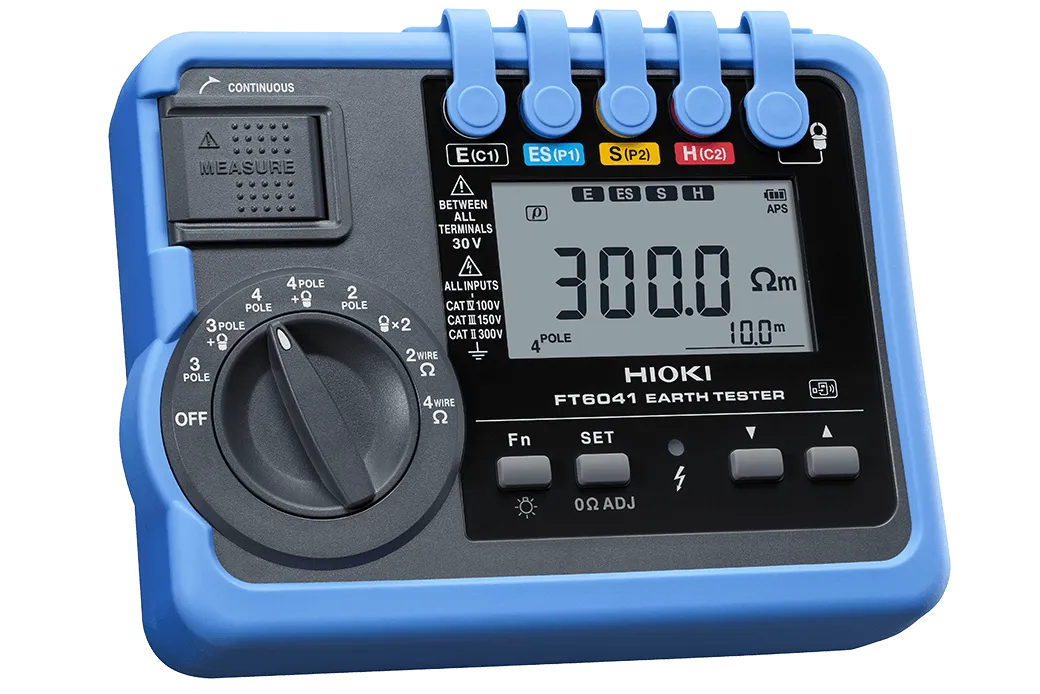

HIOKI FT6041-91 Earth Tester Set | With Clamp Sensors
$6,500.00 .( $7,150.00 inc. GST )
For all your equipment calibration needs, visit our MyCalibration website.
 Free Delivery on orders over $1000
Shipping time may vary for certain products*

Product Enquiry
If you would like more information regarding this product, simply email us here.

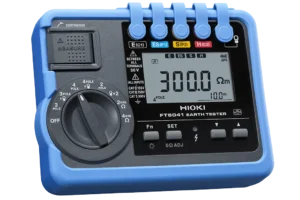
Live-system earthing verification demands more than a standard earth tester. The HIOKI FT6041-91 Earth Tester Set delivers the complete package — IP67-rated FT6041 instrument plus the FT9847 Signal Induction Clamp and CT9848 Clamp-On Sensor — so you can measure ground resistance on energised systems without disconnecting a single electrode or shutting down power. Six measurement methods. Built for Australian site conditions. Ready to test the moment it’s unboxed.


When You Can’t Afford to Shut Down Power — And Still Need Compliant Earthing Results
Earthing compliance doesn’t pause for operational schedules. A data centre running 24/7 needs verified earth resistance values just as much as a construction site that can be temporarily de-energised. The challenge is that the standard approach to earth resistance testing — disconnecting the grounding electrode, running a 3-pole fall-of-potential test, and reconnecting — simply isn’t practical in many of the environments where it matters most.
Hospitals, pharmaceutical manufacturing, food processing plants, telecommunications exchanges, server facilities — in all of these settings, power interruption carries costs and risks that far outweigh the inconvenience of a non-compliant test report. Yet the earthing system still needs to be checked. It still needs to be documented. The results still need to hold up under scrutiny.
What changes the equation entirely is having the right clamp sensors in your kit.
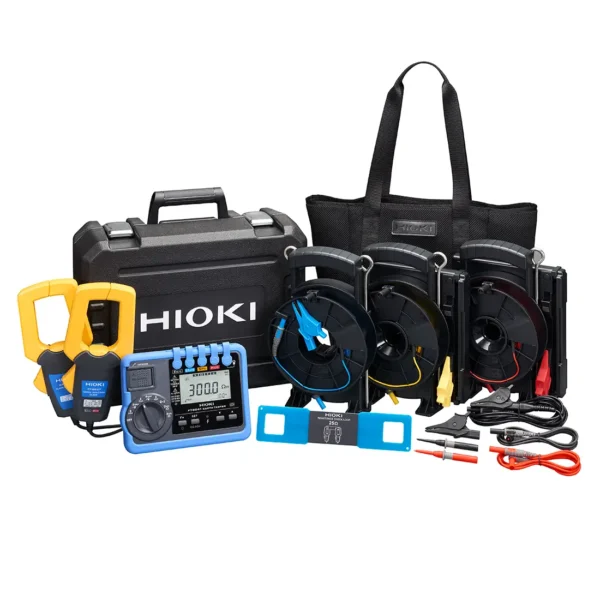
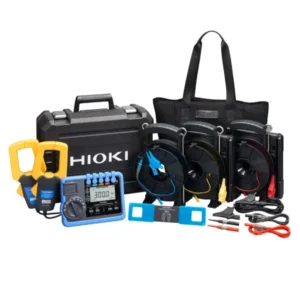
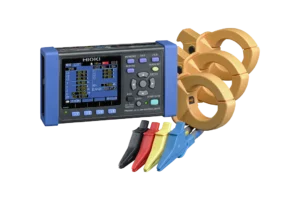
The HIOKI FT6041-91 Earth Tester Set is the configuration built specifically for professionals who need live-system ground resistance testing capability from day one. It combines the field-proven FT6041 Earth Tester with both the FT9847 Signal Induction Clamp and CT9848 Clamp-On Sensor — the complete hardware pair required to activate the FT6041’s MEC function and 2-clamp measurement method, delivered together in a single purchase.
No additional accessories to source separately. No compatibility guesswork. Everything required to test live earthing systems is in the case.
What the FT6041-91 Includes — and Why Each Component Matters
HIOKI FT6041 Earth Tester (Main Unit)
The FT6041 is HIOKI’s flagship portable earth resistance tester. Rated IP67 for dust and water protection, drop-tested from 1 metre onto concrete, and rated for operation across -25°C to +65°C, it’s built for the kind of outdoor and industrial conditions found routinely across Australian electrical work. Six measurement methods are supported natively: 3-pole, 4-pole (Wenner’s soil resistivity), MEC function, 4-terminal low-value resistance, 2-clamp, and low-resistance continuity.
Measurement speed matters on multi-point testing programs — the FT6041 returns a full 3-pole reading in 6 seconds, with auto-hold capturing the value automatically. The included 100 kΩ maximum auxiliary electrode resistance tolerance means a single rod insertion is generally sufficient even in the dry sandy soils common across much of regional Australia, eliminating the frustrating cycle of repeated insertions and water pours.
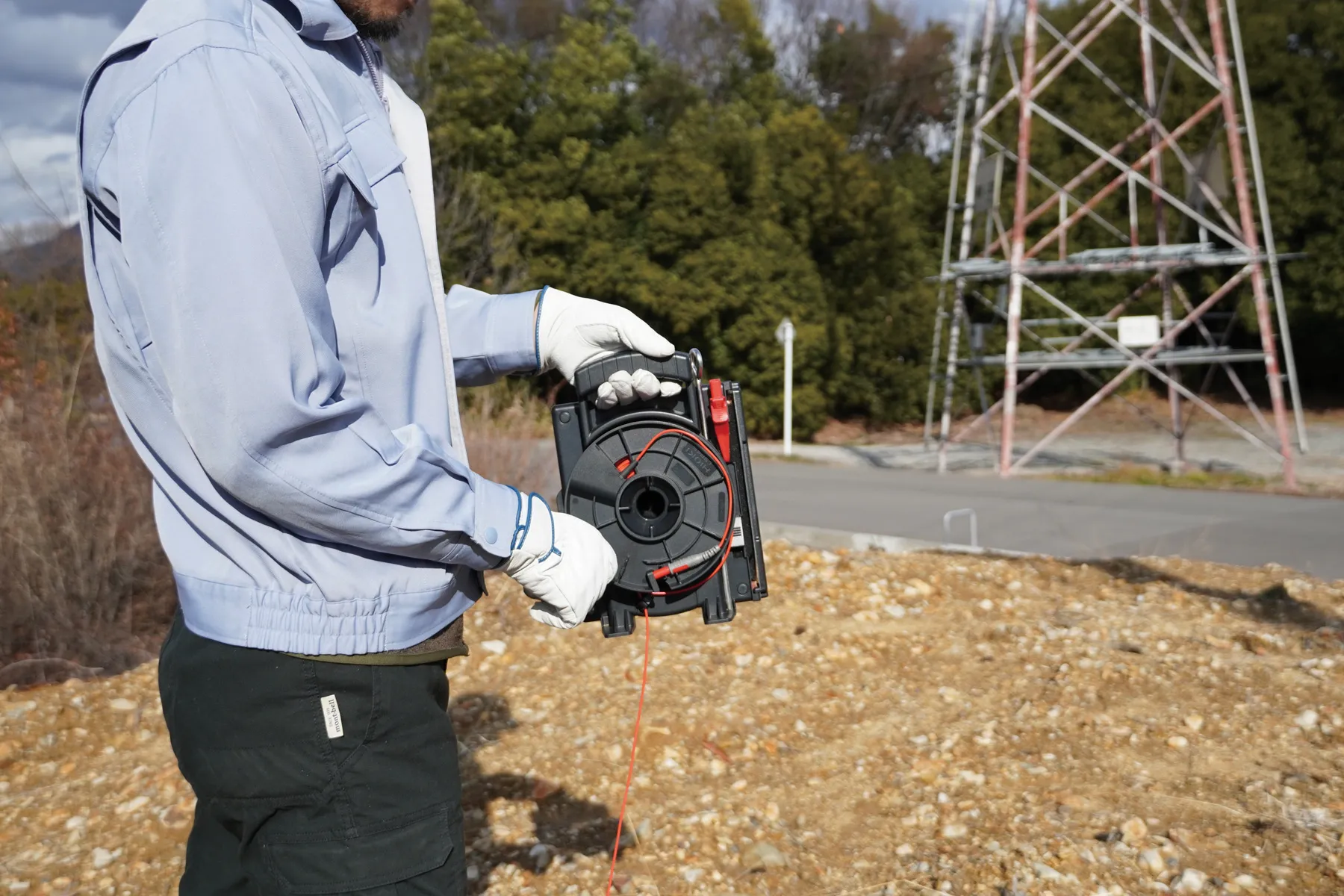
The full measurement cable set is included: 25 m yellow, 25 m blue, and 50 m red winder cables plus a 4 m black lead and 1.2 m test lead. The winder mechanism is designed to retract cleanly without tangling — a detail that sounds minor until you’ve spent time managing 50 metres of cord on a busy site.
FT9847 Signal Induction Clamp
The FT9847 is the signal injection component of the MEC and 2-clamp measurement system. It clamps around the conductor connected to the earth electrode being tested and injects the FT6041’s test signal into that specific conductor — without any electrical contact required. The clamp jaw accommodates conductors up to 52 mm diameter and bus bars up to 78 mm × 20 mm, covering the range of earthing conductor cross-sections encountered in commercial and industrial installations.
The FT9847 is also used in the 2-clamp method, where it injects the measurement signal into a multi-electrode earthing network, enabling individual electrode resistance values to be determined without disconnecting the network.
CT9848 Clamp-On Sensor
The CT9848 is the current detection component. It measures the current flowing specifically through the target electrode conductor, allowing the FT6041 to calculate resistance from the known injected signal and the measured response current. With the same jaw capacity as the FT9847 (52 mm diameter / 78 mm × 20 mm bus bar), the CT9848 is designed with a thin jaw profile to work in tight busbar compartments and enclosed switchboard spaces where a standard clamp sensor simply won’t fit.
Together, the FT9847 and CT9848 enable the FT6041 to perform:
- MEC function (3-pole with clamp): Live-system earth resistance measurement without electrode disconnection or power interruption
- MEC function (4-pole with clamp): Live-system measurement with enhanced accuracy at low resistance values
- 2-clamp method: Individual electrode resistance measurement within parallel multi-ground networks
Without these sensors, these three measurement modes are unavailable. In the standard FT6041, they must be purchased separately. In the FT6041-91, they’re included as standard.
Six Measurement Methods — Covering Every Scenario in the Field
3-Pole Method (Standard Fall-of-Potential) The go-to approach for precise ground resistance verification on standard electrical installations. Accuracy of ±1.5% rdg. ±4 dgt. across the core 30–300 Ω range. Appropriate for installation commissioning and periodic compliance verification under AS/NZS 3000 and AS/NZS 3017.
4-Pole Method — Soil Resistivity (Wenner’s Method) Required for grounding system design on new builds, subdivisions, and infrastructure projects. Australian soil conditions are highly variable — coastal sandy soils, clay-heavy suburban environments, and rocky regional terrain all have very different resistivity profiles that directly determine what earthing electrode design will achieve compliant resistance values.
MEC Function — Live System Testing The defining capability of this kit configuration. By clamping the FT9847 and CT9848 around the earthing conductor, resistance can be measured on fully energised systems without disconnecting anything. The MEC function measures only the current flowing through the specific electrode under test, isolating it from parallel grounds in the same system. For any site that cannot tolerate power interruption, this capability removes the barrier to compliant earthing documentation.
3-Pole with 4-Terminal Measurement For grounding systems where target resistance values are very low — bonded structural steelwork, reinforced concrete foundations, or high-performance earthing grids — the 4-terminal variation of the 3-pole method delivers precision at sub-ohm levels where a standard 3-pole test becomes unreliable.
2-Clamp Method Multi-point earthing networks — common in industrial facilities, transmission infrastructure, and campuses with multiple buildings sharing an earthing grid — contain parallel electrode connections that affect each other’s apparent resistance. The 2-clamp method uses the FT9847 and CT9848 pair to inject and detect independently, allowing individual electrode values to be resolved within the network without any disconnection.
Low-Resistance Measurement Built-in continuity testing using 4-terminal or 2-terminal measurement, from 0.00 Ω to 3000 Ω. Confirms bonding conductor integrity immediately after ground resistance testing — one instrument handles the complete post-installation verification sequence.
Rugged Enough for Australian Conditions
The FT6041-91 is not a lab instrument that happens to go outside. Every aspect of the FT6041 main unit is designed for sustained outdoor use in demanding environments:
IP67 Dust and Water Protection — Fully sealed against dust ingress, rated to survive 1 metre water immersion. Rain, mud, and site dust are non-issues. If it gets dirty, wash it off with water.
-25°C to +65°C Operating Temperature — Australian summer conditions on exposed plant sites, combined with winter work in alpine or southern regions, push test instruments to their limits. The FT6041 operates correctly across this full range without performance compromise.
1 m Drop Resistance (with Protector) — Tested to withstand being dropped onto concrete from 1 metre with the included protector fitted. The kind of accidental drop that destroys an entry-level instrument won’t stop the FT6041.
30 V RMS Ground Potential Tolerance — Near distribution infrastructure or in industrial environments with significant stray potentials, the FT6041 maintains stable readings up to 30 V RMS ground potential. The live wire warning function activates automatically when ground potential is detected at the earth terminal.
Measure on Any Surface — Including Concrete: The L9846 Earth Nets Module (2× Included)
Here’s a scenario that catches a lot of electricians out: you’ve driven to a site, unpacked the gear, and the auxiliary electrode locations are solid concrete — a basement plant room, a rooftop plant deck, a warehouse slab. No soil access. Nowhere to drive a rod.
This is exactly what the HIOKI L9846 Earth Nets Module is designed for, and the FT6041-91 includes two of them as standard.
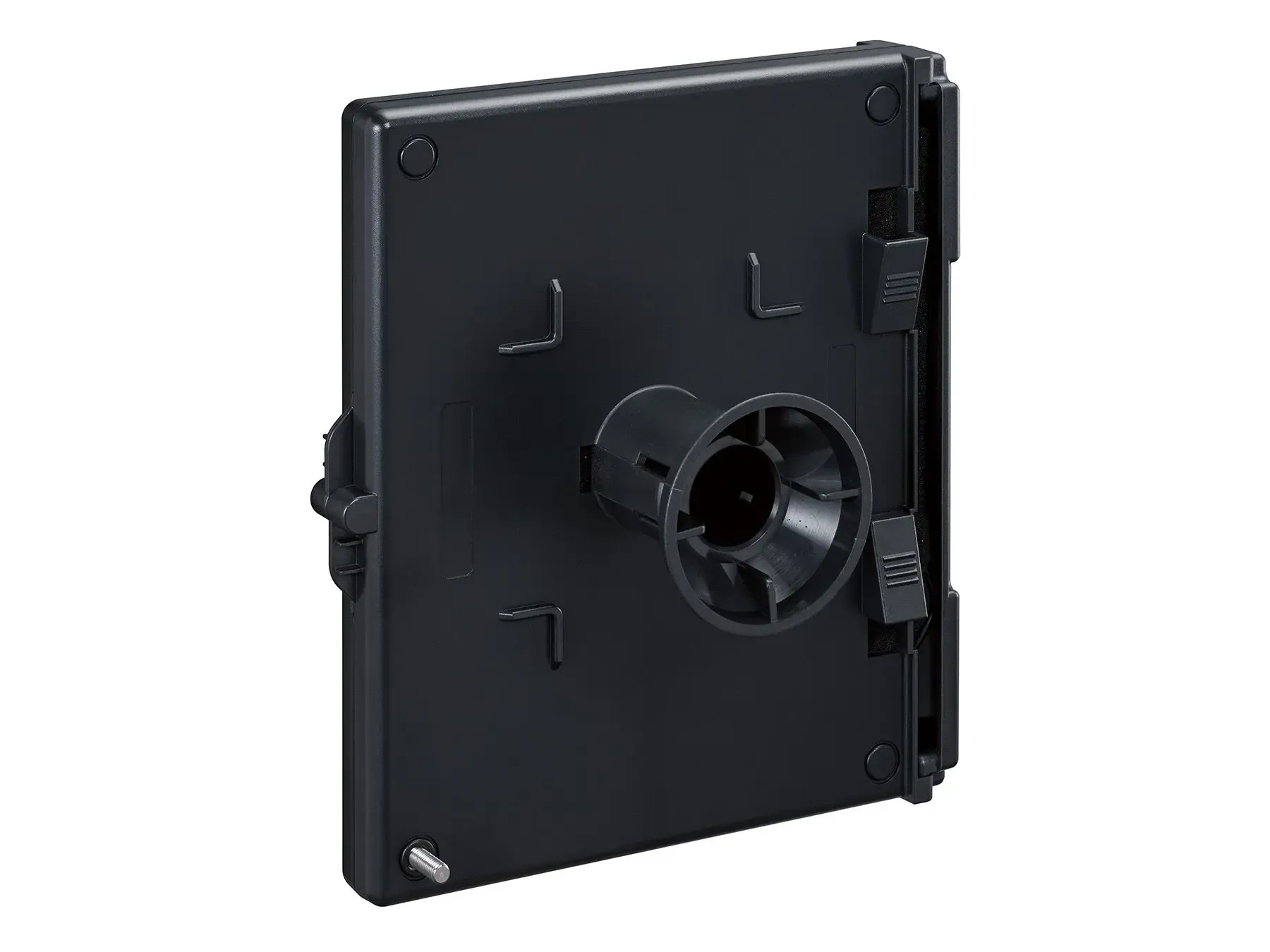
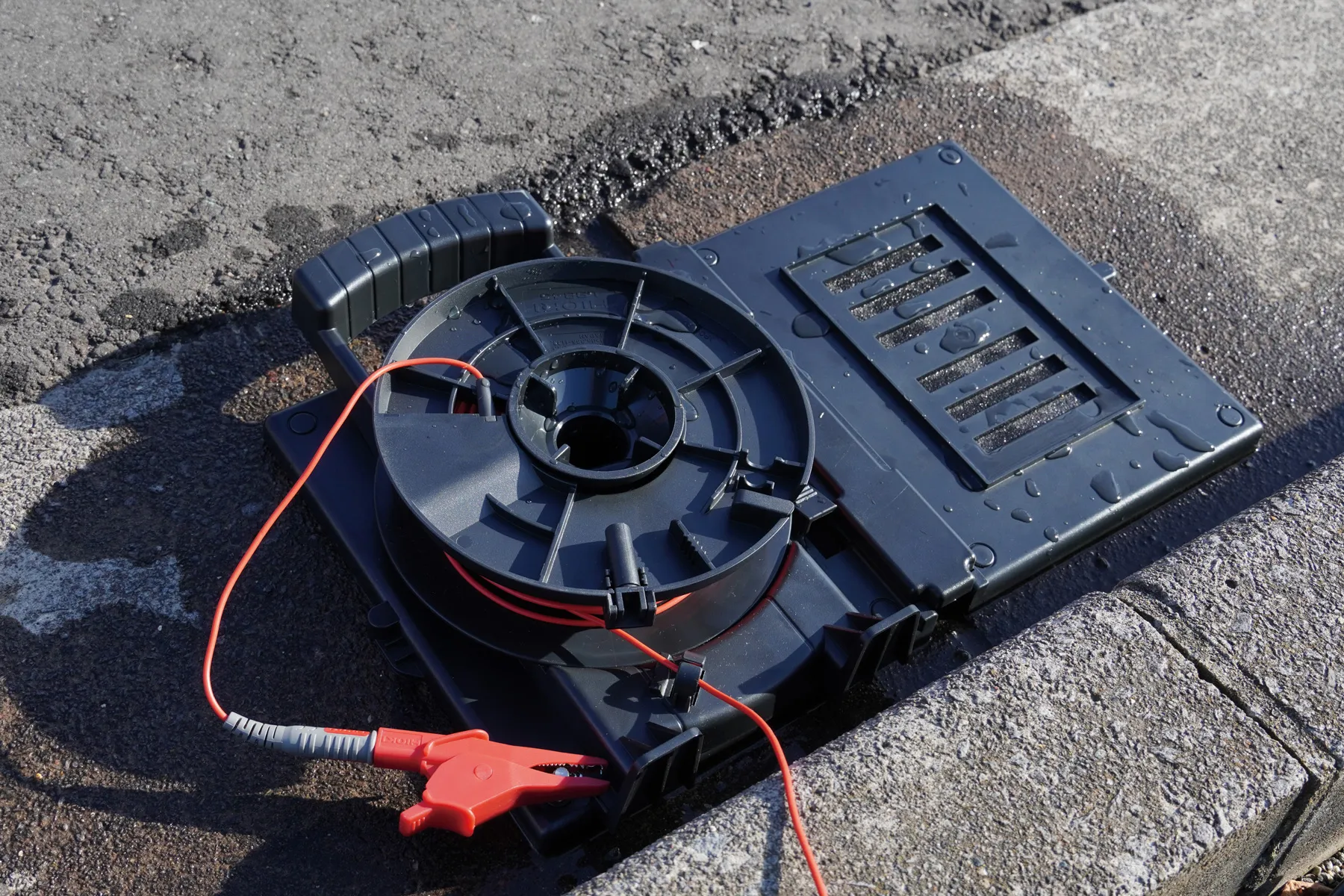
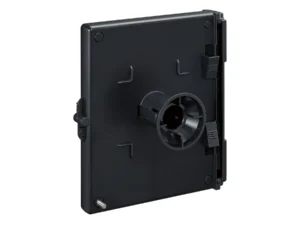
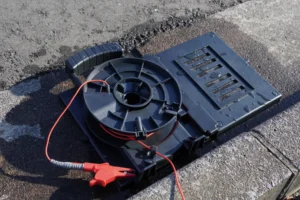
The L9846 is a foldable flat-surface auxiliary electrode with two integrated copper mesh contact pads, each measuring 18 × 22 cm. It features a magnetic latch that holds it closed during storage and transport, and clips directly onto the L9845-series cable reels included in this kit — so it travels as a single unit with the measurement cable, not as a separate item rattling around in your bag.
How it works in the field:
- Unfold the L9846 and place both copper mesh faces flat against the concrete surface
- Pour water through the built-in funnel on the attachment side — it distributes across the mesh via outlet slots on the opposite face
- Connect via the alligator clip lead and measure
The water establishes conductivity between the copper mesh and the concrete surface, creating a usable auxiliary electrode contact without any drilling, hammering, or soil access required. Standard auxiliary rods back into the picture when you return to soil-accessible locations — the L9846 slides back onto the cable reel and stows away cleanly.
Important: The L9846 is also sold separately as a standalone accessory for $650 + GST. The FT6041-91 includes two L9846 modules as standard kit items — a meaningful inclusion that eliminates a separate purchase for any job that involves hard-standing measurement locations.
The L9846 is compatible with HIOKI cable reels L9845-31 (yellow, 25 m), L9845-33 (blue, 25 m), L9845-52 (red, 50 m), L9842-11 (yellow, 10 m), and L9842-22 (red, 20 m) — all of which are part of the standard FT6041-91 cable set.
Kit Contents — Everything Included
The FT6041-91 ships as a complete, ready-to-use kit:
| Item | Qty | Purpose |
|---|---|---|
| FT6041 Earth Tester (main unit) | 1 | Multi-method ground resistance measurement |
| FT9847 Signal Induction Clamp | 1 | Signal injection for MEC and 2-clamp measurement |
| CT9848 Clamp-On Sensor | 1 | Current detection for MEC and 2-clamp measurement |
| Measurement Cable L9845-31 (Yellow, 25 m, with winder) | 1 | P electrode cable, standard 3-pole testing |
| Measurement Cable L9845-33 (Blue, 25 m, with winder) | 1 | C electrode cable, standard 3-pole testing |
| Measurement Cable L9845-52 (Red, 50 m, with winder) | 1 | Extended range electrode cable |
| Measurement Cable L9841 (Black, 4 m) | 1 | Short-range connection cable |
| Test Lead L9787 (1.2 m, with alligator clip) | 1 | 2-pole continuity and safety testing |
| Auxiliary Earthing Rod L9840 (2-piece set) | 2 sets | Auxiliary electrodes for 3-pole and 4-pole testing |
| Earth Nets Module L9846 | 2 | Foldable flat-surface auxiliary electrode for concrete and hard-standing surfaces. Two copper mesh pads (18 × 22 cm each), magnetic latch, mounts onto included cable reels. Sold separately at $650 + GST each — both included in this kit. |
| Carrying Case C0208 (hard) | 1 | Instrument and clamp sensor storage |
| Carrying Case C0209 (soft) | 1 | Measurement cable storage |
| Protector | 1 | Drop protection for the main unit |
| LR6 Alkaline Batteries (AA) | 4 | Immediate power on first use |
APPLICATIONS
Facility Maintenance — Hospitals, Data Centres, and Critical Infrastructure
The FT6041-91 was built with this use case at its core. In 24/7 operational facilities, the MEC function is not a nice-to-have — it’s the only viable method for periodic earthing verification. The included FT9847 and CT9848 clamps allow maintenance electricians and electrical engineers to document earth resistance values for every electrode in the system without scheduling a shutdown, alerting operations, or risking service continuity. Compliance records get produced on time, every time, without operational disruption.
Industrial Plant — Continuous Process Manufacturing
Chemical plants, refineries, paper mills, and other continuous-process industrial facilities run on tight production schedules where unplanned shutdowns carry significant financial penalties. Earthing systems in these environments are also safety-critical — fault current paths depend on verified resistance values. The FT6041-91’s combination of MEC live-testing capability and 30 V RMS ground potential tolerance makes it the practical choice for industrial maintenance teams working around energised plant.
Multi-Electrode Commercial and Industrial Earthing Systems
Modern commercial buildings and industrial facilities often employ complex earthing arrangements — multiple electrodes, ring earths, structural steel bonding, and lightning protection systems all interconnected. Resolving individual electrode resistances within these parallel networks requires the 2-clamp method, which relies directly on the FT9847 and CT9848 sensors included in this kit. Without them, individual electrode values within the network simply cannot be determined without physical disconnection.
Solar PV and Renewable Energy Commissioning
Utility-scale and large commercial solar installations require verified earthing systems for both safety certification and grid connection approval. The FT6041-91 supports the full commissioning sequence: Wenner 4-pole soil resistivity surveys during design, 3-pole ground resistance verification at commissioning, and ongoing live-system checks using the MEC function during periodic maintenance — all without taking the inverter system offline.
Telecommunications and Critical Communications Infrastructure
Mobile base stations, exchange buildings, and microwave relay sites all rely on low-resistance earthing for both equipment protection and interference suppression. Many of these sites operate continuously and carry operational obligations that preclude routine power interruption. The FT6041-91’s clamp-sensor capability allows regular earthing verification to proceed without service disruption.
Electrical Contractor Pre-Handover and Periodic Testing
Even where live-system testing isn’t strictly required, the FT6041-91 kit gives electrical contractors maximum flexibility at handover and during periodic compliance inspections. Having the clamp sensors on hand means no measurement scenario presents a dead end — whether it’s a tight switchboard space where conventional test leads can’t reach, a system where the client is reluctant to approve power interruption, or a multi-electrode installation that requires individual electrode resolution.
WHY CHOOSE US FOR YOUR HIOKI FT6041-91
We supply HIOKI instrumentation from authorised Australian distribution channels, backed by technical support from a team with genuine electrical compliance and calibration expertise — not a generalist online store. When you order the FT6041-91 from us, you can expect:
- Genuine HIOKI product — not grey-market imports
- Pre-sales application advice — if you’re unsure whether the FT6041-91 or FT6041-92 KIT is right for your workflow, we’ll help you work it out before you buy
- NATA-accredited calibration — when your instrument is due for calibration and you need a certificate that stands up in a compliance audit, we can handle it
- Fast Australian dispatch — no waiting on international freight timelines for your core test instruments
- Ongoing technical support — from people who understand Australian earthing standards and compliance requirements, not just the product datasheet
| Specification | Value | Why It Matters |
|---|---|---|
| Measurement Methods | 4-pole, 3-pole, MEC (3-pole & 4-pole with clamp), 2-pole, 2-clamp, low-resistance | All six methods are available from the moment the kit is unboxed — including MEC and 2-clamp, which require the included FT9847 and CT9848 |
| Ground Resistance Range | 0 to 300.0 kΩ (auto-ranging, 6 ranges) | Covers low-resistance bonded structures through to high-resistance electrodes in poor soils |
| 3-Pole Accuracy | ±1.5% rdg. ±4 dgt. (30–300 Ω range) | Compliance-grade precision for AS/NZS 3000 and AS/NZS 3017 reporting |
| MEC Function Range | 0.00 to 30.00 kΩ | Full range coverage for live-system clamp measurement |
| MEC Function Accuracy | ±5% rdg. ±6 dgt. (0–30 Ω range) | Suitable for acceptance testing and maintenance verification |
| 2-Clamp Method Range | 0.02 to 500 Ω | Multi-electrode network testing across typical industrial earthing system values |
| Allowable Ground Potential | 30.0 V RMS | Safe stable measurement near power infrastructure and in environments with stray potentials |
| Max. Auxiliary Electrode Resistance | 100 kΩ (300–3000 Ω range) | Single-insertion electrode placement in dry, rocky, or sandy Australian soils |
| Clamp Sensor Jaw Capacity | φ52 mm dia. / 78 × 20 mm bus bar | Accommodates the full range of earthing conductor and bus bar sizes in commercial and industrial installations |
| Measurement Time | 6 seconds (3-pole method) | Fast enough for efficient systematic multi-point testing |
| IP Rating | IP67 (EN60529) | Full field protection — dust-tight and waterproof |
| Drop Resistance | 1 m onto concrete (with protector) | Withstands site handling and accidental drops |
| Operating Temperature | -25°C to +65°C | Full Australian seasonal range |
| Low-Resistance Measurement | 0.00 to 3000 Ω; ±2% rdg. ±2 dgt. | Bonding conductor continuity verification without a separate instrument |
| Safety Category | CAT IV 100 V / CAT III 150 V / CAT II 300 V | Appropriate for electrical installation field use |
| Standards | EN61010, EN61326, EN61557-1/5/10/14 | Internationally certified, IEC-compliant |
| Power Supply | 4× HR6 NiMH or 4× LR03 alkaline batteries | Standard batteries, easily replaced on any site |
| Battery Life | ~500 measurements (3-pole, without Z3210) | Full working day from a single set in typical use |
| Weight / Dimensions | ~765 g (with battery & protector) / 189 × 148 × 48 mm |
FREQUENTLY ASKED QUESTIONS
Q: What is the difference between the FT6041 and the FT6041-91?
The FT6041 is the standard kit, which includes the main instrument, full measurement cable set, auxiliary earthing rods, Earth Nets Modules, carrying cases, and batteries — everything required for 3-pole, 4-pole, 2-pole, and low-resistance measurement. The FT6041-91 includes all of the above plus the FT9847 Signal Induction Clamp and CT9848 Clamp-On Sensor. These two sensors are required to activate the MEC function (live-system clamp measurement) and the 2-clamp measurement method. If your work involves live-system testing or multi-electrode network measurement, the FT6041-91 is the appropriate variant. If you only need standard 3-pole and 4-pole testing, the FT6041 is sufficient.
Q: What are the FT9847 and CT9848 used for?
The FT9847 Signal Induction Clamp and CT9848 Clamp-On Sensor are a matched pair that work together to enable live-system earth resistance measurement without electrode disconnection. The FT9847 clamps around the target conductor and injects the FT6041’s measurement signal. The CT9848 clamps around the same conductor and detects the resulting current. From these two values, the FT6041 calculates resistance. They are also used together in the 2-clamp method for resolving individual electrode values within multi-electrode earthing networks. Both sensors accommodate conductors up to 52 mm diameter and bus bars up to 78 mm × 20 mm.
Q: Can the FT6041-91 test earth resistance on a live panel without shutting down power?
Yes. This is the primary use case for the MEC function enabled by the FT9847 and CT9848 sensors. The clamps are placed around the earthing conductor — not across live conductors — and the measurement is performed without any disconnection. The FT6041 measures current flowing specifically through the target electrode, avoiding interference from parallel grounds. This is suitable for energised installations including switchboards, distribution panels, and equipment bonding conductors.
Q: Is the Z3210 Wireless Adapter included in the FT6041-91?
No. The FT6041-91 includes the instrument and clamp sensors but does not include the Z3210 Wireless Adapter. If wireless data transfer and GENNECT Cross app reporting are required, the FT6041-92 KIT includes the FT6041, both clamp sensors, and the Z3210 adapter together. Alternatively, the Z3210 can be purchased separately and added to the FT6041-91.
Q: What is the jaw size of the CT9848 and FT9847 clamps, and will they fit standard Australian earthing conductors?
Both the CT9848 and FT9847 accommodate circular conductors up to 52 mm diameter and bus bars up to 78 mm × 20 mm. This covers the full range of earthing conductor sizes specified under AS/NZS 3000 for standard commercial and industrial installations, including heavy-gauge bonding conductors and switchboard bus bars. The CT9848 features a slim jaw profile specifically designed to work in tight spaces such as enclosed switchboard sections where a wider-jaw clamp would not fit.
Q: How accurate is the MEC function compared to the standard 3-pole method?
The MEC function operates at ±5% rdg. ±6 dgt. in the 0–30 Ω range, compared to ±1.5% rdg. ±4 dgt. for the standard 3-pole method. This is a practical trade-off: the MEC function allows measurement without any system disconnection, which eliminates both safety risks and operational disruption. For acceptance testing and ongoing maintenance verification of live systems, the MEC function accuracy is appropriate. Where higher-precision values are required for detailed engineering documentation, the standard 3-pole method (with electrode disconnection) remains the reference approach.
Q: Can the FT6041-91 measure earth resistance on concrete or hard surfaces without soil access?
Yes — and this is one of the more underappreciated capabilities of this kit. The FT6041-91 includes two HIOKI L9846 Earth Nets Modules, which are purpose-designed for exactly this scenario. Each L9846 is a foldable module with two copper mesh contact pads measuring 18 × 22 cm. You unfold the module onto the concrete surface, pour water through the built-in funnel to wet the mesh (improving conductivity between the copper and the slab), and connect via the alligator clip lead. No drilling, no rods, no soil access needed. The L9846 mounts directly onto the included cable reels (L9845-31, L9845-33, L9845-52) so it integrates neatly into the measurement setup rather than being a separate item to manage. This makes it fully practical for basement plant rooms, rooftop installations, covered carparks, and any other hard-standing location where a conventional spike electrode simply cannot be used. Note: the L9846 is also sold separately as a standalone accessory for $650 + GST — both units are included as standard in the FT6041-91.
Q: What Australian electrical standards apply to earth resistance testing with the FT6041-91?
Earth resistance measurement is relevant to compliance with several Australian standards including AS/NZS 3000 (the Wiring Rules — which specifies earthing requirements for electrical installations), AS/NZS 3017 (electrical installation verification and testing), and for solar PV installations, AS/NZS 5033 and IEC 62446-1. Soil resistivity surveys using the 4-pole method are aligned with grounding system design practices referenced in AS 1768 (lightning protection) and engineering standards for high-voltage earthing systems. The FT6041-91 is certified to EN61010, EN61326, and EN61557-1/5/10/14.
Q: How many measurements can I expect from a set of batteries?
In standard 3-pole mode without the Z3210 wireless adapter, the FT6041 delivers approximately 500 measurements from four AA batteries (NiMH or alkaline). With the Z3210 adapter connected and wireless active, this reduces to approximately 400 measurements. The auto power-save function conserves battery life during periods of inactivity. AA batteries are universally available, so field replacements are straightforward.
Related Products



Next day delivery
Finance services
Price Match
Technical support
Product training
Calibration servises
Need help? Call our support team 1800 358 531