



Megger Electrician Starter Kit: MFT1815, TPT420 & DCM330 Fork Multimeter
$1,400.00 .( $1,540.00 inc. GST )
10 in stock

For all your equipment calibration needs, visit our MyCalibration website.
 Free Delivery on orders over $1000
Shipping time may vary for certain products*

Product Enquiry
If you would like more information regarding this product, simply email us here.

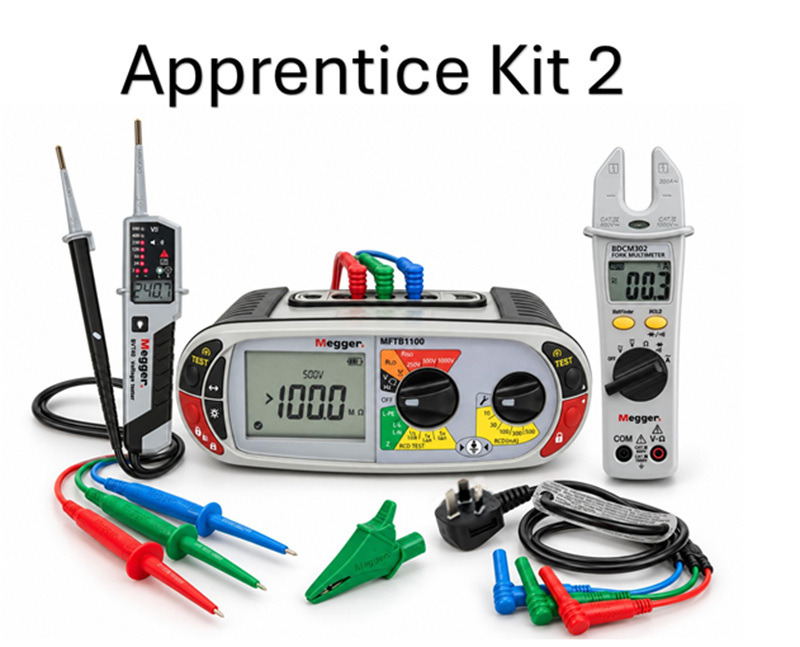
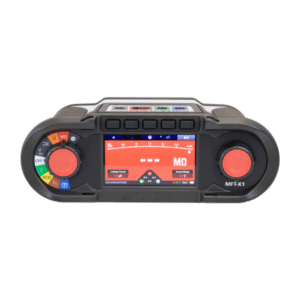
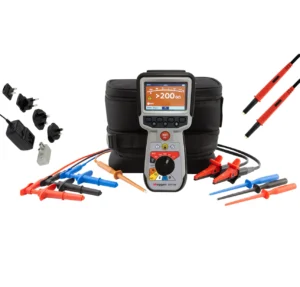
Fault-finding and verification, without an extra meter in your bag. Starter Kit 2 teams the Megger MFT1815 installation tester and TPT420 voltage tester with the DCM330 fork multimeter. The open-jaw DCM330 measures 200 A AC on conductors up to 16 mm, plus AC/DC voltage to 1000 V and resistance to 20 MΩ. A compact, practical kit for apprentices and electricians who troubleshoot as often as they test.
 Megger MFT1800 Series Datasheet
When the job is finding the fault, an extra meter gets in the way
Open any young sparky’s bag and you’ll often find the same collection: a multimeter, a separate clamp, a voltage tester and a big tester that only comes out for verification. Every extra instrument adds weight, batteries and leads, and the one you need is usually at the bottom of the bag or back in the van.
That matters most during troubleshooting, when one reading leads straight to the next. A control circuit won’t pull in, so you check the supply voltage, then the coil resistance, then the current once it’s running. Swapping meters at each step slows the job and breaks your train of thought, particularly with your head inside a cramped enclosure.
The Megger Basic Kit, Electrician Starter Kit 2, trims that down. You get a multifunction tester for formal installation testing, a two-pole tester for voltage checks, and a single fork multimeter that handles the everyday measurements in between. It’s a sensible way to set up from day one, whether you’re an apprentice buying your first gear or a working electrician tidying up a mismatched kit.
DCM330: a multimeter and current meter in one tool
The DCM330 is what defines this kit. Megger calls it a fork multimeter because the head is a fixed open jaw, which you hook around a conductor to read AC current up to 200 A. Instead of a hinged clamp, there’s nothing to open or close, and that design has some practical advantages:
- It suits dirty locations. With no moving jaw parts, it isn’t affected by the dirt, grit or moisture that can build up around a cable in a trench or trunking run.
- It’s quick in tight spaces. Hook the fork over a conductor with one hand, read the result and move on.
- It’s made for single conductors up to 16 mm in diameter. Get the conductor sitting centrally and squarely in the jaw for the best accuracy. That’s a smaller capacity than a typical closed-jaw clamp, so check your conductor sizes first.
Plug in the detachable leads and the same tool covers the rest of a typical fault-finding sequence:
| You need to check | DCM330 function |
|---|---|
| Is the supply present at this terminal? | AC/DC voltage, auto-ranging to 1000 V |
| Is this coil, winding or element open circuit? | Resistance, 0.1 Ω to 20 MΩ |
| Does this conductor or switch have a complete path? | Continuity buzzer |
| Is this diode working? | Diode check |
| What’s the load actually drawing? | AC current up to 200 A through the fork |
| Is a cable in the jaw live? | Non-contact AC voltage detection |
Every range is auto-ranging, so you won’t be stopping to select a scale. A large centre knob suits one-handed use with either hand, and HOLD lets you freeze a value and read it after pulling the meter out of an awkward spot.
Non-contact detection comes with limits. The DCM330 can sense live AC from 50 to 1000 V at 50 to 500 Hz, signalling it with a tone and red LED, and it works on any range, including OFF. It’s intended to identify live cables inside the jaw. Don’t rely on it for shielded conductors such as armoured cable, or for anything inside metal conduit or behind a metallic or conductive panel. It’s a useful indicator, and it never replaces a proper test for dead with the TPT420.
Current readings have a limit too. The DCM330 is average sensing and RMS indicating, not True RMS. Accuracy is specified at ±3% ±3 digits for sinusoidal 50 to 60 Hz current, and readings can be misleading on heavily distorted loads such as drives. Its safety rating is CAT III 1000 V and CAT IV 600 V.
Designed to survive a drop of about 1.2 m, it runs on two AAA cells for up to 250 hours on alkaline batteries. Rechargeable cells aren’t suitable. It weighs 280 g and comes with test leads, batteries and a pouch.
MFT1815: where formal testing happens
A fork multimeter can’t replace an installation tester. An ordinary meter won’t apply the 500 V or 1000 V needed for an insulation test, and it won’t measure loop impedance or trip an RCD. That’s the MFT1815’s job.
Think about how the MFT1815 fits into a typical repair. You’ve traced the fault with the DCM330 and replaced a damaged cable or device. Before the circuit goes back into service, you can switch to the MFT1815 and test the work:
- Insulation: select 250, 500 or 1000 V. The display reports resistance and the voltage actually delivered, with a range up to 999 MΩ at 1000 V.
- Continuity: a 200 mA test starts automatically, with resistance readable from 0.01 Ω. The buzzer threshold is adjustable.
- Loop impedance: use two-wire or three-wire non-trip testing on RCD-protected L-PE circuits, or high-current testing for L-N and L-L. Prospective fault current displays up to 20 kA.
- RCDs: run the half, 1x and 5x tests, a fast ramp or the automatic sequence on Type AC, A, S and programmable devices rated at 10 to 500 mA.
- Supply: check the voltage, frequency and phase rotation.
The operating logic is deliberately simple. Two colour-coded dials select the test, and the backlit screen pairs a digital value with Megger’s analogue-style arc, so a drifting reading is easy to spot. If it finds a hazardous voltage during an insulation or continuity test, the tester warns you and stops further testing.
A few design touches help on site. It has TEST and LOCK buttons at both ends for left or right-handed use, a neck strap for working off a ladder, a switched probe for quick testing and an IP54 housing with a rubber overmould. At about 1 kg with batteries, it won’t wear you out either. Its safety rating is 600 V CAT III and 300 V CAT IV.
The MFT1815 is the entry-level model in Megger’s range. You won’t get Type B RCD testing, three-phase RCD testing without an earth, 2x current RCD tests, 15 mA continuity or earth electrode testing. If those are part of your regular work, have a look at the MFT1825 instead.
TPT420: your go-to for dead testing
Your first check on any job is whether the circuit is dead, and the DCM330’s non-contact function isn’t designed to answer that. The TPT420 is the tool for this step: a two-pole voltage tester built to the EN 61243-3 and DIN VDE 0682-401 standards listed in Megger’s datasheet.
Touch the probes to the circuit and you get the voltage on both a 13-LED scale and a four-digit LCD. Its range reaches 1000 V AC and 1500 V DC, which covers mains, DC circuits and a good range of specialist work. Megger names automotive, fire alarm and solar/PV systems as applications.
The features that matter most on a fault-finding callout:
- It keeps warning. Even with exhausted batteries, the tester will still warn of dangerous voltage. Continuity, however, depends on the batteries, so check them regularly.
- It’s less likely to trip the circuit you’re on. Phase-to-earth tests are designed to stay below the trip threshold of RCDs, RCBOs and safety breakers.
- It’s easy to see in the dark. An integrated LED torch lights up the terminal you’re testing, and the backlight comes on automatically.
- It’s quick on three-phase. Phase rotation runs at 120 to 400 V, with no probe crossing.
With CAT IV 1000 V and IP64 ratings, GS38 shrouds and a storage pouch, it’s ready for daily use. Follow your safe isolation procedure each time and prove the tester on a known source before and after use. A proving unit isn’t part of this kit, so add a Megger MPU690 if you don’t own one.
Starter Kit 1 or Starter Kit 2?
Both kits share the MFT1815 and TPT420. The third instrument is the deciding factor.
| Your situation | Better fit |
|---|---|
| You want one meter for voltage, resistance, continuity and current | Starter Kit 2 (DCM330) |
| You regularly work on conductors between 16 and 27 mm | Starter Kit 1 (DCM310) |
| You mostly fault-find control circuits and equipment | Starter Kit 2 (DCM330) |
| You need current readings above 200 A | Starter Kit 1 (DCM310) |
| You want to capture maximum current with a Max Hold function | Starter Kit 1 (DCM310) |
| You work in dirty trenches or trunking | Starter Kit 2 (DCM330) |
Starter Kit 2 won’t suit everyone. For cables larger than 16 mm, currents above 200 A or non-linear loads where True RMS matters, you may need a different meter. Training providers buying in volume should also look at our Megger student kits.
Support after the sale
An instrument is only useful while you can rely on its readings. The MFT1815 comes with a factory calibration certificate, and registering it with Megger takes the warranty to three years. Megger recommends a 12-month calibration interval for the DCM330, and we can help you plan for recalibration across your kit. Need advice on which configuration suits your work? Give our team a call and we’ll point you in the right direction.
Request a quote today for the Megger Basic Kit, Electrician Starter Kit 2, for yourself, your crew or your next apprentice intake.
What’s in the Kit
| Instrument | Model | Supplied with |
|---|---|---|
| Multifunction installation tester | Megger MFT1815-AU | 3-wire lead set with prods and clips, AU/NZ plug test lead, SP5 switched probe, neck strap, quickstart guide, calibration certificate, 6 x AA batteries |
| Two-pole voltage tester | Megger TPT420 | Pouch, GS38 shrouds, 2 x AAA batteries |
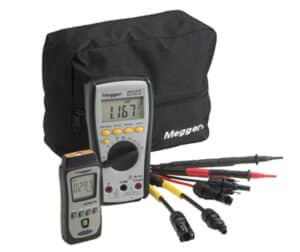
| Fork multimeter | Megger DCM330 | Test leads, pouch, batteries, user guide |
Technical Specifications
Megger DCM330 Fork Multimeter
| Specification | Value | Why It Matters |
|---|---|---|
| AC current | 0 to 200.0 A at 50 to 60 Hz; ±3% ±3 digits | Gives a current reading without opening the circuit |
| Current sensing | Average sensing, RMS indicating | Not True RMS, so take care on distorted loads |
| Conductor size | Single unshielded conductor up to 16 mm diameter | Check cable size before you buy |
| Jaw type | Fixed open fork, no moving parts | Less affected by dirt, grit and moisture |
| AC/DC voltage | Auto-ranging up to 1000 V; 200 V range DC ±1% ±2 digits, AC ±1.5% ±5 digits | Removes the need for a separate basic multimeter |
| Voltage input impedance | 2 MΩ | Helps you understand loading on sensitive circuits |
| Resistance | 200 Ω to 20 MΩ ranges; ±1% to ±1.9% | Checks coils, windings and elements |
| Continuity | Buzzer on below 50 Ω; off above 250 Ω | Gives a quick audible result |
| Diode check | Yes | Handy for control and electronic faults |
| Non-contact AC detection | 50 to 1000 V, 50 to 500 Hz | Helps identify live cables in the jaw; see limitations above |
| Display | 3½-digit, 2000-count LCD with HOLD | Keeps readings visible after you move the meter |
| Safety rating | CAT III 1000 V / CAT IV 600 V | Sets the limits for where the meter can be used |
| Drop rating | 1.2 m onto a hard floor | Designed for everyday site use |
| Battery | 2 x AAA alkaline; about 250 hours | Rechargeable cells aren’t suitable |
| Auto power-off | After about 10 minutes | Helps conserve the batteries |
| Weight and dimensions | 280 g; 68 x 237 x 42 mm | Easy to carry on the job |
| Calibration | 12-month interval recommended | Useful for planning recalibration |
Megger MFT1815 Multifunction Installation Tester
| Specification | Value | Why It Matters |
|---|---|---|
| Insulation test voltages | 250 V, 500 V, 1000 V | Applies the voltages a standard multimeter can’t |
| Insulation range | 10 kΩ to 999 MΩ at 1000 V; ±3% ±2 digits | Separates failing insulation from healthy results |
| Live circuit protection | Up to 600 V | Helps guard against accidental live connection |
| Continuity | 205 mA ±5 mA; 0.01 Ω to 99.9 kΩ | Useful for repair and bonding checks |
| Loop testing | 2-wire and 3-wire non-trip L-PE; 2-wire high current L-N and L-L | Tests RCD-protected circuits without routinely tripping them |
| PFC / PSCC | Up to 20 kA | Displays available fault current |
| RCD test multiples | 1/2x, 1x, 5x, fast ramp, auto test | Provides a repeatable RCD test sequence |
| RCD types and ratings | AC, A, S, programmable; 10 to 500 mA | Covers common devices; excludes Type B |
| Touch voltage | 0 to 253 V | Adds fault voltage to the results |
| Supply | 10 to 600 V; 15 to 400 Hz; phase rotation | Verifies the supply |
| Safety rating | 600 V CAT III / 300 V CAT IV | Sets the limits for where the tester can be connected |
| Ingress protection | IP54 | Handles dust and water splashes |
| Power | 6 x AA alkaline (supplied) | Easy to replace on the road |
| Weight and dimensions | 1 kg with batteries; 150 x 85 x 235 mm | Comfortable on a neck strap |
| Warranty | 3 years on registration | Register with Megger to activate |
Megger TPT420 Voltage Tester
| Specification | Value | Why It Matters |
|---|---|---|
| Voltage range | 12 to 1000 V AC; 12 to 1500 V DC | Handles mains and high-voltage DC |
| Safety rating | CAT IV 1000 V | High overvoltage category |
| Ingress protection | IP64 | Handles dust and water splashes |
| Display | 13 LEDs, 4-digit LCD | Shows indication and value together |
| Battery-free warning | Dangerous voltage indicated with exhausted batteries | Adds a layer of protection |
| Frequency range | 40 to 400 Hz | Covers a wide range of AC supplies |
| Peak current | Under 3.5 mA at 1000 V | Supports non-trip phase-earth tests |
| Continuity | 0 to 500 kΩ | Quick visual and audible check |
| Phase rotation | 120 to 400 V phase to phase | No probe crossing required |
| Single-pole test | 100 to 1000 V AC, 50/60 Hz | Quick phase identification |
| Extras | LED torch, automatic backlight, GS38 shrouds, pouch | Practical in dim or cramped spots |
| Weight and dimensions | About 207 g; about 255 x 67 x 30 mm | Easy to carry daily |
Quick Answers
What is included in the Megger Electrician Starter Kit 2? The kit includes the Megger MFT1815 multifunction installation tester, TPT420 two-pole voltage tester and DCM330 200 A AC fork multimeter, along with each instrument’s standard accessories. It doesn’t include a proving unit.
What is a fork multimeter? A fork multimeter combines an open, fixed-jaw current sensor with standard multimeter functions. The Megger DCM330 hooks around a single conductor up to 16 mm to measure AC current up to 200 A, and its test leads handle voltage, resistance, continuity and diode checks.
Can the Megger DCM330 replace a multimeter and clamp meter? For many everyday electrical checks, yes. It covers AC/DC voltage to 1000 V, resistance to 20 MΩ, continuity, diode check and AC current to 200 A. It isn’t True RMS and only fits conductors up to 16 mm, so some applications still need another meter.
Which is better for an apprentice, Megger Starter Kit 1 or Kit 2? It depends on the work. Kit 2 is better for fault-finding, with one meter covering voltage, resistance and current. Kit 1 is better for dedicated load checks on larger conductors, thanks to the DCM310’s 400 A range and 27 mm jaw.
Is the DCM330 voltage detector a dead test? No. Its non-contact function only indicates live AC in a cable inside the jaw and has limitations with shielded or enclosed conductors. Use a two-pole tester such as the TPT420 and follow your safe isolation procedure to confirm a circuit is dead.
Frequently Asked Questions
1. Who should buy the Megger Electrician Starter Kit 2? It suits apprentices, electricians and maintenance technicians who regularly troubleshoot circuits and want installation testing plus a single meter for voltage, resistance and current.
2. Does the DCM330 measure DC current? No. Its current function measures AC only, up to 200 A at 50 to 60 Hz. The test leads do measure both AC and DC voltage up to 1000 V.
3. Is the DCM330 True RMS? No. It’s average sensing and RMS indicating, so accuracy can suffer on distorted waveforms from loads such as variable speed drives.
4. What’s the largest conductor the DCM330 can measure? It’s specified for single unshielded conductors up to 16 mm in diameter. Starter Kit 1’s DCM310 accepts conductors up to 27 mm.
5. Why do I need the MFT1815 if the kit already has a multimeter? The DCM330 is for general measurements. The MFT1815 carries out installation tests a multimeter can’t, including insulation at up to 1000 V, loop impedance, fault current and RCD testing.
6. Can the MFT1815 test Type B RCDs? No. It tests Type AC, A and S devices and programmable RCDs. Type B testing is available on higher models in the MFT1800 range.
7. Does this kit include a proving unit? No. Add a proving unit such as the Megger MPU690 if you don’t already have one, so you can check the TPT420 before and after testing.
8. Does the kit come with calibration certificates? The MFT1815 is supplied with a factory calibration certificate. Contact us before ordering if you need certificates for the other instruments or accredited calibration.
Be the first to review “Megger Electrician Starter Kit: MFT1815, TPT420 & DCM330 Fork Multimeter”
You must be logged in to post a review.
Installation Testers Megger Electrician Starter Kit: MFT1815, TPT420 & DCM310 Clamp Meter
Installation Testers
Installation Testers
Installation Testers
Installation Testers Related Products




Next day delivery
Finance services
Price Match
Technical support
Product training
Calibration servises
Need help? Call our support team 1800 358 531
Reviews
There are no reviews yet.