




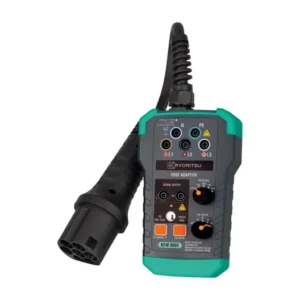
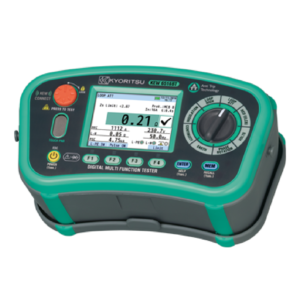
KYORITSU 6516BT Multi Function Tester with Bluetooth + 8602 EVSE Adaptor EV kit
Original price was: $3,962.00.$3,100.00Current price is: $3,100.00. .( $3,410.00 inc. GST )
For all your equipment calibration needs, visit our MyCalibration website.
 Free Delivery on orders over $1000
Shipping time may vary for certain products*

Product Enquiry
If you would like more information regarding this product, simply email us here.

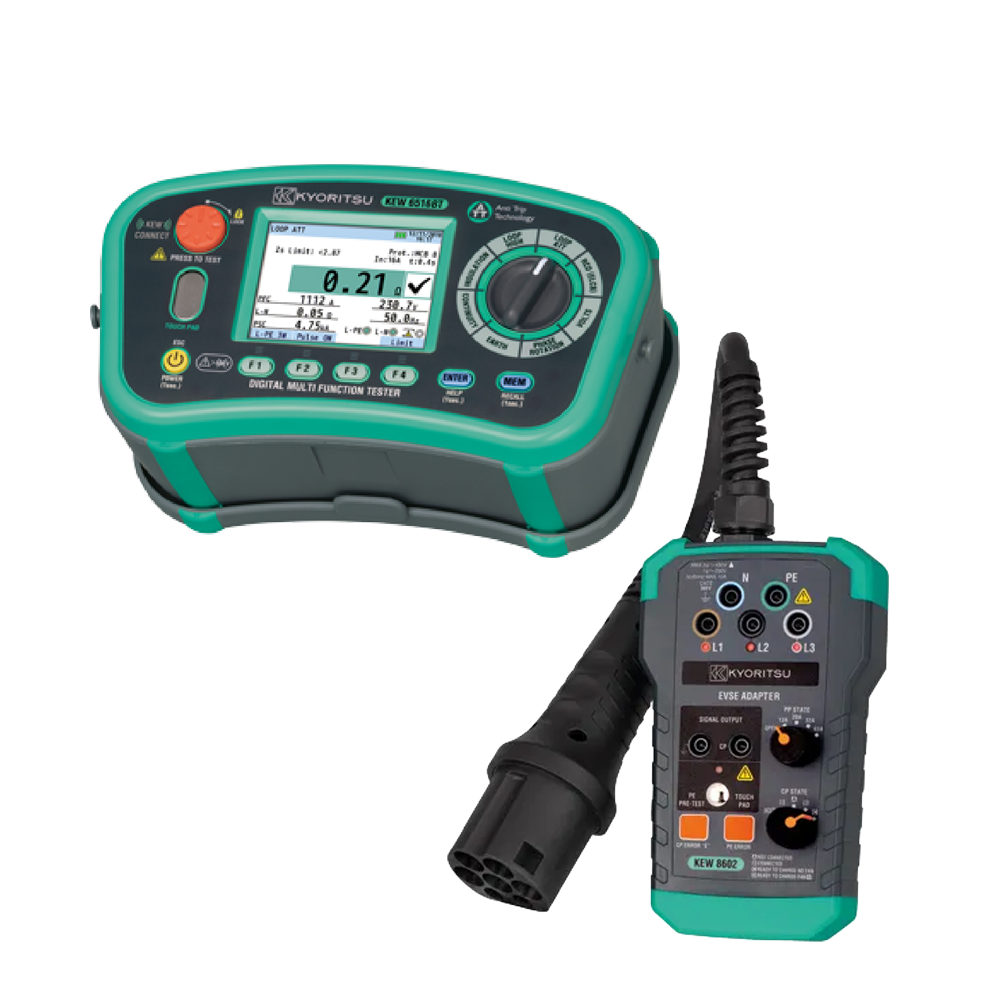
Everything you need to test an EV charge point installation in one kit. This bundle pairs the Kyoritsu KEW 6516BT multifunction installation tester (Bluetooth, ATT loop testing, EV-type RCD testing) with the KEW 8602 EVSE adapter, letting you simulate vehicle connection states and run CP/PE error checks on Mode 3 AC chargers. Equivalent to Kyoritsu’s KEW 6516BT-EV2 configuration. Complete, traceable, and ready for EVSE compliance work out of the box.
 Kyoritsu 6516-6516BT Datasheet Kyoritsu 6516-6516BT User Manual
Kyoritsu 6516 , 6516BT GUIDEBOOK
One kit for the EV charge point on the job sheet
EV charge point installation and commissioning work has its own testing requirements that a standard multifunction tester alone doesn’t fully cover. You need to verify the fixed installation feeding the charger — loop impedance, RCD protection, insulation, earthing — and you also need to check the charge point itself is behaving correctly: reporting the right Control Pilot (CP) states, responding properly to a simulated vehicle connection, and not masking an earth fault behind its own protection electronics. Buying the tester and the EVSE adapter separately means researching compatibility yourself and hoping the combination is actually supported. This kit removes that guesswork by bundling the Kyoritsu KEW 6516BT with the purpose-built KEW 8602 EVSE adapter — the same pairing Kyoritsu itself configures as the KEW 6516BT-EV2 kit.
What each part of the kit does
The KEW 6516BT is the multifunction installation tester at the centre of the kit. It covers insulation resistance, loop impedance (including trip-free ATT loop testing on RCD-protected circuits), RCD testing across AC, A, F, B, EV and Variable types, earth resistance, continuity, phase rotation, voltage/frequency, SPD testing and a PAT function — all from a single CAT IV 300V / CAT III 600V-rated instrument, with Bluetooth 5.0 for wireless transfer of stored results. Full specifications for the 6516BT on its own are covered on its dedicated product page.
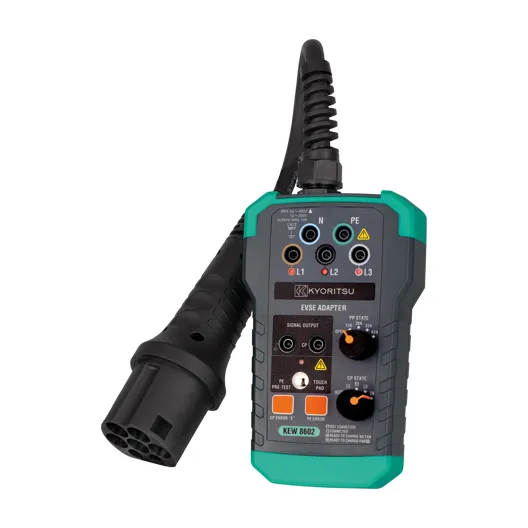
The KEW 8602 EVSE adapter is what makes EV charge point testing possible with that tester. It’s a dedicated adapter for Mode 3 AC EVSE (Electric Vehicle Supply Equipment) inspection, maintenance and troubleshooting, connecting between the charge point’s Type 2 outlet and the multifunction tester. It simulates the four Control Pilot (CP) states — A, B, C and D — along with Proximity Pilot (PP) cable-rating states (open circuit, 13A, 20A, 32A, 63A), and lets you deliberately inject a CP signal error or a PE (earth fault) error to confirm the charge point actually detects and reacts to a fault rather than just assuming it will. A dedicated touch pad handles PE voltage checks, and the adapter’s own mains socket lets the 6516BT’s leads connect through for loop, RCD and insulation testing on the charger’s supply.
Important: what this kit does — and doesn’t — cover
This is worth stating plainly rather than leaving it to the fine print: the KEW 8602 adapter is rated IEC 61010-1 CAT II 300V, which is a lower category than the 6516BT tester itself. When testing through the 8602 adapter, the test setup is governed by the adapter’s CAT II 300V rating, not the tester’s CAT IV/CAT III rating — work within that limit accordingly. The adapter also supports Mode 3 AC EVSE only; it does not support fast (DC) chargers. If your work includes DC fast-charging infrastructure, this kit is not the right tool for that side of the job — it’s built specifically for Mode 3 AC charge point commissioning, maintenance and troubleshooting.
Why bundle rather than buy separately
Beyond the convenience of one order and one supplier relationship, a matched kit means you’re not left guessing whether a given adapter and tester combination is actually supported by the manufacturer. Kyoritsu configures the KEW 6516BT-EV2 as a deliberate pairing, and this kit reflects that same configuration — so the CP/PP simulation, PE error injection, and loop/RCD pass-through between the 8602 and the 6516BT work as the manufacturer intends, without cross-brand compatibility questions.
Typical use on site
A typical EVSE test sequence with this kit runs the 6516BT’s standard installation checks — insulation resistance, loop impedance with ATT to avoid nuisance tripping, and RCD testing including the EV-specific 6mA setting — on the fixed wiring feeding the charge point, then connects the 8602 adapter at the charger’s outlet to step through CP state verification, PP cable-rating detection, and PE/CP error simulation to confirm the charger’s own protection responds correctly. That combination — fixed installation compliance plus charge-point-specific functional checks — is what EVSE commissioning and periodic testing generally calls for, covered here from a single kit rather than assembled from separate instruments.
Who this kit is for
- Electrical contractors and EV installers commissioning new Mode 3 AC home or workplace charge points, who need both fixed-installation test results and charge-point functional verification from the same visit.
- Facility and fleet EV infrastructure managers running periodic testing across multiple charge points, where consistent documented results matter for compliance records.
- Test-and-tag and maintenance teams adding EVSE troubleshooting to their existing multifunction testing capability without carrying a separate, incompatible adapter.
What’s in the kit
- Kyoritsu KEW 6516BT multifunction installation tester, complete with its own included accessories: test leads, remote-control test leads, distribution board test lead, earth resistance leads and spikes, soft case, carrying case, shoulder strap/pad, 8 x AA batteries, instruction manual and calibration certificate (see the KEW 6516BT product page for the full list).
- Kyoritsu KEW 8602 EVSE adapter, complete with 9202 carrying case, spare 8930 fuse (10A/250V), and instruction manual.
Why buy your EV testing kit from Rapid-Tech
Rapid-Tech supplies genuine Kyoritsu test and measurement equipment to Australian trade professionals, backed by local stock, expert product guidance, and in-house calibration support so your kit stays traceable and job-ready. If you’re not sure whether this kit or the standalone KEW 6516BT is right for your work, our team can talk you through it before you buy.
Pairing your 6516BT with Field Efficient takes the Bluetooth-transferred test data further, giving you a central place to manage job scheduling, certificates and reporting across your whole test fleet — including EVSE compliance records — rather than handling results instrument-by-instrument.
Technical Specifications — KEW 8602 EVSE Adapter
| Specification | Value | Why It Matters |
|---|---|---|
| Function | Dedicated adapter for Mode 3 AC EVSE inspection, maintenance and troubleshooting | Purpose-built for charge point testing rather than a generic accessory |
| Charger support | AC (normal) chargers only — does not support DC fast chargers | Confirms scope before you head to a DC fast-charging site expecting to use this kit |
| CP states simulated | A, B, C, D | Verifies the charge point correctly reports and reacts to each vehicle-connection state |
| PP states simulated | OPEN, 13A, 20A, 32A, 63A | Confirms the charger correctly detects cable current-carrying capacity |
| Error simulation | CP signal error, PE (earth fault) error | Deliberately injects faults to confirm the charger’s own protection actually responds |
| PE pre-test | Yes, via touch pad | Checks earth continuity before committing to a full test sequence |
| Test connector | IEC 62196-2 Type 2 | Matches the standard AC charging connector used across most Australian EV infrastructure |
| Rated voltage | AC 250V max (single-phase), AC 430V max (three-phase), 50/60Hz | Covers both single-phase and three-phase AC charge point installations |
| Mains socket (adapter) | AC 10A/250V, AU Type O socket | Connects the 6516BT’s mains test lead through the adapter for pass-through installation testing |
| Fuse rating | AC 10A/250V, Ø5×20mm (spare fuse included) | Protects the adapter and allows a quick field fix if the fuse blows |
| Applicable standards | IEC 61010-1 CAT II 300V, IEC 61010-2-030, IEC 61851-1, IEC 60529 (IP40) | Confirms the adapter’s own safety and construction standards — note the CAT II rating governs the test setup when the adapter is in use |
| Cable length | Approx. 250mm | Short, purpose-fit lead between adapter and charge point outlet |
| Dimensions | Unit 172(L) × 105(W) × 57(D) mm; plug 175(L) × 60(W) × 53(D) mm | Compact enough to carry alongside the 6516BT in the same kit |
| Weight | Approx. 840g | Field-practical weight for the adapter component of the kit |
| Included accessories | 9202 carrying case, 8930 spare fuse, instruction manual | Ready to use alongside the 6516BT without further accessory purchases |
| Optional accessory | 8603 (Type 1 to Type 2 conversion adapter) | Extends compatibility to Type 1 connector vehicles/chargers if needed |
For the KEW 6516BT tester’s full specification table — insulation, loop, RCD, earth, continuity, phase rotation, SPD and PAT — see the standalone KEW 6516BT product page.
What’s included in the Kyoritsu 6516BT EV testing kit? The kit bundles the Kyoritsu KEW 6516BT multifunction installation tester (with Bluetooth) and the KEW 8602 EVSE adapter, plus each item’s own standard accessories — test leads, earth spikes, carrying cases, a spare fuse for the adapter, instruction manuals and a calibration certificate for the tester.
What does the KEW 8602 EVSE adapter actually test? It simulates the four Control Pilot (CP) states, Proximity Pilot (PP) cable-rating states, and lets you inject CP signal or PE (earth fault) errors to confirm a Mode 3 AC EV charge point correctly detects a connected vehicle and responds properly to a fault condition.
Does this kit work with DC fast chargers? No. The KEW 8602 adapter supports Mode 3 AC charging equipment only — it does not support DC fast chargers.
What safety category is the EVSE adapter rated to? The KEW 8602 is rated IEC 61010-1 CAT II 300V. This is lower than the 6516BT tester’s own CAT IV 300V / CAT III 600V rating, so the test setup is governed by the adapter’s CAT II 300V limit whenever it’s connected.
Is this the same as Kyoritsu’s KEW 6516BT-EV2 kit? Yes, this bundle reflects the same KEW 6516BT + KEW 8602 pairing that Kyoritsu configures as the KEW 6516BT-EV2 kit.
| Weight | 2 kg |
|---|
Be the first to review “KYORITSU 6516BT Multi Function Tester with Bluetooth + 8602 EVSE Adaptor EV kit”
You must be logged in to post a review.
- KEW 6516/6516BT Specifications
|
Insulation resistance |
SPD(Varistor) |
||||||
|
Test voltage |
100V |
250V |
500V |
1000V |
Max.1000V |
||
|
Measuring ranges |
2.000/20.00/200.0MO (Auto-ranging) |
20.00/200.0/1000MO (Auto-ranging) |
20.00/200.0/2000MO (Auto-ranging) |
0-1000V(goes up by 1V) |
|||
|
Accuracy |
±2%rdg±6dgt (2.000/20.00MO) ±5%rdg±6dgt (200.0MO) |
±2%rdg±6dgt (20.00/200.0MO) ±5%rdg±6dgt (1000MO) |
±2%rdg±6dgt (20.00/200.0MO) ±5%rdg±6dgt (2000MO) |
±5%rdg±5dgt |
|||
|
Rated current |
1.0-1.2mA @0.1MO |
1.0-1.2mA @0.25MO |
1.0-1.2mA @0.5MO |
1.0-1.2mA @1MO |
– |
||
|
Short circuit current |
1.5mA max |
– |
|||||
|
Loop impedance |
|||||||
|
Function |
LOOP ATT |
LOOP HIGH |
|||||
|
L-PE/L-N(3wire) |
L-PE(2wire) |
L-PE(0.01ORes) |
L-PE(0.001ORes) |
L-N/L-L |
|||
|
Rated voltage |
100-260V(50/60Hz) |
48-260V(50/60Hz) |
48-260V(50/60Hz) |
100-260V(50/60Hz) |
48-500V(50/60Hz) |
||
|
Impedance range |
20.00/200.0/2000Ω (Auto-ranging) |
20.00/200.0/2000Ω (Auto-ranging) |
2.000O |
20.00O |
|||
|
Accuracy |
±3%rdg±6dgt |
±3%rdg±10dgt |
±3%rdg±4dgt |
±3%rdg±25mO |
±3%rdg±4dgt |
||
|
Nominal test current at 0Ω external loop: Magnitude/Duration at 230V |
L-N:6A/60ms N-PE:10mA |
L-PE:15mA |
20O:6A/20ms 200O:0.5A/20ms 2000O:15mA/500ms |
25A/20ms |
6A/20ms |
||
|
PSC/PFC |
|||||||
|
Range |
2000A/20kA(L-N(PSC)/L-PE(PFC)) |
2000A/20kA(PFC) |
2000A/20kA(PFC) |
2000A/50kA(PFC) |
2000A/20kA(PSC) |
||
|
Accuracy |
PSC/PFC accuracy is derived from measured loop impedance specification and measured voltage specification |
||||||
|
RCD |
|||||||
|
Rated voltage |
100-260V(50/60Hz) |
||||||
|
Function |
x1/2, x1,x5,Ramp,Auto,Uc |
||||||
|
6/10/30/100/300/500/1000mA/variable |
|||||||
|
RCD type |
AC(G/S) |
A(G/S) |
F(G/S) |
B(G/S) |
EV |
||
|
Trip current setting |
x1/2,x1,Uc |
10/30/100/300/500/1000mA(G) 10/30/100/300/500mA(S) |
10/30/100/300/500mA |
10/30/100/300/500mA |
10/30/100/300mA |
6mA(×1 only) |
|
|
x5 |
10/30/100mA |
10/30/100mA |
10/30/100mA |
10/30mA |
– |
||
|
Ramp |
10/30/100/300/500mA |
10/30/100/300/500mA |
10/30/100/300/500mA |
10/30/100/300mA |
6mA |
||
|
Accuracy |
Trip current |
x1/2 |
-8% – -2% |
-10% – 0% |
-10% – 0% |
-10% – 0% |
– |
|
x1 |
+2% – +8% |
0% – +10% |
0% – +10% |
0% – +10% |
0% – +10% |
||
|
x5 |
+2% – +8% |
0% – +10% |
0% – +10% |
0% – +10% |
– |
||
|
Ramp |
-4% – +4% |
-10% – +10% |
-10% – +10% |
-10% – +10% |
-10% – +10% |
||
|
Trip time |
x1/2 |
2000ms(G/S):±1%rdg±2ms |
– |
||||
|
x1 |
550ms(G):±1%rdg±2ms,1000ms(S):±1%rdg±2ms |
10.5s:±1%±2ms |
|||||
|
x5 |
410ms(G/S):±1%rdg±2ms |
– |
|||||
|
Continuity |
Volts |
||||||
|
Range |
20.00/200.0/2000Ω (Auto-ranging) |
Range |
300.0/600V(Auto-ranging) |
||||
|
Open circuit voltage (DC) |
7-14V |
Measuring ranges |
Volts |
2-600V |
|||
|
Measuring current |
200mA |
>200mA or more(2Ω or less) |
Frequency |
45-65Hz |
|||
|
15mA |
15mA±3mA(short-circuit) |
Accuracy |
Volts |
±2%rdg±4dgt |
|||
|
Accuracy |
±2%rdg±8dgt |
Frequency |
±0.5%rdg±2dgt |
||||
|
Phase Rotation |
Earth |
||||||
|
Rated voltage |
48-600V(50/60Hz) |
Range |
20.00/200.0/2000O(Auto-ranging) |
||||
|
Remarks |
Remarks Correct phase sequence: are displayed “1.2.3” and mark Reversed phase sequence: are displayed “3.2.1” and mark |
Accuracy |
±2%rdg±0.08O(20.00O) ±2%rdg±3dgt(200.0/2000O) |
||||
|
General |
|||||||
|
Applicable Standards |
IEC 61010-1 CAT Ⅳ 300V,CAT Ⅲ 600V Pollution degree 2, IEC 61010-2-034, IEC 61557-1,2,3,4,5,6,7,10, IEC 60529(IP40), IEC 61326(EMC) |
||||||
|
Communication Interface |
USB, Bluetooth® 5.0 LE(Bluetooth® Low Energy)*1 , AndroidTM 5.0 or more, iOS 10.0 or more |
||||||
|
Power source |
LR6(AA)(1.5V) × 8 |
||||||
|
Dimensions |
136(L) × 235(W) × 114(D)mm |
||||||
|
Weight |
1300g (including batteries.) |
||||||
|
Included Accessories |
Main test lead*², 7281(Test leads with remote control switch), 7246(Distribution board test lead), 7228A(Earth resistance test leads), 8041(Auxiliary earth spikes[2 spikes/1 set]) 9084(Soft case), 9142(Carrying case), 9151(Shoulder strap), 9199(Shoulder pad), LR6(AA) × 8, Instruction manual, 8212-USB(USB adaptor with “KEW Report(Software)”)*³, Calibration certificate |
||||||
|
Optional Accessories |
8212-USB(USB adaptor with”KEW Report(Software)”)*3, 8259(Adapter for measurement terminal), 7272(Precision measurement Cord set), 8017A(Extension prod long) |
*1 6516BT only
*2 7187A:British plug, 7218A:(EU)European SHUKO plug, 7221A(SA) South african plug, 7222A:(AU)Australian plug
*3 8212-USB : Standard accessory for 6516, optional accessory for 6516BT
Bluetooth is a trademark or registered trademark of Bluetooth SIG. Inc.
Android is a trademark or registered trademark of Google Inc.
iOS is a trademark or registered trademark of Cisco Technology, Inc. in the United States and other countries.
Kyoritsu 6516 Multi Function Tester Features
| DISPLAY | ・Color LCD 3.5 inches dot matrix. |
| ATT | ・Anti-Trip Technology (with 2 & 3 wire) for no trip LOOP L-PE testing on all RCDs. |
| ・With 2 wire only, very useful in case of no Neutral (i.e. 3-phase motor lines). | |
| LOOP | ・High test current range of 2Ω with 0.001Ω resolution. |
| ・Zs Limit compares the values required by Electrical Installations Standard with measured results. | |
| RCD | ・Type AC, A, F, B(General & Selective), EV and Variable RCDs. |
| ・Single and Auto test, Ramp test and Contact voltage. | |
| EARTH | ・Earth resistance test 2 and 3 wires with all accessories included. |
| INSULATION | ・Resistance test 100, 250, 500 & 1000V with auto discharge voltage. |
| CONTINUITY | ・Continuity test at 200mA or 15mA with selectable buzzer for fast judgment. |
| PHASE ROTATION | ・On 3-phase lines with clear indication of the sequence on the display. |
| VOLTS | ・TRMS Voltage measurements 2-600V, Mains Frequency. |
| HELP | ・Display shows how to connect the instrument according to the function selected. |
| SPD | ・Surge Protection Device test, for SPD that uses varistor. |
| PAT | ・Portable Appliance Tester function, for Insulation & Protective conductor resistance test |
| BLUETOOTH | ・Communication by “KEW CONNECT” |
| SAFETY | ・IEC 61010-1 CAT IV 300 V, CAT III 600 V. IEC 61557-1,2,3,4,5,6, |
1. Can I buy the KEW 6516BT and KEW 8602 separately instead of as a kit? Yes, both are also available individually, but buying the kit guarantees a manufacturer-matched pairing and is generally the simpler option if EV charge point testing is a core part of your work.
2. Does the kit include a calibration certificate? The KEW 6516BT tester is supplied with a factory calibration certificate. The KEW 8602 adapter ships with its instruction manual and standard accessories as listed above.
3. What connector type does the KEW 8602 use? It uses an IEC 62196-2 Type 2 connector, matching the standard AC connector used on most Australian EV charge points. The optional 8603 adapter extends this to Type 1 connections if required.
4. Can the 6516BT test the fixed wiring and the charge point in the same test sequence? Yes — the 6516BT handles insulation, loop and RCD testing (including the EV-specific 6mA setting) on the fixed installation, while the 8602 adapter handles CP/PP state and error simulation at the charge point itself.
5. What happens if the adapter’s fuse blows? A spare 8930 fuse (10A/250V) is included with the KEW 8602, so a blown fuse can be replaced in the field without downtime.
Related Products

Next day delivery
Finance services
Price Match
Technical support
Product training
Calibration servises
Need help? Call our support team 1800 358 531

Reviews
There are no reviews yet.