


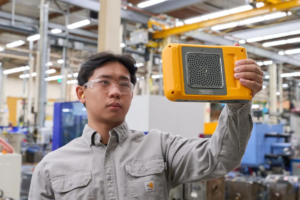
Fluke ii1030 Acoustic Imager – Leak Detection Camera
$24,100.00 .( $26,510.00 inc. GST )
For all your equipment calibration needs, visit our MyCalibration website.
 Free Delivery on orders over $1000
Shipping time may vary for certain products*

Product Enquiry
If you would like more information regarding this product, simply email us here.

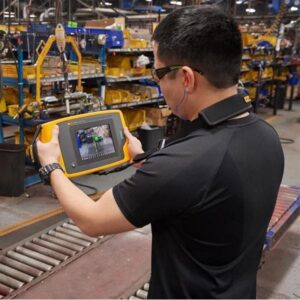
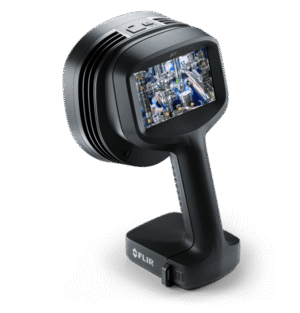
The Fluke ii1030 Acoustic Imager finds compressed air, gas and vacuum leaks in minutes and puts a dollar figure on each one. A 202-microphone array and SoundSight™ imaging overlay leak sound directly onto a 13 MP image, while LeakQ™ estimates leak rate and energy cost so you can rank repairs. Detects leaks from more than 100 m away (depending on ambient conditions), generates reports on the device, and weighs just 1.2 kg. Built for leak surveys, energy audits and air-tightness checks.

Your compressor is working overtime – and you can’t hear why
Every compressed air system leaks. The problem is that leaks don’t announce themselves. On a running factory floor, the hiss of a cracked fitting or a tired push-in connector is lost under motors, conveyors and extraction fans. The compressor just runs a bit longer each shift, the power bill creeps up, and nobody can point to where the air is going.
The old way of finding out is slow. Soapy water on every joint. A single-point ultrasonic gun swept along kilometres of pipework. Ladders and elevated work platforms to reach overhead headers. It works, but it eats days of technician time, it misses the leaks you can’t physically get to, and it leaves you with a list of “leaks found” and no clear idea which ones actually matter.
The Fluke ii1030 Acoustic Imager is built to fix exactly that. It turns ultrasonic leak noise into a picture you can see on screen, tells you roughly how big each leak is and what it’s costing, and lets you build the repair list and report right there on the tool.
How the ii1030 works: seeing sound
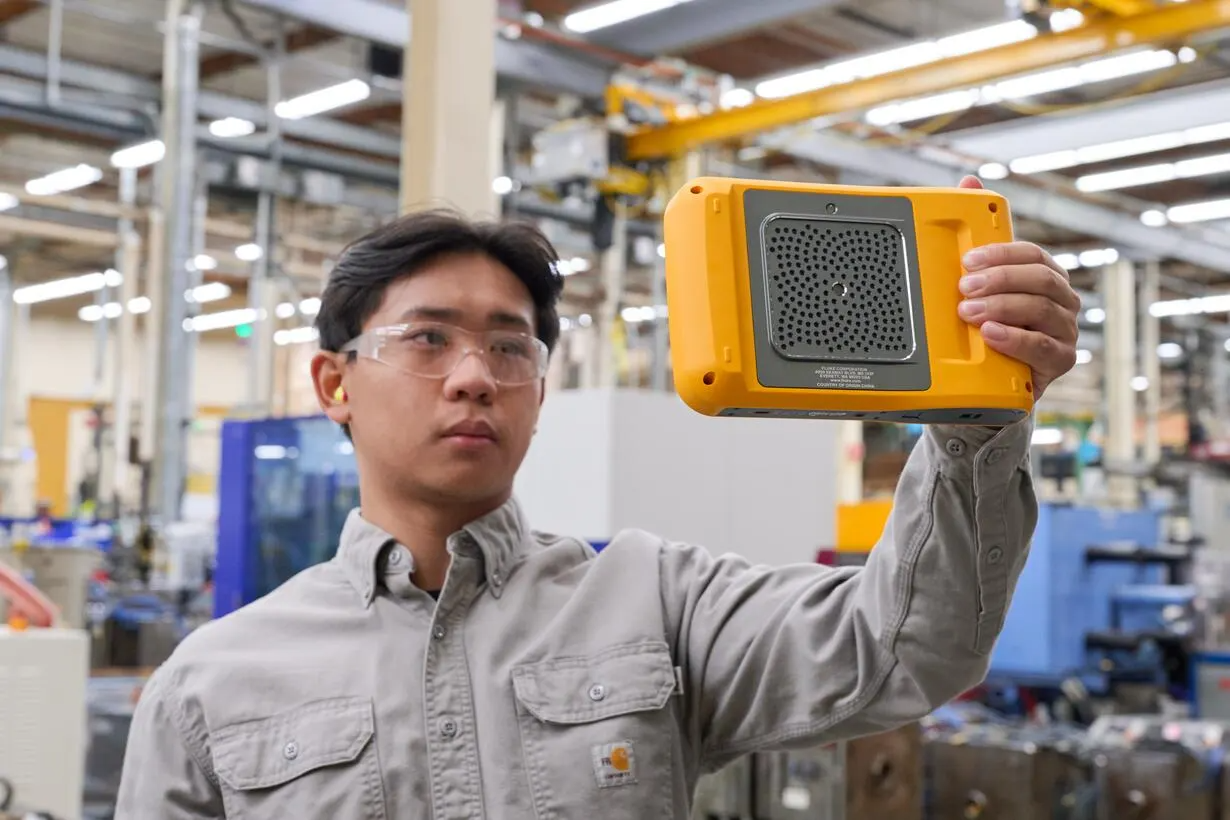
Gas escaping through a small opening creates turbulence, and that turbulence produces ultrasonic sound – mostly well above the range of human hearing. The ii1030 listens for it with an array of 202 digital MEMS microphones spread across the front of the instrument.
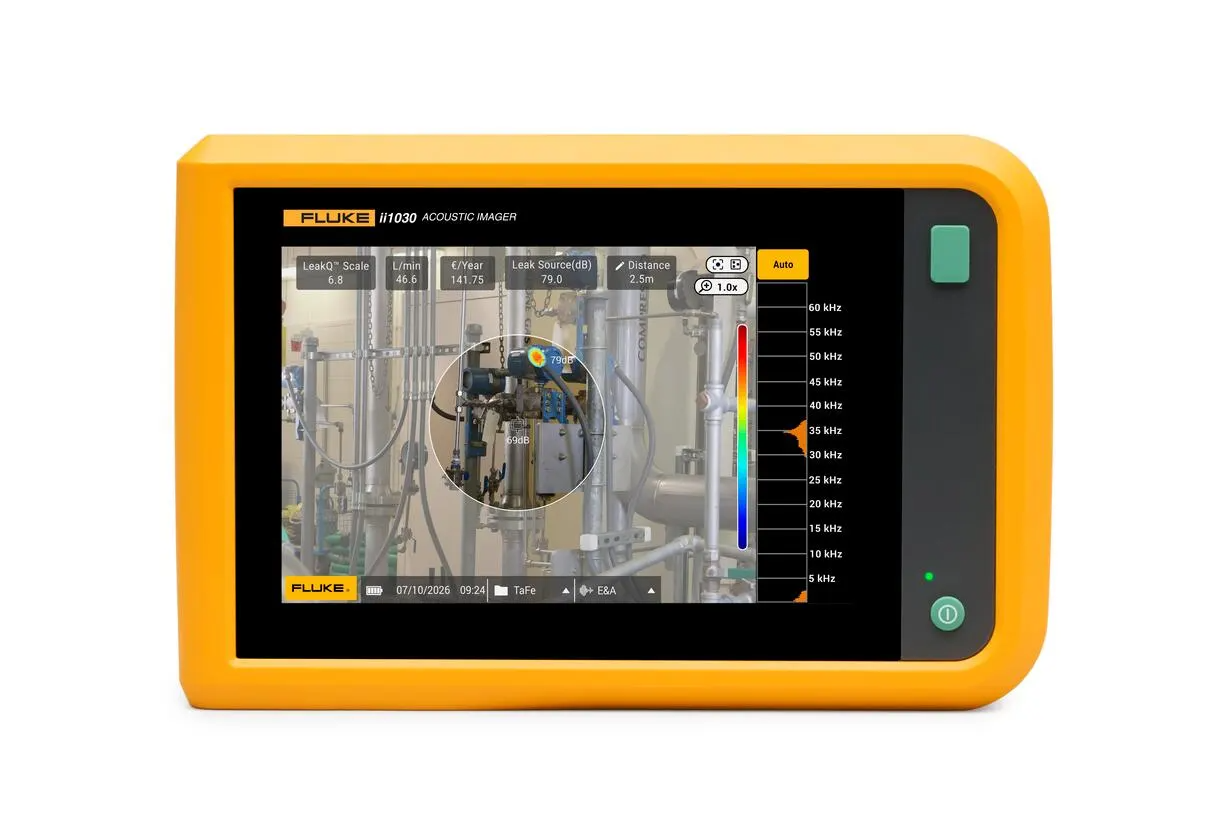
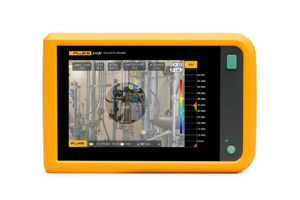
Because each microphone hears the sound arrive at a slightly different moment, the instrument can work out where the sound is coming from. Fluke’s SoundSight™ technology then draws that location as a coloured SoundMap™ overlay on top of a live image from the built-in 13 MP visible-light camera. Point the imager at a manifold, a bank of pneumatic valves or an overhead pipe run, and the leak shows up as a hotspot on the exact fitting that’s letting go.
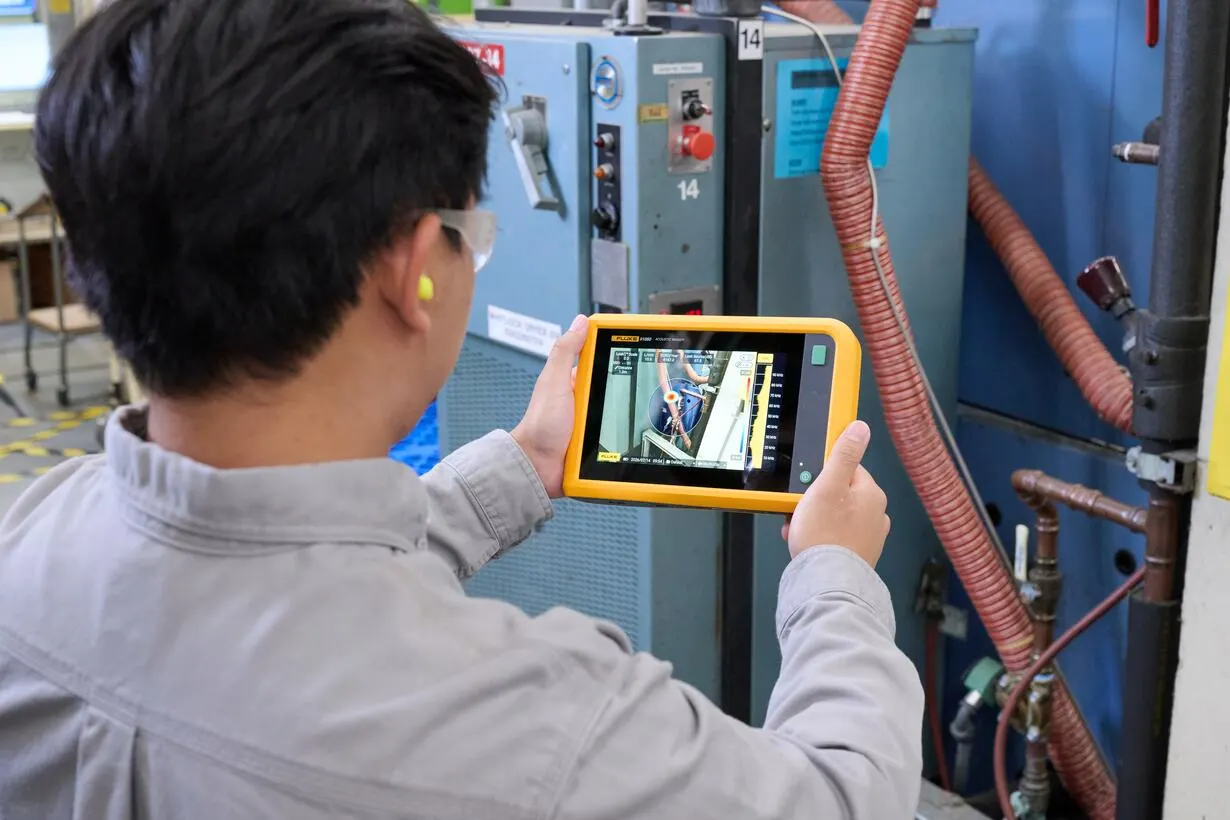
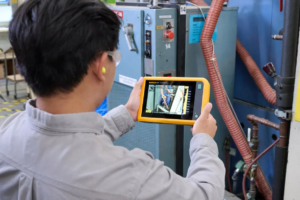
You don’t need to touch the equipment, open guards or climb to every joint. You scan, you look at the screen, and you walk straight to the problem.
The ii1030 works across a 2 kHz to 64 kHz frequency band, with user-selectable frequency presets or manual entry. That flexibility matters in a real plant: you can shift the band away from the background noise of your particular site so the leak stands out instead of the machinery around it.
More microphones, finer detail
Microphone count is one of the biggest differences between acoustic imagers. More microphones mean the instrument can separate sound sources that are close together and pick up fainter ones. With 202 MEMS microphones, the ii1030 is designed to resolve small, quiet leaks and to pinpoint individual fittings in crowded valve banks rather than just “somewhere on that panel”. It also supports multi-source display, so several leaks in the same scene can be seen at once instead of one at a time.
LeakQ™: from “leak found” to “leak worth fixing first”
Finding leaks is only half the job. The real question from the maintenance manager or the energy auditor is: which ones do we fix first, and what’s it worth?
That’s where LeakQ™ Mode comes in. For each leak, the ii1030 estimates:
- Leak size on a LeakQ™ scale (1–10)
- Leak rate (estimated volume)
- Estimated leak cost
With those numbers, you can sort a survey by financial impact rather than gut feel. The big, expensive leaks go to the top of the work order list; the minor weepers can wait for the next shutdown. It also gives you the evidence to justify a leak-repair program and to show the savings once repairs are done.
For sustainability reporting, the Fluke Online LeakQ™ Reporting Tool can also estimate the CO₂ emissions associated with the compressed air leaks you’ve identified – useful for sites tracking energy and emissions targets.
Air-tightness testing with Beacon Mode
Not every leak problem involves a pressurised line. Sometimes you need to know whether an enclosure, a cabin, a housing or a sealed assembly is actually sealed.
Pair the ii1030 with the optional Fluke SB140 SoundBeacon™ ultrasonic transmitter and switch to Beacon Mode. Place the beacon inside the enclosed product or space, and the ii1030 shows you exactly where ultrasonic sound is escaping – which is exactly where the seal has failed. It’s a fast, non-contact way to check:
- Automotive components and assemblies
- Engines and fuel systems
- HVAC equipment
- Wind turbine components
- Pressure vessels and process equipment
- Piping systems and chemical processing equipment
That makes the ii1030 useful well beyond the maintenance department – in production QA, end-of-line inspection and product development, where catching a sealing defect early can head off warranty claims.
Inspect from a distance
The ii1030 can detect leaks from 0.5 m to more than 100 m (1.6 to more than 393 ft), depending on ambient conditions. In practice, that means you can scan high roof-mounted headers, overhead process lines and hard-to-reach gas connections from floor level – cutting down on elevated work, confined-space entry and time spent near hazardous process areas.
Built for the field, not the lab
The ii1030 is designed to be carried all shift:
- 1.2 kg with battery – light enough for long survey walks
- IP54 dust and water resistance for dusty plants, outdoor yards and light rain
- 7-inch anti-glare, sunlight-readable touchscreen (1280 × 800) so the SoundMap™ stays clear outdoors and under harsh lighting
- Built-in LED lighting for dark plant rooms, pits and cabinets
- Two rechargeable, field-replaceable Li-ion batteries supplied – more than 7 hours total (2 × 3.5 h), with internal USB-C charging in under 3 hours
- Operating temperature of −10 to 45 °C, covering cold mornings and hot Australian afternoons
- ¼”-20 tripod thread for fixed-position or long-duration monitoring
- Array-health self-diagnostic that flags when the microphone array needs attention
Document and report on the spot
Leak surveys live or die on the paperwork. The ii1030 lets you capture the evidence and build the report without going back to the office:
- Blended visual + SoundMap™ photos (.JPG) and videos (.MP4, up to 5 minutes)
- Asset annotation: asset name, ID, type, leak type, gas type and pressure
- QR-code asset ID scanning for fast, consistent tagging on repeat surveys
- Up to 4 photo notes per finding for context
- Inspection status: “As found”, “As left” or “Undetermined”
- Action annotation with requirement, priority and notes
- Operating conditions and weather notes
- On-device reporting – generate a report straight from the instrument
When you’re back on the network, transfer data over Wi-Fi or USB-C. Storage capacity is listed at 128 GB on the datasheet, so you can run large surveys without offloading mid-job.
Optional thermal imaging
Add the optional Fluke TC03A iSee™ Thermal Camera Attachment to bring thermal imaging into the same workflow. Thermal can help confirm acoustic findings, spot overheating components and capture richer evidence in a single pass – one tool, one walk-round, one report.
Who the ii1030 is for
The ii1030 is the right fit when leaks are the main job:
- Plant and industrial maintenance teams running compressed air leak programs
- Energy auditors and service contractors delivering compressed air audits
- Reliability engineers tracking utility losses across a site
- Manufacturing and QA teams verifying seal and air-tightness performance
- Gas and vacuum system operators needing non-contact leak location
Industries include food and beverage, plastics, pulp and paper, metals, chemical processing, mining, oil and gas, automotive and general manufacturing.
Need partial discharge or mechanical fault detection as well? Those capabilities – PDQ Mode™ and MecQ™ – are on the Fluke ii1050, which also extends the frequency range to 100 kHz and detection range to more than 150 m. If your work is focused on compressed air, gas and vacuum leaks and air-tightness, the ii1030 gives you the full LeakQ™ toolset without paying for electrical and mechanical modes you won’t use.
Why buy from Rapid-Tech
We’re test and measurement specialists, not a general tool shop. We’ll help you work out whether the ii1030 or the ii1050 is the better fit for your site, which accessories make sense (SB140 SoundBeacon™, TC03A thermal attachment, tripod/pistol grip) and how to get the most out of a leak survey program. Australian-based support, genuine Fluke stock and real technical advice.
Request a quote today and we’ll get your leak program sorted.
Technical Specifications
| Specification | Fluke ii1030 | Why It Matters |
|---|---|---|
| Microphones | 202 digital MEMS | More microphones resolve fainter and closer-spaced leaks |
| Frequency band | 2 kHz to 64 kHz | Covers the ultrasonic range where gas leaks are loudest |
| Frequency selection | User presets or manual entry | Tune out site-specific background noise |
| Detection range | 0.5 to >100 m (1.6 to >393 ft), depending on ambient conditions | Scan overhead and hard-to-reach lines from the ground |
| Acoustic field of view (typical) | 64° × 48° | Wide view for fast scanning of large areas |
| Frame rate (nominal) | 25 FPS | Smooth, real-time SoundMap™ display |
| Measurement range (typical) | 20 kHz: −10.4 to 122 dB SPL; 25 kHz: −24.7 to 122 dB SPL; 31.5 kHz: −13 to 122 dB SPL; 40 kHz: −10.7 to 122 dB SPL; 50 kHz: 8 to 122 dB SPL | Picks up very quiet leaks without saturating on loud ones |
| Gain | Auto or user-selectable max dB | Hands-off scanning or fine manual control |
| Visible camera | 13 MP, 3× digital zoom, focus 50 cm to infinity | Clear images showing exactly which fitting is leaking |
| Display | 7″ anti-glare LCD, sunlight readable, 1280 × 800, capacitive touch | Readable outdoors and in bright plant lighting |
| Palettes | Grayscale, Ironbow, Blue-Red; overlay transparency 1–100 % | Adjust the view to suit the scene and your report |
| LeakQ™ | Leak size scale (1–10), leak rate and cost estimation | Prioritise repairs by financial impact |
| Beacon Mode | Yes, with Fluke SB140 SoundBeacon™ (optional) | Air-tightness and sealing verification |
| Thermal | Yes, with Fluke TC03A (optional) | Acoustic + thermal evidence in one workflow |
| Partial discharge (PDQ Mode™) / MecQ™ | Not available (see ii1050) | – |
| Image / video format | Blended visual + SoundMap™ .JPG / .MP4 (video up to 5 min) | Easy to share and include in reports |
| Storage | 128 GB | Large surveys without offloading mid-job |
| Reporting | On-device reporting, plus PC and online reporting tools | Results reach the repair team faster |
| Asset ID | Text input and automatic QR-code identification | Consistent tagging for repeat surveys |
| Connectivity | 2 × USB-C, Wi-Fi | Quick data transfer and charging |
| Battery | 2 × rechargeable, field-replaceable Li-ion; >7 h total (2 × 3.5 h) | Full-shift surveys with a battery swap |
| Charging | Internal via USB-C, <3 h | Charge from the supplied 65 W USB-C charger |
| Lighting | Built-in LED | See what you’re aiming at in dark areas |
| Tripod mount | ¼”-20 UNC | Fixed-position inspections |
| Operating temperature | −10 to 45 °C | Suits Australian outdoor and plant conditions |
| Storage temperature | −20 to 70 °C | – |
| Relative humidity | 10 to 95 % RH, non-condensing | – |
| Operating altitude | Up to 2000 m | – |
| Ingress protection | IP54 | Handles dust and light rain |
| Dimensions (H × W × L) | 235 × 154 × 46 mm | Compact handheld |
| Weight (with battery) | 1.2 kg | Less fatigue on long surveys |
| Self-diagnostics | Microphone array-health test | Know when the array needs attention |
| Safety / EMC | IEC 61010-1 (pollution degree 2); IEC 61326-1; CISPR 11 Group 1 Class A; RoHS | – |
| Warranty | 2 years | – |
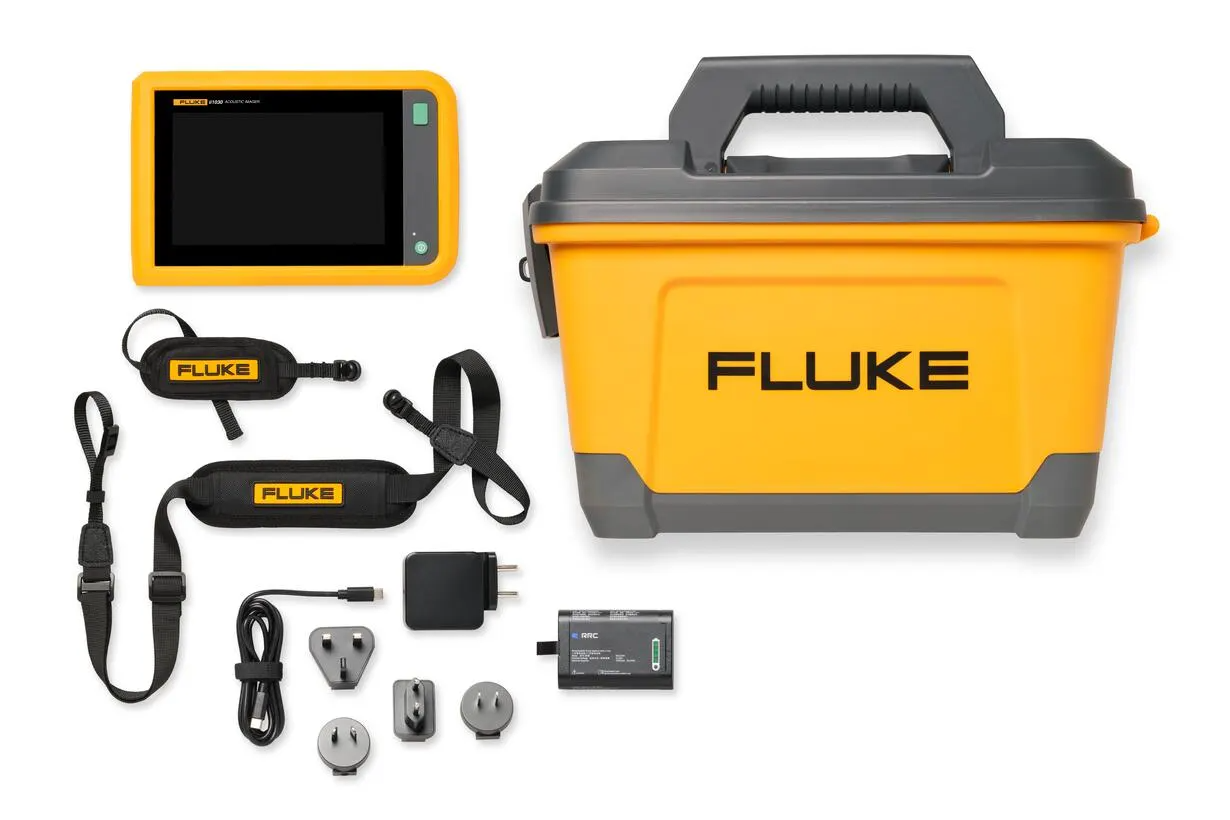
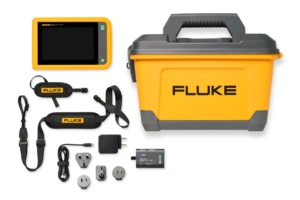
What’s in the box
- Fluke ii1030 Acoustic Imager
- 2 × lithium-ion smart battery packs
- Adjustable wrist strap and neck strap
- Hard carry case
- USB-C cable
- 65 W USB-C charger
Optional accessories
- Fluke SB140 SoundBeacon™ ultrasonic transmitter (Beacon Mode)
- Fluke TC03A iSee™ Thermal Camera Attachment
- Fluke TP01 pistol grip / tripod
- Spare RRC2040 battery pack
What is the Fluke ii1030 used for?
The Fluke ii1030 is a handheld acoustic imager used to find and quantify compressed air, gas and vacuum leaks. It uses 202 microphones to see ultrasonic leak noise as a coloured overlay on a camera image, and its LeakQ™ mode estimates each leak’s size, rate and cost so maintenance teams can prioritise repairs.
How far away can the Fluke ii1030 detect a leak?
The ii1030 has a detection range of 0.5 m to more than 100 m (1.6 to more than 393 ft), depending on ambient conditions. This lets technicians scan overhead pipework and hard-to-reach connections from ground level.
Can the Fluke ii1030 detect partial discharge?
No. The ii1030 is focused on leak detection and air-tightness testing. Partial discharge detection (PDQ Mode™) and mechanical inspection (MecQ™) are only available on the Fluke ii1050.
What is LeakQ™ on the Fluke ii1030?
LeakQ™ is Fluke’s leak quantification mode. On the ii1030 it estimates leak size on a 1–10 scale, leak rate and leak cost, helping teams rank repairs by financial impact. The Fluke Online LeakQ™ Reporting Tool can also estimate CO₂ emissions from identified compressed air leaks.
How does an acoustic imager find compressed air leaks?
Escaping gas creates ultrasonic sound. An acoustic imager uses an array of microphones to measure where that sound is coming from and displays it as a colour map over a live camera image, so the technician can see the leaking fitting on screen without touching the system.
What’s the difference between the Fluke ii1030 and ii1050?
Both use a 202-microphone array, 13 MP camera, 7″ anti-glare screen and LeakQ™. The ii1050 adds PDQ Mode™ for partial discharge, MecQ™ for mechanical faults, a wider 2–100 kHz frequency band (vs 2–64 kHz) and longer detection range of more than 150 m (vs more than 100 m), depending on ambient conditions.
Frequently Asked Questions
Does the Fluke ii1030 work in noisy factories? Yes. The ii1030 listens in the ultrasonic range (2–64 kHz), above most audible machinery noise, and lets you select frequency bands through presets or manual entry to filter out site-specific background noise.
Can I create reports directly on the ii1030? Yes. The ii1030 supports on-device reporting, including LeakQ™ reports. You can add asset details, photo notes, inspection status and action priorities on the instrument, then transfer data via Wi-Fi or USB-C.
What is Beacon Mode? Beacon Mode works with the optional Fluke SB140 SoundBeacon™ ultrasonic transmitter. You place the beacon inside an enclosed product or space and use the ii1030 to locate where ultrasonic sound escapes, revealing sealing and air-tightness defects.
How long does the battery last? The ii1030 comes with two rechargeable, field-replaceable Li-ion batteries, giving more than 7 hours of use (2 × 3.5 hours). Charging is internal via USB-C and takes under 3 hours.
Is the Fluke ii1030 suitable for outdoor use? Yes. It’s rated IP54 for dust and water resistance, operates from −10 to 45 °C and has a sunlight-readable anti-glare display.
Can I add thermal imaging to the ii1030? Yes. The optional Fluke TC03A iSee™ Thermal Camera Attachment adds thermal imaging so you can combine acoustic, thermal and visible-light evidence in one inspection.
How much does the Fluke ii1030 weigh? 1.2 kg including battery.
What warranty does the ii1030 have? The ii1030 comes with a 2-year Fluke warranty.
Does the Fluke ii1030 replace the ii905? The ii1030 is Fluke’s next-generation leak-detection acoustic imager in the ii-Series range. Contact us for advice on moving from an older Fluke acoustic imager.
Handheld Thermal Imager
Acoustic Leak Detector HIKMICRO AI56L (Air Leaks only) Acoustic Imaging Camera – Advanced Gas Leak Detection
Hikmicro HIKMICRO POCKET2 Water Detection Kit – Advanced Leak & Temperature Diagnostic Set for ProfessionalsRelated Products

Next day delivery
Finance services
Price Match
Technical support
Product training
Calibration servises
Need help? Call our support team 1800 358 531