



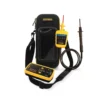
Martindale FD650 Digital Circuit Breaker & Fuse Finder Kit
$395.00 .( $434.50 inc. GST )
For all your equipment calibration needs, visit our MyCalibration website.
 Free Delivery on orders over $1000
Shipping time may vary for certain products*

Product Enquiry
If you would like more information regarding this product, simply email us here.

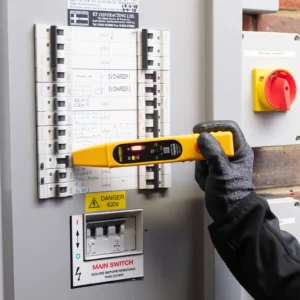
Stop guessing which breaker feeds which circuit. The Martindale FD650 Digital Circuit Breaker and Fuse Finder Kit lets electricians and facility teams trace live circuits from 13A sockets, light fittings, and distribution boards — all without powering anything down. The FD650’s smart auto-threshold receiver filters out false signals from adjacent circuits, delivering fast, reliable identification with both audible and LED bar graph confirmation. Everything you need comes in the kit, ready for the job.

The Problem Every Sparky Knows
You’re standing in front of a distribution board that hasn’t been properly labelled since it was first installed. The circuits are live, the panel’s a maze of breakers, and the client is waiting. Tracing each circuit manually — shutting off power, testing continuity, restoring supply — isn’t just time-consuming; it’s disruptive and carries real risk of missing something.
This is the daily reality for electrical contractors working on maintenance, fitouts, or compliance inspections across commercial and industrial sites. Poorly labelled switchboards are everywhere, and the traditional trial-and-error approach to circuit identification wastes time, frustrates clients, and adds unnecessary switching events to live installations.
There’s a better way.
Trace Live Circuits Without Shutting Down
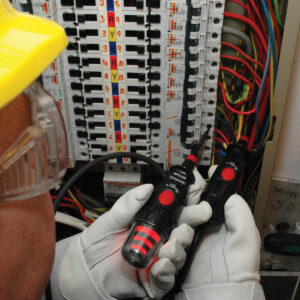
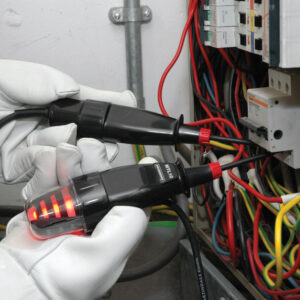
The Martindale FD650 Digital Circuit Breaker and Fuse Finder Kit is purpose-built for exactly this scenario. It lets you identify the correct fuse or circuit breaker for any given outlet or fitting while the installation remains fully energised — no guesswork, no unnecessary outages, no disruption.
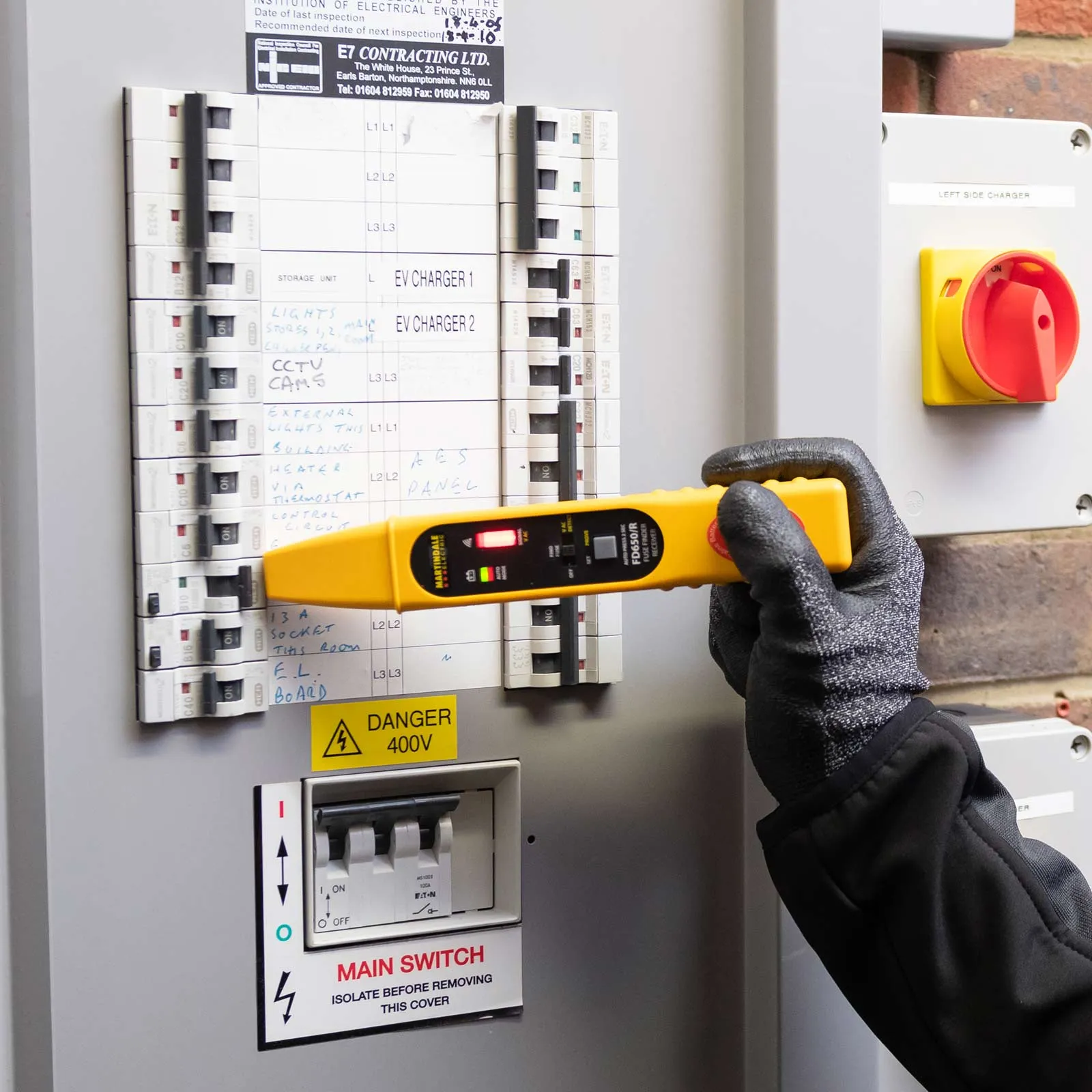
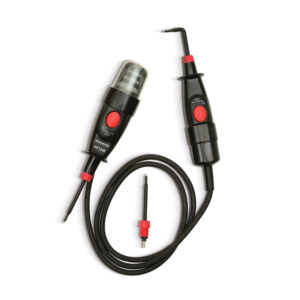
At the heart of the system is the relationship between the FD600/T multi-purpose transmitter and the FD650/R digital receiver. The transmitter injects a signal into the circuit at the point you’re testing — whether that’s a standard 13A socket, a light fitting, or directly across a distribution board using the included test leads. The receiver then scans the board and immediately identifies which breaker or fuse corresponds to that circuit through both audible tone and a clear LED bar graph display.
What sets the FD650 apart from simpler fuse finders is the inclusion of the FD600/T multi-purpose transmitter. Unlike the basic FD500/T (which plugs directly into a socket), the FD600/T connects via the included IEC mains lead and crocodile clip test leads. This opens up tracing capabilities well beyond wall sockets — you can identify breakers from lighting circuits, trace between distribution boards, and work on virtually any live point in the installation.
Smart Detection That Ignores the Noise
One of the practical challenges with circuit tracing is signal coupling — weaker signals that bleed from one circuit into adjacent wiring and create false positives. In a crowded switchboard or multi-circuit installation, this can make basic fuse finders unreliable.
The FD650/R receiver addresses this with its auto-threshold detection mode. In auto mode, the receiver performs a single sweep to learn the signal environment, then automatically adjusts its sensitivity threshold to ignore weaker coupled signals. The result is clean, confident identification even in complex installations with multiple circuits running in close proximity. For jobs where you need speed, the manual mode delivers fast, direct detection without the calibration step.
The receiver doubles as a non-contact voltage indicator, detecting live conductors from 40V to 600V AC across the frequency range 50Hz to 1kHz. A single instrument handles both circuit identification and basic voltage presence checking — fewer tools to carry, fewer pockets to dig through on site.
Built for Australian Electrical Work
The FD650 is rated to operate on 230V nominal supply — aligned with Australia’s standard single-phase supply — with an operating frequency range of 30 to 70Hz that covers the Australian 50Hz grid. Both the transmitter and receiver carry dual-rated safety certifications: the FD600/T transmitter is rated to CAT III 300V (BS EN 61010-1), and the FD650/R receiver carries the higher CAT IV 600V rating — appropriate for use at the origin of fixed installations including switchboards and distribution equipment. Class II double-insulated construction provides an additional layer of protection for both instruments.
For electrical contractors working to AS/NZS 3000 installation standards and AS/NZS 3760 inspection requirements, the FD650 fits naturally into the toolkit — supporting safe working practice by reducing the need for unnecessary circuit interruptions during testing and inspection activities.
Everything in the Kit
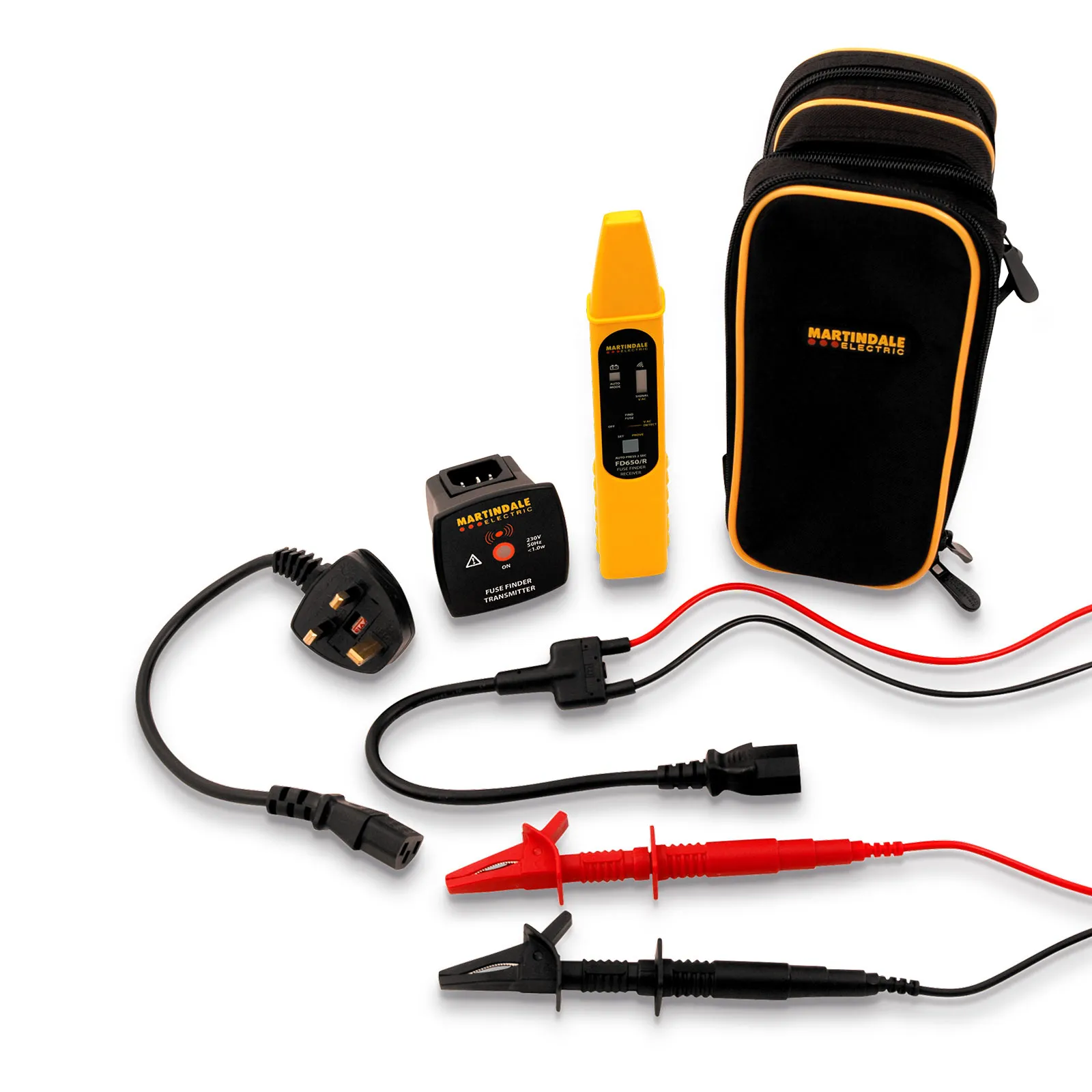
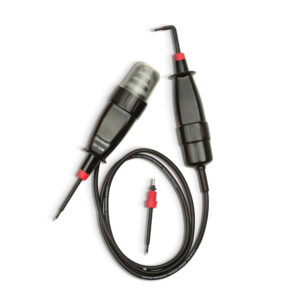
The FD650 is supplied as a complete, ready-to-use kit that includes:
- FD650/R — digital receiver with auto/manual detection modes and non-contact voltage indication
- FD600/T — multi-purpose mains-powered transmitter for sockets, light fittings, and boards
- FD500/T — standard plug-in 13A socket transmitter
- EX332 — IEC 13A mains lead adaptor
- TL83 — 2-wire fused test lead set with crocodile clips for direct circuit connection
- TC57 — soft carry case for organised, protected storage on site
- 9V PP3 alkaline battery — pre-installed in the receiver
- Instruction manual
The soft carry case keeps everything together and protected, which matters on busy sites where loose components have a habit of disappearing.
Where the FD650 Fits in Your Work
Maintenance and Inspection Work Electrical maintenance teams working through large commercial or industrial facilities can use the FD650 to rapidly map circuits during inspections, verify board labelling accuracy, and document circuit assignments — all without taking systems offline.
Fitouts and Renovations When working on a fitout or renovation in an occupied building, minimising downtime is critical. The FD650 allows electricians to identify and isolate only the specific circuit being worked on, keeping the rest of the installation live and operational.
Switchboard Audits and Relabelling Many older commercial buildings have switchboards with missing, incorrect, or illegible labelling. The FD650 provides a systematic, reliable way to audit and relabel every circuit — a job that becomes far more efficient when you don’t have to shut down circuits one by one.
Facility Management and Compliance Facility managers responsible for electrical compliance documentation can use the FD650 to verify circuit assignments and support periodic inspection records — particularly useful when coordinating with external electrical contractors.
Distribution Board Tracing Using the TL83 test leads and FD600/T transmitter, the kit can trace circuits between distribution boards — useful in multi-tenancy buildings, industrial facilities, or anywhere the supply is broken across multiple panels.
A Trusted Name in Electrical Test Instruments
Martindale Electric has been producing professional-grade electrical test equipment for decades, with a reputation built on reliability and practical design. The FD650 reflects that heritage — it’s not a gadget, it’s a professional tool engineered for the realities of working with live electrical systems.
We stock the complete Martindale FD range and can advise on the right solution for your application, whether that’s the FD550 for socket-only tracing or the FD650 kit for full multi-point capability.
Technical Specifications
| Specification | Value | Why It Matters |
|---|---|---|
| Transmitter Model | FD600/T (multi-purpose) + FD500/T (socket) | Two transmitters expand tracing from sockets to light fittings and boards |
| Transmitter Nominal Voltage | 230V | Compatible with Australian standard single-phase supply |
| Supply Frequency Range | 30–70 Hz | Covers the Australian 50 Hz grid with margin |
| Transmitter Power Consumption | Approx. 1W | Draws minimal current from the circuit under test |
| Internal Fuse Rating | 500 mA | Protects both the instrument and the circuit |
| Earth Leakage | Nil | Safe for use on circuits requiring zero leakage |
| Receiver Model | FD650/R | Shared receiver for both transmitters |
| Fuse Finding Tracing Depth | Up to 10 cm (conditions dependent) | Locates concealed fuses and MCBs through panel enclosures |
| Sensitivity Setting | Auto-threshold or manual push-button | Auto mode rejects coupled signals; manual mode for speed |
| Voltage Detection Range | 40V–600V AC | Covers low-voltage installations through to distribution level |
| Voltage Frequency Range | 50 Hz–1 kHz | Detects standard 50 Hz supply and higher-frequency signals |
| Receiver Power Supply | 9V PP3 alkaline battery (IEC 6LR61) | Standard, widely available battery type |
| Low Battery Indication | Flashing green battery LED | Clear warning before battery failure |
| Operating Temperature | –10°C to +40°C | Suitable for indoor and sheltered outdoor locations |
| Storage Temperature | –10°C to +50°C | Safe for storage in vehicles or site boxes |
| Altitude Rating | Up to 2,000 m | Compliant for use across all Australian metropolitan and regional sites |
| Transmitter Dimensions | 65(H) × 65(W) × 50(D) mm | Compact enough to remain plugged in while scanning the board |
| Receiver Dimensions | 202(H) × 32(W) × 22(D) mm | Slim wand format for close scanning of closely-spaced breakers |
| Transmitter Weight | Approx. 60 g | Lightweight; won’t strain cable clips or socket faceplate |
| Receiver Weight | Approx. 135 g (including battery) | Comfortable for extended use on large boards |
| Safety Rating – Transmitter | CAT III 300V (BS EN 61010-1) | Rated for distribution-level circuits and fixed installations |
| Safety Rating – Receiver | CAT IV 600V | Highest category; suitable at origin of electrical installation |
| Insulation Class | Class II, double insulated | No earth connection required; additional user protection |
| EMC Compliance | BS EN 31326-1 | Electromagnetic compatibility certified |
| Warranty | 2 years | Martindale standard manufacturer warranty |
Applications and Use Cases
1. Identifying Unlabelled Breakers in Commercial Switchboards
Plug the FD600/T transmitter into the outlet circuit, engage auto mode on the FD650/R receiver, and scan the board. The correct breaker is identified within seconds — without interrupting supply to surrounding circuits.
2. Tracing from Light Fittings
When a lighting circuit needs to be isolated for replacement or repair, the FD600/T connects via the IEC lead and test leads directly to the fitting’s wiring, allowing the corresponding breaker to be identified before any work begins.
3. Circuit Mapping During Switchboard Replacement
When replacing or upgrading a distribution board, accurate circuit mapping is essential. The FD650 provides a systematic method to confirm which existing circuit connects to which position in the new board.
4. Board-to-Board Tracing in Multi-Panel Installations
Using the TL83 test leads, the transmitter can inject a signal at any accessible point in the wiring, including sub-board feeds, allowing electricians to trace circuits across multiple distribution points in large commercial or industrial sites.
5. Voltage Presence Verification
The FD650/R doubles as a non-contact voltage indicator for conductors carrying 40V to 600V AC. It provides a secondary check during safe isolation procedures, complementing a dedicated voltage indicator for preliminary circuit assessment.
6. Facility Circuit Compliance Documentation
Facilities teams responsible for maintaining accurate electrical records can use the FD650 to audit and verify circuit labelling during periodic inspections, building a reliable, documented circuit register.
What is a circuit breaker and fuse finder used for in electrical work? A circuit breaker and fuse finder is a test instrument used to identify which specific MCB or fuse in a distribution board controls a given circuit — without needing to power down the installation. The technician connects a transmitter to the live circuit at an outlet, fitting, or wiring point, then scans the board with a receiver that indicates the matching breaker through audible and visual signals. This saves time, reduces circuit interruptions, and improves safety during electrical maintenance, inspection, and switchboard labelling work.
How does a digital fuse finder work? A digital fuse finder works by injecting a low-power signal into a live circuit via a transmitter connected at the circuit endpoint — such as a socket or light fitting. A handheld digital receiver is then scanned across the circuit breakers or fuses in the distribution board. When the receiver passes over the breaker connected to that circuit, it detects the injected signal and indicates it through an LED bar graph and audible alarm. Digital models like the Martindale FD650 include auto-threshold modes that filter out false signals from nearby circuits.
Can a fuse finder be used on lighting circuits? Yes, provided the fuse finder kit includes a multi-purpose transmitter that can connect via test leads rather than a direct socket plug. The Martindale FD650 kit includes the FD600/T transmitter, which connects to lighting circuits, junction box wiring, or any accessible point in the circuit using the included IEC lead and crocodile clip test leads. This makes it suitable for tracing lighting circuit breakers, not just those fed from power outlets.
What is the difference between CAT III and CAT IV rated test instruments? CAT III (Category III) covers equipment used on circuits within a fixed installation — including distribution panels, busbar systems, and fixed loads such as motors. CAT IV (Category IV) covers the highest-risk environments, including work at the origin of the installation such as service entrance equipment, main switchboards, and overhead lines. For fuse finders and circuit tracers used at or near distribution boards, a CAT IV-rated receiver provides the highest level of user protection against transient overvoltages. The Martindale FD650/R receiver is rated CAT IV 600V.
What should I look for when buying a fuse finder in Australia? For Australian electrical work, look for a fuse finder rated for 230V single-phase operation with a 50Hz compatible transmitter. Safety ratings of at least CAT III 300V for the transmitter and CAT IV 600V for the receiver are recommended for distribution board work. If you need to trace lighting circuits as well as power circuits, ensure the kit includes a multi-purpose transmitter that connects via test leads — not just a direct-plug socket transmitter. An auto-threshold receiver mode is highly beneficial in multi-circuit installations to prevent false identification from signal coupling between adjacent cables.
| Weight | .5 kg |
|---|
Be the first to review “Martindale FD650 Digital Circuit Breaker & Fuse Finder Kit”
You must be logged in to post a review.
Technical Specifications
| Specification | Value | Why It Matters |
|---|---|---|
| Transmitter Model | FD600/T (multi-purpose) + FD500/T (socket) | Two transmitters expand tracing from sockets to light fittings and boards |
| Transmitter Nominal Voltage | 230V | Compatible with Australian standard single-phase supply |
| Supply Frequency Range | 30–70 Hz | Covers the Australian 50 Hz grid with margin |
| Transmitter Power Consumption | Approx. 1W | Draws minimal current from the circuit under test |
| Internal Fuse Rating | 500 mA | Protects both the instrument and the circuit |
| Earth Leakage | Nil | Safe for use on circuits requiring zero leakage |
| Receiver Model | FD650/R | Shared receiver for both transmitters |
| Fuse Finding Tracing Depth | Up to 10 cm (conditions dependent) | Locates concealed fuses and MCBs through panel enclosures |
| Sensitivity Setting | Auto-threshold or manual push-button | Auto mode rejects coupled signals; manual mode for speed |
| Voltage Detection Range | 40V–600V AC | Covers low-voltage installations through to distribution level |
| Voltage Frequency Range | 50 Hz–1 kHz | Detects standard 50 Hz supply and higher-frequency signals |
| Receiver Power Supply | 9V PP3 alkaline battery (IEC 6LR61) | Standard, widely available battery type |
| Low Battery Indication | Flashing green battery LED | Clear warning before battery failure |
| Operating Temperature | –10°C to +40°C | Suitable for indoor and sheltered outdoor locations |
| Storage Temperature | –10°C to +50°C | Safe for storage in vehicles or site boxes |
| Altitude Rating | Up to 2,000 m | Compliant for use across all Australian metropolitan and regional sites |
| Transmitter Dimensions | 65(H) × 65(W) × 50(D) mm | Compact enough to remain plugged in while scanning the board |
| Receiver Dimensions | 202(H) × 32(W) × 22(D) mm | Slim wand format for close scanning of closely-spaced breakers |
| Transmitter Weight | Approx. 60 g | Lightweight; won’t strain cable clips or socket faceplate |
| Receiver Weight | Approx. 135 g (including battery) | Comfortable for extended use on large boards |
| Safety Rating – Transmitter | CAT III 300V (BS EN 61010-1) | Rated for distribution-level circuits and fixed installations |
| Safety Rating – Receiver | CAT IV 600V | Highest category; suitable at origin of electrical installation |
| Insulation Class | Class II, double insulated | No earth connection required; additional user protection |
| EMC Compliance | BS EN 31326-1 | Electromagnetic compatibility certified |
| Warranty | 2 years | Martindale standard manufacturer warranty |
Frequently Asked Questions
Q: What is the Martindale FD650 used for? A: The FD650 is a professional circuit breaker and fuse finder kit used to identify which fuse or MCB controls a specific circuit in a live electrical installation. It works from 13A sockets, light fittings, and distribution board points, allowing electricians to locate the correct breaker without powering down the installation.
Q: How does the FD650 trace circuits from light fittings — not just sockets? A: The FD650 kit includes the FD600/T multi-purpose transmitter, which connects via an IEC mains lead and crocodile clip test leads (TL83) rather than a direct plug-in. This allows the transmitter to inject a signal at any accessible point in the circuit — including lighting circuits, junction boxes, and wiring behind light fittings — enabling the receiver to identify the corresponding breaker.
Q: What is the difference between the FD550 and the FD650? A: The FD550 includes the FD500/T transmitter, which plugs directly into a 13A socket. The FD650 includes both the FD500/T and the FD600/T multi-purpose transmitter, which connects via test leads. This means the FD650 can trace circuits from light fittings, distribution boards, and any other accessible wiring point — not just wall sockets. The FD650 also includes test leads and a carry case.
Q: What does auto-threshold mode do on the FD650/R receiver? A: In auto-threshold mode, the receiver performs a single calibration sweep over the board and automatically sets its sensitivity to ignore weaker signals caused by electromagnetic coupling between adjacent circuits. This reduces false positives in installations with multiple closely-spaced circuits and makes identification more reliable without manual adjustment.
Q: Can the FD650 be used as a voltage detector? A: Yes. The FD650/R receiver includes a non-contact voltage detection function that detects the presence of live conductors carrying 40V to 600V AC at frequencies from 50Hz to 1kHz. It provides a relative voltage indication via LED bar graph and audible tone. This is a supplementary function and does not replace a dedicated voltage indicator for formal safe isolation procedures.
Q: Is the FD650 safe to use on live Australian 230V circuits? A: Yes. The FD600/T transmitter operates on 230V nominal supply and is rated CAT III 300V, while the FD650/R receiver carries the higher CAT IV 600V rating — both certified to BS EN 61010-1. The instruments are Class II double insulated. These ratings are appropriate for work on fixed installations including distribution boards operating on Australia’s standard 230V/50Hz supply.
Q: What circuits can the FD650 trace? A: The FD650 can trace from standard 13A power outlets (using the FD500/T), from lighting circuits and light fittings (using the FD600/T with test leads), and from one distribution board to another. It cannot trace de-energised circuits — a live signal is required for fuse-finding operation.
Q: How deep can the FD650/R receiver detect a signal through a switchboard enclosure? A: The receiver can detect the transmitted signal through up to approximately 10 cm of material, depending on local conditions. This is sufficient for standard switchboard enclosures and consumer unit housings, allowing the receiver to identify the correct MCB or fuse without opening the board.
Q: Does the FD650 work with multiple transmitters simultaneously? A: The FD650/R receiver is compatible with multiple transmitters, but standard operation involves one transmitter at a time. Connecting multiple transmitters simultaneously would produce overlapping signals. The kit is supplied with two transmitters (FD500/T and FD600/T) for different connection scenarios, used one at a time.
Q: What battery does the FD650/R receiver use? A: The receiver operates from a standard 9V PP3 alkaline battery (IEC 6LR61, NEDA 1604A). The kit is supplied with a battery pre-installed. A flashing green LED indicates when the battery is running low (approximately 6.9V).
Q: What is included in the FD650 kit? A: The kit contains the FD650/R digital receiver, FD600/T multi-purpose transmitter, FD500/T socket transmitter, EX332 IEC 13A mains lead adaptor, TL83 2-wire fused test lead set with crocodile clips, TC57 soft carry case, 9V PP3 battery, and instruction manual.
Q: Does the FD650 comply with Australian electrical safety standards? A: The FD650 transmitters and receiver are certified to BS EN 61010-1 (equivalent to IEC 61010-1, which underpins Australian standard AS 61010.1), covering safety requirements for electrical test and measurement equipment. The CAT III and CAT IV voltage category ratings are consistent with the overvoltage categories defined in AS/NZS 3000 for Australian low-voltage installations.
Related Products

Next day delivery
Finance services
Price Match
Technical support
Product training
Calibration servises
Need help? Call our support team 1800 358 531
Reviews
There are no reviews yet.