



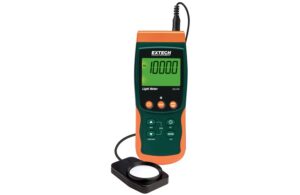
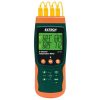
EXTECH SDL400 Light/Lux Meter / Datalogger to SD Card
$644.00 .( $708.40 inc. GST )
Available on back-order
For all your equipment calibration needs, visit our MyCalibration website.
 Free Delivery on orders over $1000
Shipping time may vary for certain products*

Product Enquiry
If you would like more information regarding this product, simply email us here.

Struggling to document illuminance levels across multiple sites without losing data? The Extech SDL400 Light Meter and Datalogger captures up to 20 million timestamped readings directly to an SD card in Excel-compatible format — eliminating manual transcription and clipboard guesswork. With a measurement range of 100,000 Lux and optional NIST-traceable calibration, it’s the go-to instrument for facility managers, WHS officers, lighting designers, and compliance teams across Australia who need defensible light-level records, fast.
 SDL400_DS_en-US
SDL400 User Manual
When “I Think the Lighting’s Fine” Isn’t Good Enough
In workplaces governed by Safe Work Australia guidelines and the Building Code of Australia (BCA), lighting compliance isn’t a matter of opinion — it’s a documented obligation. Whether you’re conducting an office ergonomic assessment, commissioning a new industrial facility, verifying emergency lighting performance, or completing a building energy audit, you need measured lux values, not estimations.
The problem with basic light meters is that they only tell you what’s happening right now. You get a snapshot, jot down a number, move on. If someone later questions your results — or if lighting conditions change across a shift — there’s nothing to back you up. What you actually need is continuous, timestamped light data that you can export, review, and attach to a compliance report without spending hours reformatting spreadsheets.
That’s exactly what the Extech SDL400 Light Meter and Datalogger is built to do.
Continuous Light Measurement with Automatic Data Capture
The SDL400 isn’t just a lux meter — it’s a field-ready datalogger that removes the manual bottleneck from illuminance measurement entirely. Insert the included SD card, set your sampling interval anywhere from once per second to once per hour, and the instrument takes care of the rest. Every reading is date- and time-stamped, then written directly to the card in a format that opens straight into Microsoft Excel — no conversion software, no proprietary apps, no USB adaptor juggling.
For compliance professionals who need to demonstrate lighting conditions over time — across a full work shift, during commissioning, or as part of a periodic workplace inspection — this is a genuine workflow improvement. You’re not just measuring; you’re automatically generating the evidence trail.
The onboard memory holds up to 99 manual readings for quick spot-checking, while the SD card expands that to an extraordinary 20 million data points. In continuous logging mode with a 2G card, you can leave the SDL400 running for extended monitoring tasks without intervention.
Measurement Range That Covers the Full Spectrum of Australian Work Environments
From dimly lit server rooms and archive storage areas to high-bay industrial warehouses and outdoor construction sites in full Australian sun, the SDL400 spans a measurement range capable of capturing it all:
- Lux (metric): 2,000 / 20,000 / 100,000 Lux across three auto-selectable ranges
- Foot Candles (imperial): 200 / 2,000 / 10,000 Fc for projects requiring US or legacy documentation formats
- Basic accuracy: ±4% of reading — sufficient for most workplace and building compliance applications
The light sensor incorporates a precision silicon photodiode with a cosine-corrected and colour-corrected spectral response filter. That matters in practice: without cosine correction, a meter tilted even slightly from the light source will return artificially high or low readings. Without colour correction, fluorescent, LED, and high-pressure sodium sources skew results. The SDL400 compensates for both, returning values that genuinely reflect how a human eye perceives the light environment — which is precisely what workplace lighting standards are designed to assess.
The 1.1-metre cable between the meter body and the light sensor head means you can position the sensor correctly at workplane height while keeping the display where you can read it comfortably. The protective cover keeps the sensor clean between measurements — a small detail that makes a real difference when you’re moving between dusty industrial environments.
Temperature Logging: A Bonus Channel for Building and Environmental Audits
Many lighting assessments are conducted as part of a broader workplace or building audit. The SDL400 recognises this by including a dedicated thermocouple input that simultaneously logs ambient temperature alongside illuminance — all to the same SD card file.
- Type K thermocouple: -100°C to 1300°C
- Type J thermocouple: -100°C to 1200°C
This makes the SDL400 a genuinely multi-purpose audit tool. HVAC technicians conducting energy audits, environmental health officers inspecting cold storage compliance, and building inspectors assessing thermal comfort can log both light and temperature in a single pass. Optional thermocouple probes are available separately to suit different measurement environments.
Built for the Field — Not Just the Lab
The SDL400 is packaged with practical field use in mind. It ships complete and ready to work:
- 6 × AA batteries installed (no waiting for a charge)
- SD card included
- Hard carry case for protection between sites
- Backlit LCD for readability in low-light spaces
- Data Hold function to freeze a reading while you note context
- Auto power-off to preserve battery life on extended deployments (can be disabled for unattended logging)
- MIN/MAX record and recall for identifying lighting peaks and troughs across a measurement session
The offset adjustment function allows you to zero the meter against a reference condition — useful for making relative measurements in environments where you’re comparing against a baseline rather than an absolute value.
NIST-Traceable Calibration Option
For applications where calibration traceability is a non-negotiable requirement — NATA-accredited inspections, formal WHS compliance audits, or building commissioning sign-offs — the SDL400-NIST variant ships with a Certificate of Calibration traceable to NIST (National Institute of Standards and Technology) standards. This is the version to specify when your client, insurer, or regulator requires documented calibration evidence alongside measurement data.
Not sure which variant suits your situation? Our team is happy to advise.
Who Uses the Extech SDL400?
Workplace Health & Safety Officers and Facility Managers — Conducting periodic illuminance assessments to verify compliance with AS/NZS 1680 Interior Lighting standards across offices, warehouses, and production floors.
Electrical Contractors and Building Commissioning Teams — Verifying that installed lighting systems meet design lux levels during NCC (National Construction Code) sign-off, particularly for commercial and industrial projects.
Energy Auditors — Logging light levels across shifts and areas to identify over-lit zones where dimming or zoning controls could reduce energy consumption.
HVAC and Environmental Technicians — Conducting combined light and temperature surveys during building audits, using a single instrument rather than two separate meters.
Lighting Designers and Architects — Validating that installed luminaire layouts achieve designed lux targets before client handover.
Occupational Hygienists and WHS Consultants — Gathering time-series illuminance data to support formal workplace lighting reports and risk assessments.
Educational Institutions (TAFE and RTOs) — Teaching students practical illuminance measurement techniques with an instrument that demonstrates real-world datalogger workflows.
What’s in the Box
- Extech SDL400 Light Meter / Datalogger
- Light sensor with 1.1m (45″) cable and protective cover
- SD card (2G)
- 6 × AA batteries (installed)
- Hard carry case
- User manual
SDL400-NIST version includes: Certificate of Calibration Traceable to NIST
Optional accessories available: Type J bead wire probe (model 872502), Type K bead wire probe (TP870), Type K clamp probes (TP200, TP400), and 100–240V AC adaptor (UA100-240) with AU/US/EU/UK plugs.
TECHNICAL SPECIFICATIONS
| Specification | Value | Why It Matters |
|---|---|---|
| Lux Ranges | 2,000 / 20,000 / 100,000 Lux | Three auto-selectable ranges cover everything from candlelit archival rooms to bright outdoor environments — no manual range switching mid-survey |
| Foot Candle Ranges | 200 / 2,000 / 10,000 Fc | Supports legacy and US-standard documentation requirements on dual-format projects |
| Lux Resolution | 1 Lux | Fine enough for distinguishing borderline compliance in office environments where AS/NZS 1680 specifies narrow lux bands |
| Foot Candle Resolution | 0.1 Fc | Sufficient precision for standard field compliance measurement |
| Basic Accuracy (Light) | ±4% of reading | Industry-standard accuracy for compliance assessments; NIST-traceable calibration option available where tighter traceability is required |
| Spectral Response | Cosine and colour corrected via silicon photodiode | Compensates for angle-of-incidence and light source colour variations — returns values that reflect human visual perception accurately |
| Type K Temperature Range | -100°C to 1300°C | Covers ambient monitoring right through to high-temperature industrial process environments |
| Type J Temperature Range | -100°C to 1200°C | Compatible with older industrial thermocouple installations that use Type J probes |
| Temperature Resolution | 0.1° | Adequate for environmental and thermal comfort surveys |
| Temperature Accuracy | ±(0.4% + 1°C) | Suitable for general environmental monitoring; not intended for precision calibration |
| Manual Memory | 99 readings | Quick spot-check storage without SD card |
| SD Card Data Logging | Up to 20 million records (2G card) | Supports extended unattended monitoring campaigns — weeks or months of continuous logging |
| Sampling Interval | 1 to 3600 seconds (adjustable) | Choose between high-frequency capture for dynamic environments or slow logging for long-term trend analysis |
| Data Format | Excel-compatible (.xls) on SD card | Direct import into Excel and most data analysis platforms — no conversion tools needed |
| Display | Large backlit LCD | Readable in dim spaces and bright outdoor conditions |
| Power | 6 × AA batteries | Common, field-available batteries — no proprietary cells to manage |
| Certifications | CE (standard); NIST traceable (SDL400-NIST) | CE certification for international compliance; NIST option for formal audit and commissioning requirements |
| Warranty | 3 years | Above industry average; indicates manufacturer confidence in build quality |
| Dimensions | 182 × 73 × 48 mm | Fits in a standard tool pouch; manageable single-handed |
| Weight | 475 g | Light enough for extended single-handed use across multi-area surveys |
APPLICATIONS & USE CASES
1. Workplace Lighting Compliance Audits (AS/NZS 1680)
Australian employers are obligated to provide adequate lighting for the tasks performed in their workplaces. AS/NZS 1680 sets out minimum lux levels by task type — from 80 Lux in storage areas to 750 Lux or more for fine detail work. The SDL400’s automatic SD logging lets WHS officers conduct a full-shift illuminance survey, capturing how lighting levels vary across the working day as daylight contribution changes — something a single spot measurement can never reveal.
2. Commercial and Industrial Building Commissioning
Lighting systems in new commercial and industrial buildings must be verified against design lux levels before client handover under the NCC. The SDL400 allows commissioning teams to systematically measure and document illuminance across every zone, with all data automatically timestamped and exportable to Excel for inclusion in handover documentation packages.
3. Energy Audit and Lighting Upgrade Projects
When assessing a facility for LED lighting upgrades or automated daylight-harvesting controls, energy auditors need to understand existing light levels across different times of day and zones. The SDL400’s adjustable logging interval means you can profile an entire facility over a business week before sizing controls or specifying replacement luminaires — ensuring the upgrade is based on actual measured data, not assumptions.
4. Emergency and Exit Lighting Verification
Australian Standard AS 2293 governs emergency lighting performance, including minimum maintained illuminance levels on escape paths. The SDL400 allows lighting contractors and facility managers to measure and record exit lighting lux values as part of periodic testing, creating a documented record that can be presented during regulatory inspections.
5. HVAC and Environmental Site Audits
When conducting a combined environmental assessment — looking at thermal comfort and lighting together — the SDL400 eliminates the need for two separate instruments. Connect a Type K thermocouple, and both light level and ambient temperature are logged simultaneously to the same SD card file, simplifying data analysis and report generation.
6. Horticulture and Controlled Environment Agriculture
Plant growth under artificial lighting depends on achieving consistent light levels (measured in lux or PPFD). While the SDL400 isn’t a PAR meter, it provides a reliable baseline for monitoring growth-room lighting consistency, identifying failing lamps or shading problems before crop yield is affected.
7. Training and Educational Applications
TAFEs and registered training organisations (RTOs) delivering electrical, building, or environmental health training need instruments that teach real-world workflows. The SDL400’s datalogger functionality exposes students to the complete measurement-to-report pipeline — from instrument setup, through data capture, to Excel analysis — in a single practical exercise.
What is a light meter datalogger? A light meter datalogger is an instrument that both measures illuminance (in Lux or Foot Candles) and automatically records those measurements over time with date and time stamps. Unlike a basic light meter that only shows a live reading, a datalogger stores a continuous history of light levels to internal memory or an SD card. This allows professionals to demonstrate how lighting conditions change across a work shift, verify compliance over time, and export data directly into Excel or other reporting tools — without manual note-taking.
What is a lux meter used for in a workplace? In Australian workplaces, a lux meter is used to verify that artificial and natural lighting meets the minimum levels required by AS/NZS 1680 (Interior Lighting) for the type of work being performed. WHS officers, facility managers, and electrical contractors use lux meters to conduct compliance surveys, identify areas where lighting is insufficient or excessive, and generate documented evidence for safety audits, building commissioning, or energy efficiency assessments.
What is cosine correction on a light meter? Cosine correction on a light meter means the sensor is designed to account for the angle at which light hits the measurement surface. In a real space, light arrives from multiple angles simultaneously. A cosine-corrected meter weights those contributions in proportion to the cosine of their angle from vertical — mimicking how a horizontal surface like a workplane actually receives illumination. Without cosine correction, a light meter held at even a slight tilt can report significantly different values from the true ambient illuminance.
What does NIST-traceable calibration mean for a measuring instrument? NIST-traceable calibration means the instrument has been calibrated against reference standards that are directly linked to the National Institute of Standards and Technology — the US body responsible for maintaining the fundamental measurement standards used globally. A NIST-traceable calibration certificate provides documented evidence of that chain of traceability, giving clients, regulators, and auditors confidence that the measurement values produced by the instrument are accurate within stated tolerances. In Australia, NIST traceability is widely recognised alongside NATA (National Association of Testing Authorities) accredited calibration as a credible standard for compliance measurement work.
| Weight | 1 kg |
|---|
FREQUENTLY ASKED QUESTIONS
Q: What is the Extech SDL400 used for? The SDL400 is a professional light meter and datalogger used to measure and record illuminance levels in Lux and Foot Candles. It’s primarily used for workplace lighting compliance surveys, building commissioning, energy audits, and any application where continuous or time-stamped light level data needs to be documented. The thermocouple input adds simultaneous temperature logging capability.
Q: What’s the difference between the SDL400 and the SDL400-NIST? Both models are functionally identical. The SDL400-NIST includes a Certificate of Calibration traceable to NIST (National Institute of Standards and Technology) standards. This is required for formal compliance audits, regulated industry applications, or wherever your client or regulator requires documented calibration traceability alongside your measurement records.
Q: How does the SDL400 store data? The SDL400 logs timestamped measurements directly to an SD card in a format that opens natively in Microsoft Excel. There are two storage modes: manual memory (up to 99 readings stored on-device) and continuous SD card logging (up to 20 million records with a 2G card). The sampling interval is adjustable from 1 second to 3,600 seconds to suit different applications.
Q: What does “cosine and colour corrected” mean and why does it matter? Cosine correction compensates for the angle at which light strikes the sensor — without it, readings vary depending on sensor orientation rather than true ambient illuminance. Colour correction matches the sensor’s spectral response to human eye sensitivity across different light source types (LED, fluorescent, metal halide, natural daylight). Together, these corrections ensure the SDL400 measures what a person actually experiences in a space, which is what workplace lighting standards are based on.
Q: Can I measure temperature at the same time as light? Yes. The SDL400 has a dedicated thermocouple input compatible with Type K and Type J probes (sold separately). When a probe is connected, temperature is logged alongside illuminance to the same SD card file, making it straightforward to correlate both parameters in Excel for combined environmental reports.
Q: What Australian standards apply to workplace lighting measurement? The primary standard is AS/NZS 1680 (Interior Lighting), which specifies minimum maintained illuminance values for different task categories and working environments. Additional relevant standards include AS 2293 for emergency and exit lighting, and the National Construction Code (NCC) for building commissioning. Safe Work Australia’s Code of Practice for Managing the Work Environment and Facilities also references illuminance requirements for general workplaces.
Q: How long will the battery last during continuous logging? Battery life depends on ambient temperature and the logging interval. With fresh AA batteries and the backlight disabled, the SDL400 can run for many hours in standard conditions. For extended unattended logging deployments, the optional 100–240V AC adaptor (model UA100-240, including an Australian plug) eliminates battery concerns entirely.
Q: Is the SDL400 suitable for outdoor use? The SDL400 can be used outdoors and its upper range of 100,000 Lux covers typical Australian daylight conditions. However, it is not rated as an IP-protected instrument, so it should be protected from rain and direct water exposure during use.
Q: Can the SDL400 measure plant-growth light (PAR/PPFD)? No — the SDL400’s spectral response is matched to human visual perception (photopic response), not photosynthetically active radiation (PAR). For horticulture applications requiring PPFD measurements in µmol/m²/s, a dedicated PAR quantum meter is needed. The SDL400 can still be useful for monitoring consistency of artificial grow-room lighting when absolute PAR values aren’t required.
Q: What accessories are available for the SDL400? Optional accessories include Type J bead wire thermocouple probe (872502), Type K bead wire probe (TP870), Type K clamp probes for pipe or surface measurement (TP200, TP400), 117V AC adaptor (153117), and a universal 100–240V AC adaptor with four international plugs including Australian standard (UA100-240).
TECHNICAL SPECIFICATIONS
| Specification | Value | Why It Matters |
|---|---|---|
| Lux Ranges | 2,000 / 20,000 / 100,000 Lux | Three auto-selectable ranges cover everything from candlelit archival rooms to bright outdoor environments — no manual range switching mid-survey |
| Foot Candle Ranges | 200 / 2,000 / 10,000 Fc | Supports legacy and US-standard documentation requirements on dual-format projects |
| Lux Resolution | 1 Lux | Fine enough for distinguishing borderline compliance in office environments where AS/NZS 1680 specifies narrow lux bands |
| Foot Candle Resolution | 0.1 Fc | Sufficient precision for standard field compliance measurement |
| Basic Accuracy (Light) | ±4% of reading | Industry-standard accuracy for compliance assessments; NIST-traceable calibration option available where tighter traceability is required |
| Spectral Response | Cosine and colour corrected via silicon photodiode | Compensates for angle-of-incidence and light source colour variations — returns values that reflect human visual perception accurately |
| Type K Temperature Range | -100°C to 1300°C | Covers ambient monitoring right through to high-temperature industrial process environments |
| Type J Temperature Range | -100°C to 1200°C | Compatible with older industrial thermocouple installations that use Type J probes |
| Temperature Resolution | 0.1° | Adequate for environmental and thermal comfort surveys |
| Temperature Accuracy | ±(0.4% + 1°C) | Suitable for general environmental monitoring; not intended for precision calibration |
| Manual Memory | 99 readings | Quick spot-check storage without SD card |
| SD Card Data Logging | Up to 20 million records (2G card) | Supports extended unattended monitoring campaigns — weeks or months of continuous logging |
| Sampling Interval | 1 to 3600 seconds (adjustable) | Choose between high-frequency capture for dynamic environments or slow logging for long-term trend analysis |
| Data Format | Excel-compatible (.xls) on SD card | Direct import into Excel and most data analysis platforms — no conversion tools needed |
| Display | Large backlit LCD | Readable in dim spaces and bright outdoor conditions |
| Power | 6 × AA batteries | Common, field-available batteries — no proprietary cells to manage |
| Certifications | CE (standard); NIST traceable (SDL400-NIST) | CE certification for international compliance; NIST option for formal audit and commissioning requirements |
| Warranty | 3 years | Above industry average; indicates manufacturer confidence in build quality |
| Dimensions | 182 × 73 × 48 mm | Fits in a standard tool pouch; manageable single-handed |
| Weight | 475 g | Light enough for extended single-handed use across multi-area surveys |
Be the first to review “EXTECH SDL400 Light/Lux Meter / Datalogger to SD Card”
You must be logged in to post a review.
Related Products




Next day delivery
Finance services
Price Match
Technical support
Product training
Calibration servises
Need help? Call our support team 1800 358 531

Reviews
There are no reviews yet.