

 Clearance
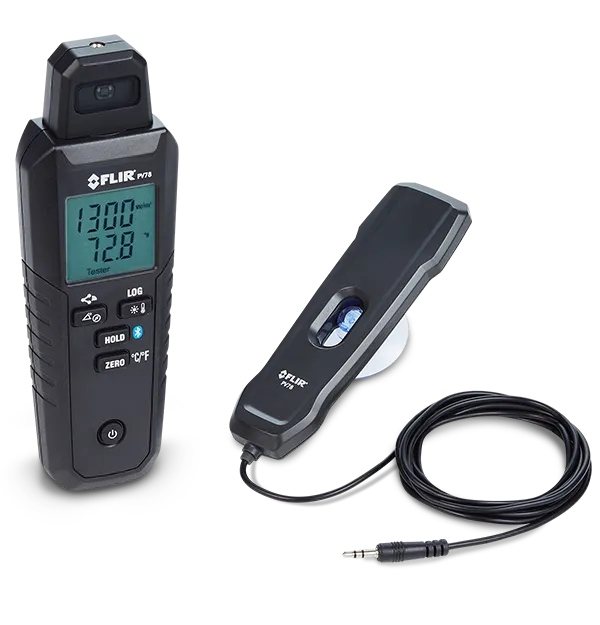
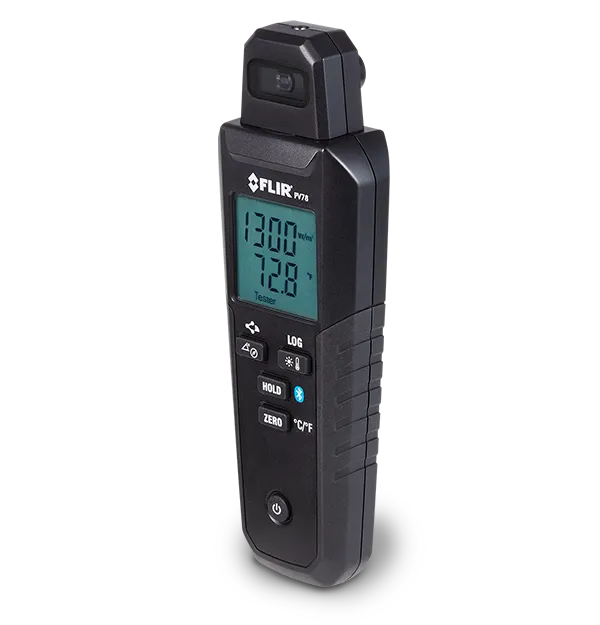
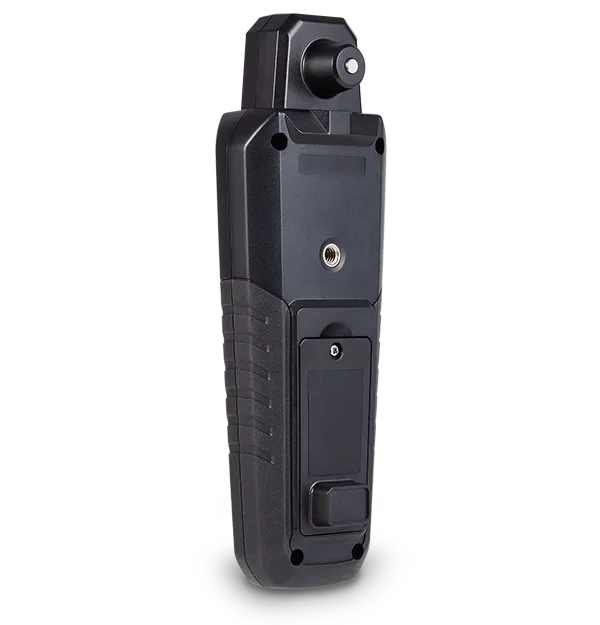
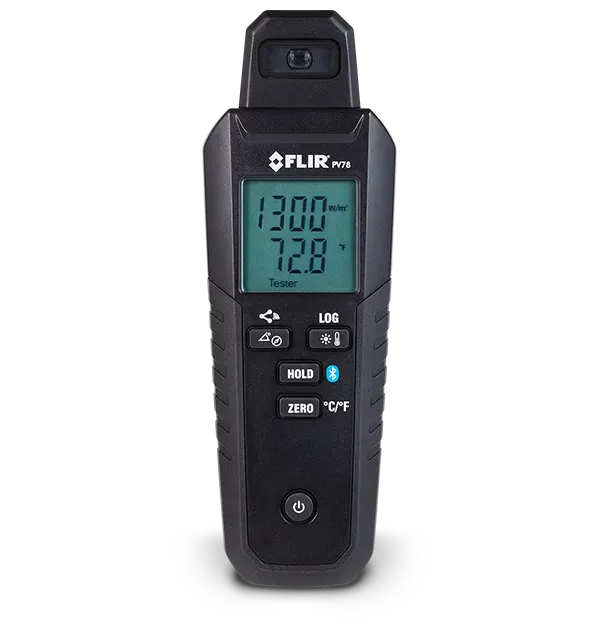
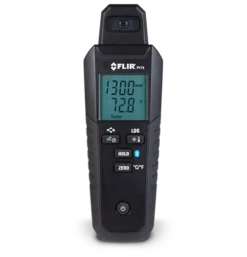
FLIR PV78 Solar Irradiance Meter | IEC 62446-1 Rated
$720.00 .( $792.00 inc. GST )
For all your equipment calibration needs, visit our MyCalibration website.
 Free Delivery on orders over $1000
Shipping time may vary for certain products*

Product Enquiry
If you would like more information regarding this product, simply email us here.

Accurate site surveys and compliance checks start with knowing exactly how much solar resource is available — and whether your panels are positioned to capture it. The FLIR PV78 measures irradiance (W/m²) to the IEC 62446-1 standard, panel and ambient temperature, compass bearing, and tilt angle — all in one compact meter. METERLiNK® Bluetooth connects directly to your phone for instant reporting. Purpose-built for Australian solar installers, O&M teams, and CEC-accredited designers who need documented, standards-compliant measurements.

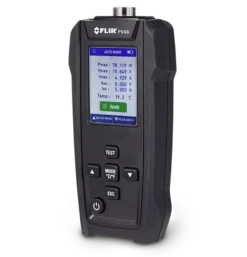
FLIR PV78 Solar Irradiance and Temperature Meter with Tilt Sensor and METERLiNK
The Data Your Solar Report Actually Needs
When an inspector, asset manager, or client asks why a solar system isn’t hitting its energy yield predictions, the first question is always: what were the conditions at the time of testing? Without a calibrated irradiance measurement taken at the panel surface, any performance comparison against the manufacturer’s STC datasheet is essentially guesswork.
For solar professionals working under AS/NZS 5033 compliance obligations and the requirements of the IEC 62446-1 photovoltaic system documentation standard, having a dedicated, calibrated irradiance meter isn’t optional — it’s a core part of the commissioning and maintenance toolkit.
Four Critical Measurements. One Instrument.
The FLIR PV78 is a purpose-designed solar site measurement tool that consolidates four measurements that previously required separate instruments or cumbersome setups:
Solar Irradiance (W/m²) The PV78 measures irradiance from 0 to 1,400 W/m² — the full range you’d encounter from overcast Melbourne mornings through to peak summer radiation on a north-facing Perth rooftop. The 50–1,400 W/m² measurement range aligns with IEC 62446-1 requirements for solar PV system performance verification, making results directly usable in compliance documentation.
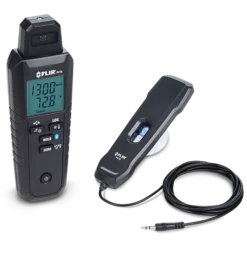
Panel Surface Temperature Connect the included external temperature probe and mount it directly to the panel surface for continuous module temperature readings across a range of −30 °C to 100 °C. Module temperature is essential for accurate STC correction — a panel at 65 °C will deliver measurably less power than at 25 °C, and documenting that temperature gives your performance calculations credibility.
Ambient Temperature The built-in meter sensor captures ambient temperature from −10 °C to 50 °C, logged alongside irradiance for contextual reporting — particularly useful when comparing against manufacturer performance guarantees or modelling seasonal yield variation.
Tilt Angle and Compass Direction The integrated tilt sensor and compass let you verify and document the physical orientation of panels and arrays. For new installations, this confirms panels have been mounted at the specified pitch and azimuth. For performance investigations, it helps rule out suboptimal positioning as a contributing factor to underperformance. A quick check during commissioning can prevent the kind of dispute that arises months later when an owner questions why their north-facing system is underperforming.
METERLiNK — From Rooftop to Report Without the Clipboard
One of the most practical features for busy solar teams is the FLIR METERLiNK® Bluetooth connectivity. Rather than squinting at a screen, manually transcribing values, and entering data back at the office, the PV78 transmits live readings wirelessly to the METERLiNK mobile app on your Android or iOS device.
From the app, you can monitor multiple compatible FLIR meters simultaneously, log readings with timestamps, annotate with site notes, and generate reports directly from the field. Share results with a client or upload to a job management system before you’ve even packed your test kit. For compliance-focused work, the digital audit trail is an added benefit over handwritten site notes.
The METERLiNK app also integrates with compatible FLIR thermal cameras, allowing irradiance and temperature data to be embedded directly into thermal inspection images — a significant workflow improvement for thermographers conducting PV array inspections.
Built for Australian Solar Conditions
The PV78 was designed to be positioned on or near the panel surface for continuous monitoring, not just a quick spot reading. The external probe and mounting bracket enable it to be secured in place during extended testing sessions — useful for monitoring irradiance variation during partial cloud cover, or for logging conditions over a test period to build a more representative performance picture.
The high-contrast, large LCD remains visible in direct sunlight — critical for working on rooftops in Australian summer conditions where display washout is a real usability problem with cheaper instruments.
Who Uses the FLIR PV78?
CEC-accredited solar installers use the PV78 during commissioning to capture the irradiance and temperature conditions at the time of performance testing — providing the contextual data required for IEC 62446-1 documentation and demonstrating diligence under AS/NZS 5033 requirements.
Solar O&M teams use it during scheduled maintenance visits and performance investigations, logging irradiance alongside system output data to calculate performance ratio and identify degradation or shading losses.
Solar surveyors and designers use it during pre-installation site surveys to document available solar resource and verify optimal panel orientation before system design is finalised.
Large-scale solar farm operators use the PV78 alongside dataloggers and monitoring systems to cross-reference on-ground irradiance against pyranometer data for yield analysis and performance modelling validation.
Technical Specifications
| Specification | Value | Practical Significance |
|---|---|---|
| Irradiance Range | 0 to 1,400 W/m² | Full range from overcast to peak Australian summer radiation |
| IEC Compliance | IEC 62446-1 | Results accepted in PV system commissioning documentation |
| Meter Temperature Range | −10 °C to 50 °C | Covers all Australian ambient operating conditions |
| Meter Temperature Accuracy | ±1.5 °C | Sufficient accuracy for STC correction calculations |
| External Probe Range | −30 °C to 100 °C | Covers module surface temperatures including high-heat days |
| External Probe Accuracy | ±1.5 °C | Accurate module temperature for performance corrections |
| Tilt Sensor | Built-in | Verify and document panel inclination angle |
| Compass | Built-in | Confirm array orientation (azimuth) |
| Wireless Connectivity | FLIR METERLiNK® Bluetooth | Live data to smartphone app; supports multi-meter logging |
| Mobile App Compatibility | iOS and Android | METERLiNK app for reporting and data sharing |
| Display | High-contrast large LCD | Readable in direct Australian sunlight |
| Included Accessories | External temp probe, mounting bracket | Enables continuous panel-mounted measurement |
Conversational query: “What irradiance meter do I need for IEC 62446-1 solar commissioning?”
IEC 62446-1 requires irradiance measurement as part of photovoltaic system performance verification and commissioning documentation. A calibrated irradiance meter with a measurement range that covers typical on-site conditions — generally up to 1,400 W/m² for Australian conditions — is required. The FLIR PV78 is designed specifically to meet IEC 62446-1 requirements, measuring solar irradiance from 0 to 1,400 W/m² alongside panel temperature, ambient temperature, tilt angle, and compass bearing in a single handheld instrument. METERLiNK Bluetooth connectivity enables direct data transfer to a mobile device for compliant documentation and reporting.
Conversational query: “Why do I need to measure irradiance when testing solar panel performance?”
Solar panel performance is rated at Standard Test Conditions (STC), defined as 1,000 W/m² irradiance at 25 °C cell temperature. On any real installation, irradiance and temperature will differ from STC. Without measuring the actual irradiance at the time of testing, you cannot accurately compare measured output against the rated specification — a panel tested at 600 W/m² will naturally produce less power than its rated output, but that doesn’t mean it’s faulty. Measuring irradiance with an instrument like the FLIR PV78 gives you the reference data needed to normalise measurements to STC and make a meaningful performance comparison.
|
Measurement |
Range |
Accuracy |
|
Irradiance |
50 W to 1400 W/m² |
±5% |
|
Inclination angle |
−90° to 90° |
±3° |
|
Temperature from meter |
−10°C to 50°C (14°F to 122°F) |
±1.5°C (±2.7°F) |
|
Temperature from external probe |
−30°C to 100°C (−22°F to 212°F) |
±1.5°C (±2.7°F) |
|
Compass |
0° to 360° |
±7° |
|
Measuring rate |
3 samples per second |
|
|
Static Datalogging and Storage |
||
|
Data storage interval |
1 minute |
|
|
Readings per memory set |
360 set per file |
|
|
Connectivity |
||
|
Wireless technology |
Bluetooth BLE |
|
|
Communications protocol |
METERLiNK |
|
|
Bluetooth range |
10 m (32 ft) |
|
|
Power System |
||
|
Battery |
9 V Alkaline battery |
|
|
Battery life |
Approx. 25 hours, with alkaline battery |
|
|
Auto power off |
After approximately 30 minutes of inactivity |
|
|
General Information |
||
|
Warranty |
Limited 3-Years Warranty https://www.flir.com/testwarranty |
|
|
Calibration cycle |
Once per year, recommended |
|
Certifications |
|
|
Certifications |
CE, FCC, RCM |
|
EMC standards |
EN61326-1, EN300328 |
|
Environmental Data |
|
|
Operating ambient temperatures and relative humidity (RH) |
Meter: −10°C to 50°C (14°F to 122°F), <80% RH Probe: −30°C to 100°C (−22°F to 212°F), <80% RH |
|
Storage temperature and RH |
−20°C to 60°C (−4°F to 140°F), 0 to 80% RH (without batteries) |
|
Operating altitude |
2000 m (6560 ft) |
|
Pollution degree |
2 |
|
Meter Physical Data |
|
|
Weight |
300 g (0.66 lbs) |
|
Dimensions (L × W × H) |
240.5 mm × 67 mm × 38 mm (9.5 in × 2.6 in × 1.5 in) |
|
Included in the box |
PV78 Pouch External Temperature Probe 1 × 9 V Alkaline Battery User Manual |
Q: Does the FLIR PV78 meet the irradiance measurement requirements of IEC 62446-1?
Yes. The PV78 is designed specifically to satisfy the irradiance measurement requirements of IEC 62446-1 (Electrical Safety of PV Installations), with a measurement range of 0–1,400 W/m². Results captured with the PV78 can be used directly in commissioning reports and system performance documentation.
Q: Can the PV78 log irradiance and temperature data over time, or is it point-in-time measurement only?
The PV78 supports continuous monitoring when paired with the FLIR METERLiNK® app. The Bluetooth connection allows the app to log readings over time from up to seven compatible FLIR meters simultaneously, building a dataset suitable for performance analysis and reporting.
Q: How does the external temperature probe attach to the panel?
The external probe connects to the PV78 meter body and is designed for direct panel surface contact using the included mounting bracket. This keeps the probe in stable contact with the module surface for continuous temperature monitoring during testing sessions rather than a snapshot reading.
Q: Can the PV78 work alongside the FLIR PV48 I-V curve tracer?
Yes — the two instruments are designed to complement each other. The PV78 captures irradiance and module temperature at the time of testing, while the PV48 captures the panel’s I-V curve and electrical parameters. Together, they provide the full dataset needed to calculate STC-corrected performance and compare against panel manufacturer datasheets.
Q: Does the PV78 carry RCM certification for use in Australia?
The PV78 carries CE marking as standard. For current RCM certification status in Australia, please contact us directly — our team can confirm current compliance documentation for this instrument.
Be the first to review “FLIR PV78 Solar Irradiance Meter | IEC 62446-1 Rated”
You must be logged in to post a review.
You may also like…


AC/DC Clamps
Test Equipment For Electricians
Data Logger Related Products






Next day delivery
Finance services
Price Match
Technical support
Product training
Calibration servises
Need help? Call our support team 1800 358 531
Reviews
There are no reviews yet.